Australian businesses are witnessing a surge in cloud ai services, transforming the way we work, compete, and grow. With 2026 on the horizon, the pressure to innovate and adapt has never been greater.
Organisations are seeking smarter, faster solutions to stay ahead. Cloud ai services offer that edge, enabling rapid deployment and access to advanced technologies without heavy upfront costs.
This guide will walk you through every step, from understanding the basics to practical deployment, real-world examples, and future trends. Together, we will explore how to harness innovation, boost productivity, and secure your organisation’s future. Ready to embrace the possibilities?
Understanding Cloud AI Services in 2026
Cloud AI services have rapidly become the engine behind innovation for businesses across Australia. Unlike traditional AI, which needed on-premises infrastructure and complex maintenance, cloud AI services deliver powerful intelligence through the internet, making advanced capabilities accessible to organisations of any size.

1. Define cloud AI services and explain how they differ from traditional AI deployments.
Cloud AI services are platforms that allow businesses to access AI tools, models, and infrastructure via the cloud. In contrast to traditional AI deployments, where companies had to invest heavily in hardware and expertise, cloud AI services offer ready-made solutions that scale on demand. For a comprehensive look at service categories and offerings, see this Cloud AI services overview.
- Traditional AI required local servers and in-house teams.
- Cloud AI services provide instant access to the latest models and updates.
- Businesses can now focus on innovation, not infrastructure.
2. Outline the core components: data storage, AI model hosting, APIs, and integration platforms.
Every cloud AI service is built from essential components:
- Secure cloud data storage for handling massive datasets.
- AI model hosting platforms that run and manage models remotely.
- APIs that let businesses plug AI features into their own apps.
- Integration platforms to connect cloud AI services with other business systems.
Australian providers, like Synap AI, specialise in connecting documents, data, and workflows for seamless automation.
3. Discuss the growth of cloud AI, referencing industry data (e.g., Gartner predicts 75% of enterprises will use AI cloud services by 2026).
The adoption of cloud AI services is accelerating. According to Gartner, 75% of enterprises globally are expected to use cloud AI services by 2026. In Australia, spending on public cloud continues to surge, reflecting widespread confidence in cloud-based AI. This growth is driven by organisations seeking smarter, faster ways to serve customers and improve efficiency.
4. Explain public, private, and hybrid cloud models, with real-world Australian business examples.
Australian businesses have three main options for deploying cloud AI services:
- Public cloud: Shared infrastructure, like AWS or Microsoft Azure, offers quick setup and cost savings.
- Private cloud: Dedicated environments, such as those used by Synap AI, suit firms with strict data privacy needs.
- Hybrid cloud: Combines both, popular with banks and healthcare providers needing flexibility and compliance.
A Sydney fintech, for example, uses public cloud for customer insights but private cloud for sensitive financial data.
5. Explore benefits: scalability, cost-efficiency, rapid deployment, and access to advanced AI models.
Cloud AI services deliver several key benefits:
- Scalability: Instantly increase or decrease resources as needed.
- Cost-efficiency: Pay only for what you use, reducing IT expenses.
- Rapid deployment: Launch new AI solutions in days, not months.
- Access to advanced models: Use the latest AI engines without building them yourself.
These advantages help businesses stay agile and competitive.
6. Address limitations: data privacy, latency, vendor lock-in, and regulatory challenges.
Despite their promise, cloud AI services come with limitations:
- Data privacy concerns, especially where sensitive information is involved.
- Latency can affect real-time applications if data centres are far away.
- Vendor lock-in risks, making it hard to switch providers later.
- Navigating Australia’s strict regulatory environment can be complex.
Choosing local, compliant providers helps address these issues.
7. Compare leading global and Australian providers and their service offerings.
Let’s compare major cloud AI service providers:
| Provider | Strengths | Local Hosting | Compliance |
|---|---|---|---|
| AWS | Broad AI tools | Yes | Varies |
| Google Cloud | Advanced ML models | Limited | Varies |
| Azure | Enterprise integration | Yes | Varies |
| Synap AI | Private AI agents, automation | Yes | Full AU |
Australian companies like Synap AI stand out for privacy-first, tailored solutions. They provide dedicated support and ensure data sovereignty for local businesses.
Cloud AI services are reshaping how organisations operate in Australia. By understanding the landscape, we can make informed choices and drive meaningful innovation.
Key Categories of Cloud AI Services
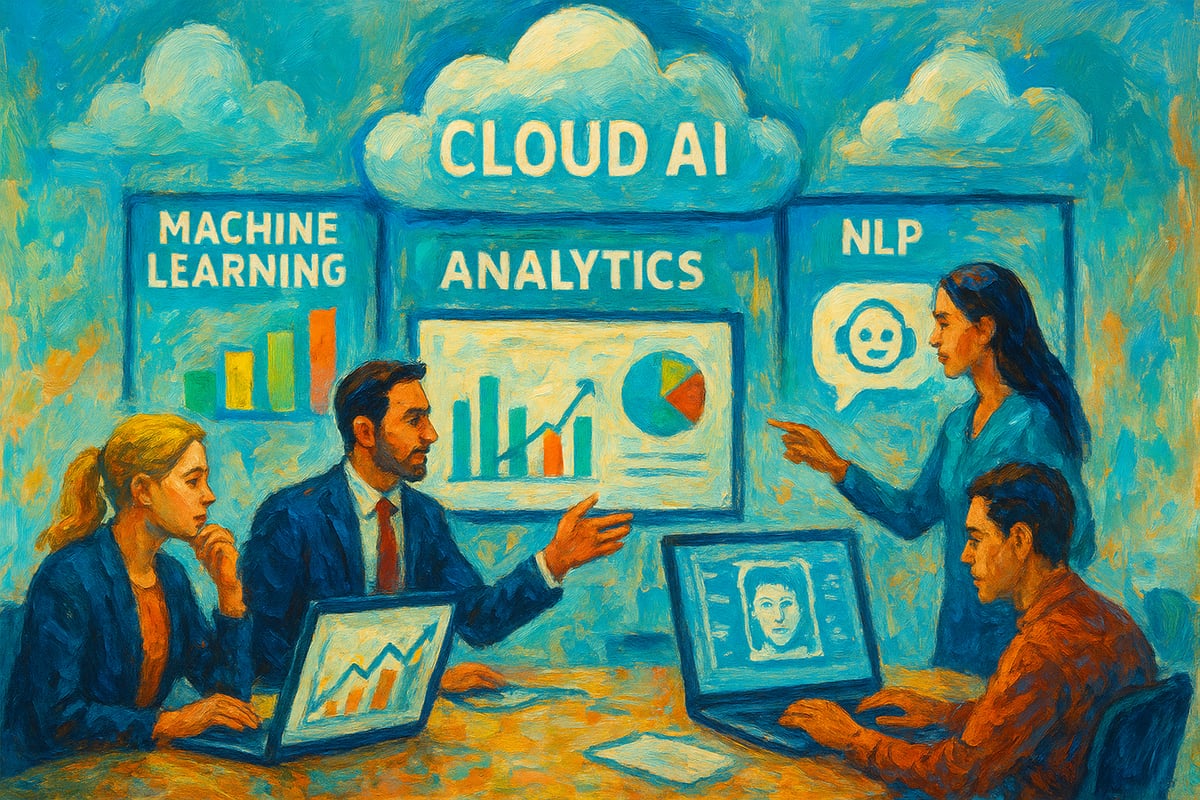
Cloud ai services have evolved rapidly, offering businesses in Australia a wide array of categories to suit every operational need. In 2026, the major categories include Machine Learning as a Service (MLaaS), AI-powered analytics platforms, Natural Language Processing (NLP) tools, computer vision services, and automation platforms. Each category brings unique capabilities, from predicting trends to automating repetitive processes.
To help you select the right fit, let’s break down a simple step-by-step guide:
- Identify your core business goals. Do you need better insights, automation, or smarter customer engagement?
- Assess your data. Structured data suits MLaaS and analytics, while unstructured data is ideal for NLP and computer vision.
- Map business problems to categories. For example, finance teams often use predictive analytics, while customer service benefits from NLP chatbots.
- Evaluate integration needs with your existing systems.
Real-world examples make these categories come alive. In Australian finance, predictive analytics help detect fraud and model risk. Manufacturing firms use computer vision to monitor quality and predict maintenance needs. Customer service teams in retail deploy NLP platforms to automate responses and personalise support.
Choosing a provider is crucial. Compare features and pricing between AWS, Google Cloud, Azure, and local platforms like Synap AI. Global providers offer broad model libraries and scalability, but local options can deliver better compliance and support. Pricing often depends on usage, model complexity, and service level.
Emerging categories are reshaping the market in 2026. Generative AI, private AI agents, and industry-specific solutions are in high demand. According to Telsyte's 2024 Hyperscale Cloud Market Study, generative AI is fuelling rapid growth in cloud ai services, with adoption rates soaring across sectors.
Integration is key for value. Leading platforms provide APIs and ready-to-use connectors for CRMs, ERPs, and data lakes. This enables seamless deployment of cloud ai services, turning raw data into actionable intelligence.
By understanding these categories and their practical applications, your organisation can confidently navigate the cloud ai services landscape and unlock new levels of innovation.
Step-by-Step Guide: Deploying Cloud AI in Your Organisation
Adopting cloud ai services is a journey that rewards careful planning and the right approach. In 2026, Australian businesses are seizing the moment to boost innovation, efficiency, and resilience with AI-driven cloud tools. Let’s walk through a step-by-step guide to ensure your organisation unlocks the full value of cloud ai services while staying secure, compliant, and future-ready.

- Assess Business Needs and AI Opportunities
Begin with a clear-eyed review of your goals. What challenges could cloud ai services help you solve? Pinpoint high-impact areas like customer service, automation, or data analytics. Involve teams from across the business so everyone’s voice is heard.
- Audit Data Infrastructure and Readiness
Next, check your data health. Is it accessible, accurate, and secure? Robust data is the backbone of cloud ai services. Review how data is captured, stored, and shared. Identify gaps or silos that could limit AI’s potential.
- Select the Right Deployment Model
Choose between public, private, or hybrid cloud setups. Each model has trade-offs. Public cloud offers flexibility and cost savings, while private cloud supports strict compliance and control. Hybrid models blend both for maximum agility. For example, Synap AI’s private solutions keep data onshore for Australian data sovereignty.
- Shortlist Vendors—Compliance, Scalability, Support
Find partners who understand your sector and compliance needs. Compare features, support levels, and security credentials. Ask for local references. Australian SMEs like a regional law firm have found success by partnering with Synap AI for private, scalable deployments that meet regulatory standards.
- Pilot AI Solutions on Small Projects
Start with a focused pilot. Choose a process that’s easy to measure—like automating invoice processing or client onboarding. Use cloud ai services to test, learn, and refine. For more practical tips, check out how to integrate AI in business for a hands-on approach.
- Integrate AI into Workflows Using APIs and Automation
Once the pilot succeeds, expand gradually. Use APIs and automation tools to connect cloud ai services with your existing systems. This ensures seamless data flow and reduces manual work. Platforms like Synap AI allow fast integration with CRMs, document stores, and communication channels.
- Train Teams and Build AI Literacy
Empower staff with training on AI basics and security. Encourage a culture of curiosity and open dialogue. When teams understand cloud ai services, adoption rises and risks drop. Ongoing learning keeps everyone up to speed with new features and best practices.
- Monitor, Optimise, and Scale
Set up dashboards to track AI performance. Review results and tweak models as needed. As confidence grows, scale up to more processes or departments. Synap AI’s pay-per-agent model helps businesses grow at their own pace, with local support and tailored guidance.
Ready to take the next step? Book a free online consult with our AI technologist for tailored advice and a roadmap for success.
Industry Applications: Real-World Cloud AI Success Stories
Cloud ai services are rewriting the playbook for Australian industries. From healthcare to legal, organisations are seeing tangible benefits. Let us explore how these innovations are making a difference, one sector at a time.

1. Healthcare: Smarter Diagnosis and Patient Care
Australian hospitals are harnessing cloud ai services to improve diagnosis and patient care. AI-powered tools analyse medical images, supporting doctors with faster, more accurate results. Patient triage systems are streamlining emergency room workflows, ensuring urgent cases get attention first.
Data analysis platforms built on cloud ai services help researchers uncover patterns in patient outcomes. For instance, a Sydney hospital reduced diagnostic errors by 20 percent after introducing AI-driven image analysis.
2. Finance: Fighting Fraud and Powering Insights
Banks and insurers across Australia are adopting cloud ai services for real-time fraud detection and risk modelling. AI algorithms sift through millions of transactions, identifying suspicious activity within seconds.
Customer insights are deeper than ever, with cloud ai services enabling personalised offers and improved service. According to the Australian Government's AI Ecosystem Report, over 70 percent of major financial firms now leverage AI-powered analytics to improve decision-making and compliance.
3. Manufacturing: Predictive Maintenance and Quality Control
Manufacturers are using cloud ai services to keep production lines running smoothly. Predictive maintenance tools, powered by machine learning, anticipate equipment failures before they happen. This reduces downtime and saves money.
Quality control is also enhanced. AI vision systems inspect products for defects, ensuring higher standards and fewer recalls. One Melbourne-based plant reported a 30 percent drop in unplanned outages after implementing cloud-based predictive analytics.
4. Education: Personalised Learning and Automation
In schools and universities, cloud ai services are transforming the way students learn. Automated grading systems give teachers more time to focus on personalised instruction. AI-powered tools recommend resources tailored to each student’s needs.
Research assistance platforms built on cloud ai services help academics sift through vast data sets. For example, several universities in Queensland now use AI to match students with optimal learning pathways.
5. Legal: Smarter Document Review and Research
Law firms are streamlining document review, contract analysis, and case research with cloud ai services. AI agents quickly scan thousands of legal documents, highlighting relevant information in seconds.
This not only boosts productivity but also reduces the risk of human error. A Brisbane-based practice saw research time cut by half after deploying private AI agents for document analysis.
6. Productivity Gains and Automation in Action
Australian businesses are reporting significant productivity improvements with cloud ai services. Statistics show a 25 percent average boost in operational efficiency across sectors where AI is deployed.
AI agents and automation platforms, like those offered by Synap, connect documents, emails, and business systems for instant answers. This means customer service teams resolve queries faster, and operations run more smoothly.
7. The Next Step: Embracing Cloud AI in Your Industry
Cloud ai services are not just a trend, they are a catalyst for lasting transformation. Every industry, from healthcare to legal, stands to gain. Interested in learning how cloud ai services can help your organisation? Book an online consult with our AI technologist for tailored guidance.
Security, Compliance, and Data Sovereignty in Cloud AI
Protecting sensitive data is at the heart of every Australian organisation’s digital strategy. As cloud ai services become more widespread, the stakes for privacy and security have never been higher. Each data breach can erode trust, create financial losses, and damage reputations.
Australian data sovereignty laws shape how businesses use cloud ai services. These laws mandate that certain data, such as health records and personal information, must stay within Australia’s borders. This ensures that local regulations like the Privacy Act 1988 and the Australian Privacy Principles are strictly followed. For many, these rules are not just legal requirements but essential safeguards for customer trust.
To help you select the right cloud ai services provider, follow this step-by-step checklist:
- Confirm the provider’s data centre location and hosting arrangements.
- Review certifications for ISO 27001, SOC 2, and IRAP compliance.
- Assess their incident response and breach notification processes.
- Verify encryption standards for data at rest and in transit.
- Check for clear data ownership and exit policies.
Following these steps ensures your cloud ai services provider can meet both your operational and regulatory needs.
Next, let’s look at best practices for securing information in cloud ai environments:
- Use multi-factor authentication and strong access controls.
- Regularly audit user activity and permissions.
- Encrypt sensitive data before uploading.
- Develop a robust incident response plan.
- Choose providers with transparent, local hosting.
For organisations prioritising privacy, private AI agents hosted locally are an excellent solution. For example, Deploying private AI agents with Synap AI Pty Ltd allows businesses to keep all data within Australia. This approach minimises risk, maintains compliance, and provides complete control over proprietary information.
Recent studies reveal the average cost of a data breach in Australia has reached AUD 4.03 million, with compliance failures contributing to nearly 40 percent of incidents. To manage ongoing risk, use frameworks like NIST or ASD Essential Eight and invest in regular security audits.
As cloud ai services continue to evolve, maintaining compliance and security is a shared responsibility. By staying informed, using trusted partners, and embracing privacy-first solutions, we can protect our data and build a future ready for innovation.
The Future of Cloud AI Services: Trends and Innovations for 2026
Cloud ai services are set to redefine how Australian organisations work, connect, and compete in 2026. New trends are emerging that will shape the next wave of digital transformation. Let us step through what lies ahead and how you can get ready for the future.
1. Generative AI and Autonomous Agents
In 2026, generative AI will be a game-changer for cloud ai services. We will see AI models that can write, design, and even create new products. Autonomous AI agents will handle routine tasks, freeing humans to focus on creativity and strategy.
For example, Synap AI’s private AI agents are already helping Australian businesses automate document management and customer queries. This shift means faster innovation and less manual work.
2. AI Convergence: IoT, Edge, and Blockchain
Cloud ai services will merge with IoT, edge computing, and blockchain to enable smarter, safer systems. Imagine sensors in factories sending data to cloud AI for instant analysis, or blockchain verifying AI decisions in real time.
This convergence makes supply chains more transparent and healthcare monitoring more accurate. Businesses will need platforms that can integrate these technologies seamlessly.
3. Industry-Specific and Customisable Solutions
Cloud ai services are moving beyond one-size-fits-all. In 2026, we will see more industry-specific platforms tailored to sectors like finance, healthcare, and education. These solutions will come with pre-built templates, allowing quick deployment.
Synap AI already provides customisable agents and automation for Australian compliance needs, making adoption easier for local organisations. This trend ensures AI meets unique business challenges.
4. Market Growth and Investment
The future looks bright for cloud ai services in Australia. According to Gartner's 2025 Australian Public Cloud Forecast, public cloud spending is projected to exceed $26 billion by 2025. This surge means more resources for innovation and widespread adoption.
As more companies invest, expect the market to grow even faster, opening up new opportunities for AI-driven transformation.
5. Regulatory Trends and Compliance
With cloud ai services becoming central to business, staying compliant is more important than ever. Australian data sovereignty laws will shape how companies use and store data in the cloud.
The Microsoft's Public Cloud Adoption Whitepaper discusses how compliance is driving cloud adoption in Australia. Local providers like Synap AI offer private hosting and strict controls, giving organisations peace of mind.
6. Human-AI Collaboration and Augmented Decisions
The role of humans will evolve as cloud ai services become smarter. We will see teams working alongside AI agents, using insights to make faster, better decisions. Augmented decision-making means AI handles data, while people focus on judgment and innovation.
Training staff and building AI literacy will be key to success. Organisations that invest in human-AI collaboration will stay ahead of the curve.
7. Next Steps: Ready for the Future?
Staying ahead in cloud ai services means being proactive. Start by assessing your needs, upskilling your team, and exploring automation options like Synap AI’s agents.
Want tailored advice? Book a free online consult with our AI technologist to map your journey and unlock new opportunities for your organisation.
We’ve explored how cloud AI is reshaping Aussie businesses, from smarter automation to rock solid data security and compliance. If you’re excited to see how these innovations could work for your team, why not take the next step with a friendly, expert chat? We’re here to help you cut through the noise and find practical, tailored AI solutions that truly fit your goals and keep your data safe at home. Let’s work together to unlock your business’s full potential with private, Australian cloud AI.
Book a Consultant Now