
The artificial intelligence landscape has evolved dramatically over the past year. Australian businesses now have access to powerful tools that were science fiction just months ago. The best AI tools in 2026 aren't just chatbots anymore. They're comprehensive platforms that handle everything from customer service to complex data analysis. Understanding which tools deliver real value versus marketing hype is crucial for businesses looking to maintain competitive advantage.
Understanding the AI Tool Landscape
The market for AI solutions has expanded beyond recognition. In early 2026, over 85% of Australian businesses reported using at least one AI tool in their daily operations, according to recent industry surveys. This represents a 42% increase from the previous year.
Three categories dominate the current market. First, generative AI platforms handle content creation and communication. Second, automation tools streamline repetitive tasks and workflows. Third, analytical AI systems process data and generate insights. Each category serves distinct business needs.
Most organisations don't require just one tool. They need an integrated ecosystem. The best AI tools work together seamlessly. They share data. They complement each other's strengths. They create compounding value.
Selecting Tools That Match Your Business Needs
Choosing appropriate AI solutions requires careful assessment. Start by identifying bottlenecks in your current operations. Where do staff spend excessive time on repetitive tasks? Which processes generate frequent errors? What customer pain points remain unsolved?
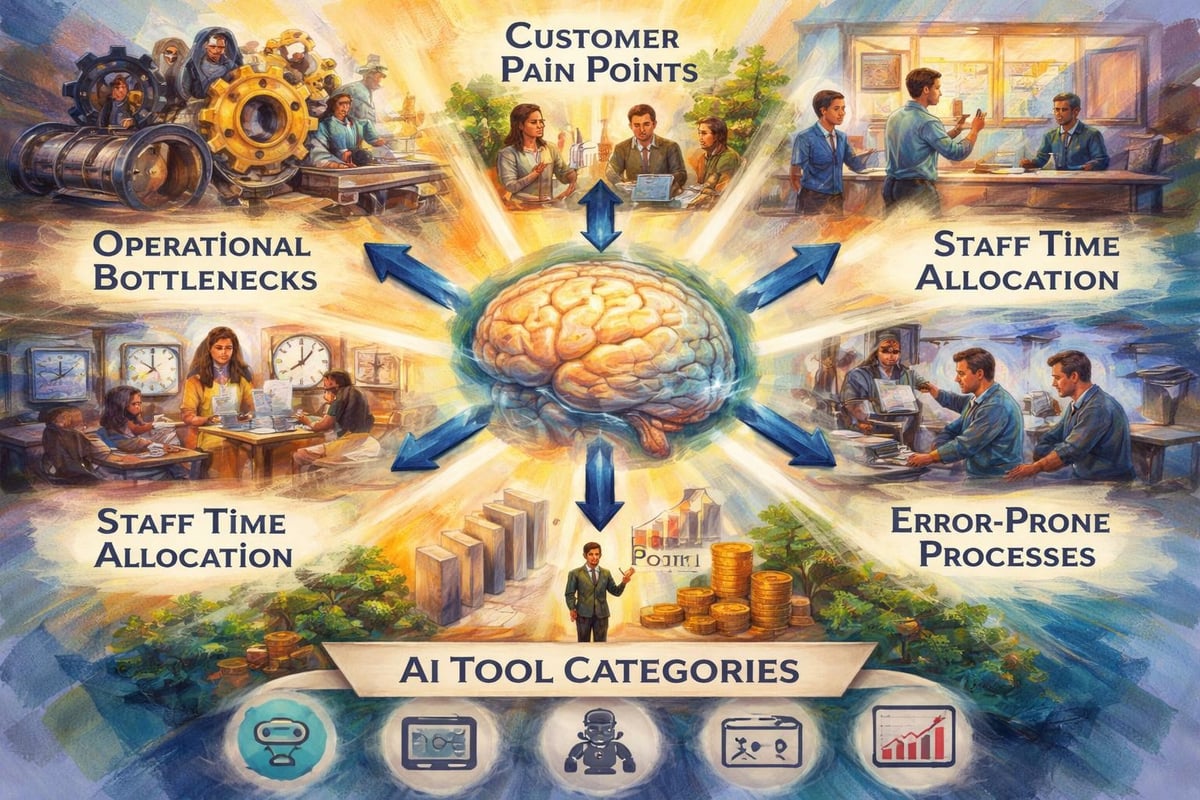
Document these challenges before exploring solutions. This prevents purchasing tools based on features rather than outcomes. Synap AI's readiness assessment provides structured frameworks for this evaluation process.
- Map current workflows and identify inefficiencies
- Quantify time and cost impacts of each bottleneck
- Research tools specifically designed for those challenges
- Test with pilot programs before full deployment
- Measure results against baseline metrics
Conversational AI and Chatbot Platforms
Conversational AI has matured significantly. The best AI tools in this category now understand context, maintain coherent multi-turn dialogues, and integrate with business systems. Google's Gemini platform demonstrates these capabilities across multiple use cases.
ChatGPT continues dominating enterprise adoption. Recent statistics show 67% of businesses using conversational AI platforms selected ChatGPT as their primary tool. Its API enables custom integrations. Its multimodal capabilities handle text, images, and code. Its reasoning improves monthly through updates.
Claude offers stronger safety guardrails. This matters for regulated industries. Financial services and healthcare organisations often prefer Claude. Its constitutional AI approach reduces harmful outputs. Its extended context window handles longer documents.
Implementing Chatbots for Customer Service
Customer service automation delivers measurable ROI. Companies report 40-60% reduction in support ticket volume after deploying conversational AI. Response times drop from hours to seconds.
Implementation requires strategic planning. Don't simply add a chatbot widget. Design conversation flows. Train on your specific domain. Establish clear escalation paths to human agents.
- Analyse your top 50 customer service queries
- Create response templates for common questions
- Build conversational flows with branching logic
- Integrate with your CRM and knowledge base
- Monitor conversations and refine responses weekly
Australian businesses using AI consulting services typically see faster deployment. Expert guidance reduces trial-and-error. Pre-built integrations save development time. Ongoing optimisation ensures continuous improvement.
Content Generation and Creative Tools
Generative AI has revolutionised content creation. The best AI tools now produce marketing copy, blog articles, social media posts, and visual assets. Quality varies significantly between platforms.
| Platform | Strength | Best Use Case | Price Point |
|---|---|---|---|
| ChatGPT | Versatility | Long-form content | Mid-range |
| Claude | Accuracy | Technical writing | Premium |
| Jasper | Marketing | Ad copy | High |
| Copy.ai | Speed | Social posts | Budget |
Text generation represents just one dimension. Image creation tools have reached photorealistic quality. Midjourney produces stunning visuals. DALL-E 3 integrates directly with ChatGPT. Stable Diffusion offers open-source flexibility.
Video generation is the newest frontier. Google's Veo 3.1 platform now generates high-quality videos from text prompts. Object-level editing capabilities exceed previous generations. Background audio generation adds polish.
Building Content Workflows
The most effective approach combines multiple tools. Use one for ideation, another for drafting, a third for refinement. This assembly line maximises each platform's strengths.
Start with mind mapping software. AI-enhanced mind mapping tools help brainstorm content angles. They suggest related topics. They identify content gaps. They visualise connections between ideas.
- Generate topic ideas using conversational AI
- Create detailed outlines with mind mapping tools
- Draft initial content using specialised writing platforms
- Refine and fact-check with editing AI
- Generate supporting visuals with image creation tools
- Schedule and optimise with social media AI
Quality control remains essential. AI-generated content requires human review. Check for factual accuracy. Ensure brand voice consistency. Verify that outputs align with strategic goals.
Automation and Workflow Optimisation
Process automation delivers the highest ROI among AI applications. Businesses save an average of 15-25 hours per employee weekly through intelligent automation. These aren't simple macros. They're sophisticated systems that handle complex decision-making.
Zapier and Make.com lead the integration space. They connect thousands of applications. They trigger actions based on conditions. They pass data between systems automatically. The best AI tools in this category now incorporate machine learning to improve over time.

Document processing has transformed completely. AI extracts data from invoices, contracts, and forms automatically. It categorises information. It populates databases. It flags anomalies for review. Accuracy rates exceed 95% for structured documents.
Designing Effective Automation Systems
Successful automation requires systematic implementation. Identify high-volume, rule-based processes first. These deliver quick wins. They build organisational confidence in AI capabilities.
- Document current manual processes step-by-step
- Identify decision points and business rules
- Map data flows between systems
- Configure automation workflows with error handling
- Test thoroughly with sample data
- Deploy gradually with monitoring
- Optimise based on performance metrics
Synap's automation solutions incorporate Australian-specific compliance requirements. Privacy regulations matter. Data residency rules apply. Local expertise ensures implementations meet legal standards.
Data Analysis and Business Intelligence
Analytical AI transforms raw data into actionable insights. These platforms identify patterns humans miss. They predict future trends. They recommend optimal actions. The best AI tools combine statistical rigour with interpretable outputs.
Power BI and Tableau now embed AI capabilities throughout their platforms. Natural language queries eliminate SQL requirements. Automated insight generation surfaces important trends. Predictive analytics forecast business metrics.
Specialised tools target specific functions. Sales forecasting AI predicts revenue with 85-90% accuracy. Inventory optimisation AI reduces carrying costs by 20-30%. Customer churn prediction AI identifies at-risk accounts weeks in advance.
Implementing Predictive Analytics
Predictive capabilities require quality data foundations. Garbage in, garbage out remains true. Clean, consistent, comprehensive data feeds accurate predictions.
| Implementation Stage | Timeline | Key Activities | Success Metrics |
|---|---|---|---|
| Data Preparation | 2-4 weeks | Cleaning, integration, validation | Data quality score >95% |
| Model Development | 3-6 weeks | Training, testing, tuning | Prediction accuracy >80% |
| Deployment | 1-2 weeks | Integration, monitoring setup | System uptime >99% |
| Optimisation | Ongoing | Refinement, retraining | Continuous accuracy improvement |
- Consolidate data from all relevant sources
- Establish data quality standards and cleaning processes
- Define specific business questions to answer
- Select appropriate AI models for your use case
- Train models on historical data
- Validate accuracy with test datasets
- Deploy with real-time monitoring
- Retrain periodically as new data accumulates
Businesses working with AI consultants in Melbourne or AI consultants in Sydney benefit from localised industry knowledge. Different sectors face unique challenges. Retail patterns differ from professional services. Manufacturing requires distinct approaches from healthcare.
Communication and Collaboration Enhancement
Remote work has accelerated AI adoption in communication tools. The best AI tools enhance team collaboration rather than replacing human interaction. They transcribe meetings. They summarise discussions. They track action items automatically.
Meeting assistants like Otter.ai and Fireflies.ai record conversations, generate transcripts, and extract key points. They integrate with Zoom, Teams, and Google Meet. They save hours of note-taking weekly. Research shows that teams using AI collaboration tools report 30% higher productivity.
Email management AI prioritises messages based on importance. It suggests responses to routine queries. It schedules meetings considering all participants' calendars. It follows up automatically when responses are overdue.
Optimising Team Workflows
Successful implementation requires team buy-in. Introduce tools gradually. Provide training. Demonstrate clear benefits. Address privacy concerns transparently.
- Survey team members about current pain points
- Select tools addressing specific challenges
- Conduct hands-on training sessions
- Establish usage guidelines and best practices
- Gather feedback after 30 days
- Adjust configurations based on actual usage
- Expand to additional features incrementally
Project management platforms now incorporate AI scheduling. They optimise task assignments. They predict completion dates. They identify bottlenecks before they impact deadlines. Tools like Asana, Monday.com, and ClickUp offer these capabilities.
Specialised Industry Applications
Industry-specific AI delivers higher value than generic tools. Healthcare AI analyses medical images. Legal AI reviews contracts. Manufacturing AI predicts equipment failures. Retail AI optimises inventory placement.
Education technology has embraced conversational AI rapidly. Popular AI chatbots now assist students with research, writing, and problem-solving. Educators must balance AI benefits with academic integrity concerns.
Software development has transformed through AI coding assistants. These tools suggest code completions, identify bugs, and explain complex functions. Developer productivity increases 25-40% according to recent studies.

Financial services employ AI for fraud detection. Algorithms analyse transaction patterns in real-time. They flag suspicious activities instantly. False positive rates have dropped to under 5% with modern systems.
Evaluating Specialised Solutions
Industry-specific tools often outperform general platforms for particular tasks. They understand domain terminology. They incorporate industry regulations. They deliver pre-configured workflows.
- Identify your industry's unique AI requirements
- Research platforms built specifically for your sector
- Request demonstrations with your actual data
- Verify compliance with relevant regulations
- Compare costs against expected efficiency gains
- Check integration capabilities with existing systems
- Evaluate vendor stability and support quality
Privacy and Security Considerations
Data protection cannot be an afterthought. The best AI tools prioritise security and privacy by design. Australian businesses must comply with Privacy Act requirements. International clients may require GDPR adherence.
On-premises AI solutions offer maximum control. They keep sensitive data within your infrastructure. They eliminate third-party access concerns. However, they require significant technical expertise to maintain.
Cloud-based platforms provide easier deployment. Leading providers offer Australian data residency options. They maintain SOC 2 compliance. They provide encryption at rest and in transit. They undergo regular security audits.
Implementing Secure AI Practices
Security requires ongoing vigilance. Establish clear policies before deploying AI tools. Train staff on data handling requirements. Monitor usage continuously.
- Conduct privacy impact assessments for each tool
- Verify data residency and sovereignty compliance
- Implement access controls and authentication
- Encrypt sensitive data before AI processing
- Establish data retention and deletion policies
- Monitor for unauthorised access attempts
- Maintain audit logs of AI interactions
- Review vendor security practices annually
Comprehensive consulting services help navigate these complexities. Expert guidance ensures compliant implementations. Risk assessments identify potential vulnerabilities. Ongoing monitoring maintains security posture.
Cost-Benefit Analysis and ROI Measurement
AI investments must deliver measurable returns. The best AI tools pay for themselves within 6-12 months through efficiency gains. However, hidden costs often surprise organisations.
Licensing fees represent obvious expenses. Per-user pricing, API call charges, and premium features add up quickly. Less obvious costs include implementation time, staff training, and ongoing maintenance.
| Cost Category | Typical Range | Optimisation Strategy |
|---|---|---|
| Software Licenses | $20-500/user/month | Annual commitments for discounts |
| Implementation | $5,000-50,000 | Phased rollout reduces upfront costs |
| Training | $500-2,000/person | Internal champions multiply expertise |
| Maintenance | 15-20% annually | Managed services reduce burden |
| Integration | $10,000-100,000 | API-first tools lower integration costs |
Benefits extend beyond time savings. Improved accuracy reduces costly errors. Faster response times increase customer satisfaction. Data-driven decisions improve strategic outcomes. Enhanced employee satisfaction results from eliminating tedious tasks.
Calculating True ROI
Accurate ROI calculation requires tracking multiple metrics. Establish baseline measurements before implementation. Monitor changes over 90-day periods minimum.
- Document current process costs and timeframes
- Calculate fully-loaded hourly rates for affected staff
- Measure quality metrics and error rates
- Implement AI solution with phased approach
- Track time savings and quality improvements weekly
- Calculate hard cost savings and efficiency gains
- Survey staff for satisfaction and productivity changes
- Compare total costs against cumulative benefits
- Project ongoing returns based on actual data
Integration Strategies and Technical Considerations
The best AI tools integrate seamlessly with existing systems. APIs enable data flow between platforms. Webhooks trigger actions automatically. Native integrations reduce technical complexity.
Legacy system compatibility poses challenges. Older platforms lack modern APIs. Data formats may be incompatible. Custom middleware may be required. Budget for integration development.
Detailed guides help technical teams navigate implementation challenges. Step-by-step tutorials reduce learning curves. Best practice documentation prevents common mistakes.
Building Robust Integrations
Integration success requires careful planning. Map data flows before coding. Test thoroughly before production deployment. Monitor continuously after launch.
- Inventory all systems requiring integration
- Document data schemas and API capabilities
- Design integration architecture with error handling
- Develop in staging environment first
- Test with realistic data volumes
- Implement monitoring and alerting
- Deploy to production with rollback plan
- Optimise performance based on usage patterns
Technical resources make significant differences. Visual IDEs designed for AI applications accelerate development. Pre-built components reduce coding requirements. Visual workflows make logic more maintainable.
Emerging Trends and Future Outlook
AI capabilities evolve rapidly. Features impossible in 2025 are commonplace now. Multimodal models process text, images, audio, and video simultaneously. Reasoning capabilities approach human-level performance on complex tasks.
Agentic AI represents the next frontier. These systems take actions autonomously. They break complex goals into subtasks. They use tools independently. They learn from outcomes. Early implementations show promising results.
Smaller, more efficient models challenge the bigger-is-better paradigm. On-device AI eliminates cloud dependencies. It reduces latency. It enhances privacy. Mobile AI applications multiply weekly.
Australian businesses gain competitive advantage through early adoption. Comprehensive AI tools reviews help identify emerging capabilities. Detailed comparisons evaluate tools across multiple dimensions.
Industry consolidation continues. Major platforms acquire specialised tools. They integrate capabilities into comprehensive suites. This simplifies vendor management but may reduce specialisation benefits.
Practical Implementation Framework
Success requires structured approaches. Random tool adoption creates chaos. Strategic deployment delivers results. Start small. Prove value. Expand systematically.
Establish an AI governance committee. Include representatives from IT, operations, legal, and key business units. Define evaluation criteria. Set budget parameters. Create implementation standards.
- Form cross-functional AI steering committee
- Assess organisational readiness for AI adoption
- Prioritise use cases by impact and feasibility
- Select pilot projects with clear success metrics
- Allocate budget and resources appropriately
- Implement with vendor support and expert guidance
- Measure results against defined KPIs
- Scale successful pilots across organisation
- Continuously evaluate new AI capabilities
- Refine strategy based on outcomes and learnings
Partner selection matters enormously. The best AI tools require proper configuration. Enterprise solutions need customisation. Business platforms require optimisation. Expert implementation accelerates value realisation.
Change management determines ultimate success. Technology alone doesn't transform organisations. People do. Communicate benefits clearly. Address concerns honestly. Celebrate wins publicly.
Training investments pay dividends. Don't assume intuitive interfaces eliminate learning curves. The best AI tools offer deep capabilities. Surface-level usage wastes potential. Comprehensive training unlocks full value.
Monitor usage metrics continuously. Which features see heavy adoption? Which remain unused? Why? User feedback reveals optimisation opportunities. Regular reviews ensure tools evolve with business needs.
For businesses seeking strategic AI guidance, booking a consultation provides personalised recommendations. An experienced AI technologist can assess your specific situation, identify optimal tools, and design implementation roadmaps. Schedule time with experts who understand Australian business requirements at https://cal.com/hamish-mackellar-9sxhbs/30min.
The AI tool landscape offers unprecedented opportunities for Australian businesses willing to invest strategically. Success requires selecting platforms aligned with specific needs, implementing systematically, and measuring results rigorously. Whether you're just beginning your AI journey or optimising existing deployments, expert guidance accelerates outcomes and minimises costly mistakes. Synap AI specialises in helping Australian businesses navigate these choices, providing consulting, platform development, and ongoing support tailored to your unique requirements.