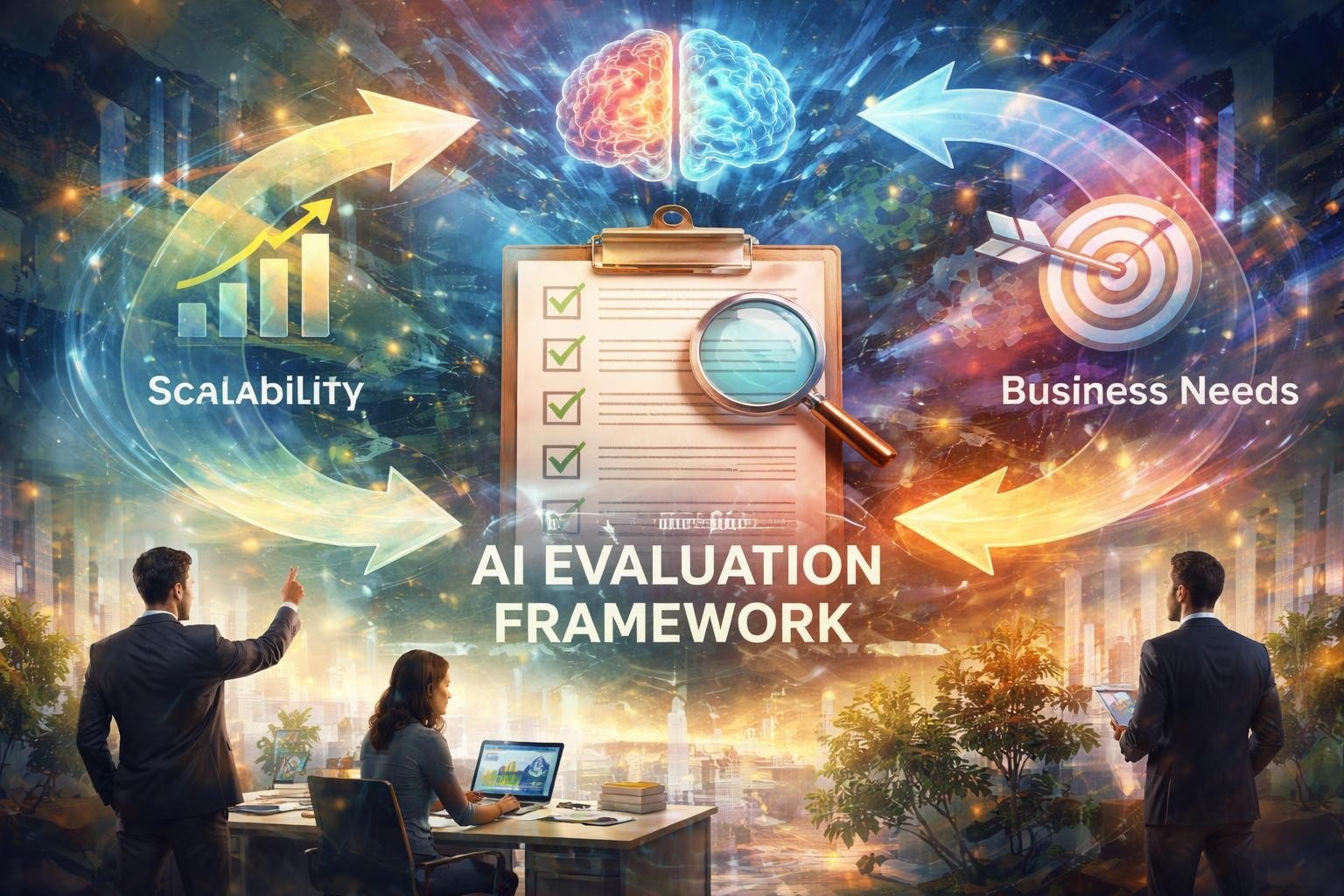
The search for the best AI solutions has become critical for Australian businesses seeking competitive advantages in 2026. Organisations across industries now recognise that artificial intelligence isn't just a technological trend. It's a fundamental business capability that drives efficiency, innovation, and growth. With thousands of AI tools flooding the market, selecting the right solutions requires strategic thinking and expert guidance. This comprehensive guide examines what makes AI solutions truly valuable and how businesses can implement them effectively.
Understanding What Makes the Best AI Solutions
The best AI solutions share common characteristics that distinguish them from mediocre alternatives. These tools deliver measurable business value rather than just impressive demonstrations. According to recent industry analysis, effective AI platforms combine powerful capabilities with practical usability.
Key Performance Indicators for AI Solutions
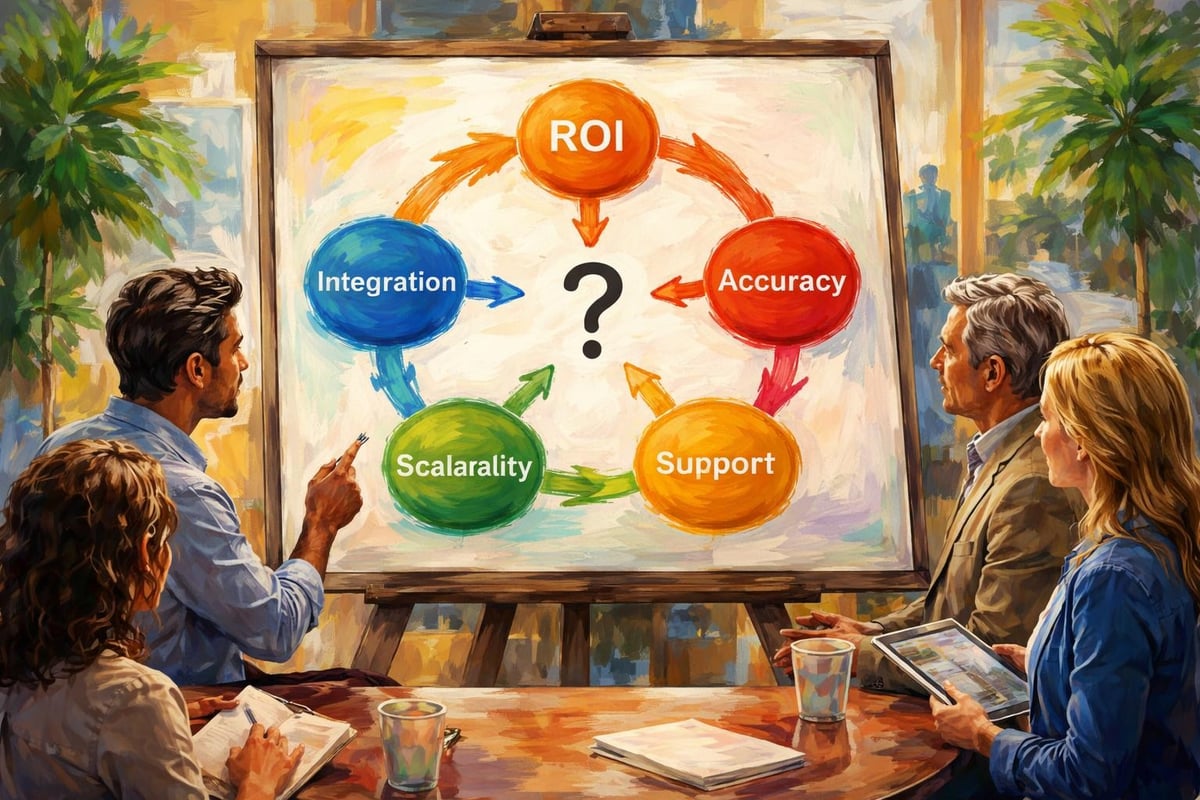
Evaluating AI tools requires looking beyond marketing claims. Business leaders need concrete metrics to assess value. The following framework helps organisations make informed decisions:
- Return on Investment Timeframe - Calculate how quickly the solution pays for itself through cost savings or revenue generation.
- Integration Complexity - Measure how easily the tool connects with existing business systems and workflows.
- Accuracy Benchmarks - Verify the solution's performance against industry-standard datasets and real-world scenarios.
- Scalability Metrics - Assess whether the platform can handle growing data volumes and user numbers.
- Support Response Times - Evaluate vendor responsiveness and problem-resolution capabilities.
Research shows that 73% of Australian small businesses have adopted AI tools in some capacity by 2026. The Associated Press reports this adoption has significantly improved operational efficiency. However, successful implementation requires more than just purchasing software.
Real-World Application Across Industries
Manufacturing companies use computer vision systems to detect product defects with 99.2% accuracy. Financial services firms deploy fraud detection algorithms that process millions of transactions hourly. Healthcare providers leverage diagnostic AI to identify early warning signs in patient data. Professional services organisations automate document review and contract analysis.
The best AI solutions adapt to specific industry requirements rather than offering generic capabilities. Customisation remains essential for extracting maximum value from AI investments.
Implementing AI Strategy in Your Organisation
Successful AI implementation follows a structured approach. Random tool adoption without strategy leads to wasted resources and disappointing results. Australian businesses need methodical frameworks for AI integration.
Step-by-Step AI Implementation Guide
The following process has proven effective across multiple industries and company sizes:
- Conduct Readiness Assessment - Evaluate current technology infrastructure, data quality, team capabilities, and organisational culture. AI readiness assessments identify gaps before investment.
- Define Clear Objectives - Specify measurable outcomes such as reducing processing time by 40% or improving customer satisfaction scores by 25 points.
- Identify Use Cases - Prioritise applications based on potential impact, implementation difficulty, and strategic alignment.
- Select Appropriate Solutions - Match tools to specific needs rather than choosing based on brand recognition or cost alone.
- Develop Pilot Programs - Test solutions with limited scope before full deployment to validate assumptions and refine approaches.
- Train Team Members - Ensure staff understand how to use tools effectively and interpret AI-generated insights correctly.
- Monitor Performance Metrics - Track defined KPIs weekly to identify issues early and optimise configurations.
- Scale Gradually - Expand successful implementations methodically while maintaining quality standards.
This systematic approach reduces risk and increases success probability. Companies that follow structured implementation processes report 3.5 times higher satisfaction with AI investments compared to those using ad-hoc methods.
Categories of High-Impact AI Tools
The best AI solutions fall into distinct categories addressing different business needs. Understanding these classifications helps organisations identify relevant technologies.
Natural Language Processing Applications
Chatbots and virtual assistants handle customer inquiries 24/7 without human intervention. Popular AI chatbots now understand context and maintain coherent conversations across multiple interactions. Document processing tools extract key information from contracts, invoices, and reports. Sentiment analysis platforms monitor customer feedback across social media and review sites.
| Application Type | Primary Use Case | Average Time Savings | Implementation Complexity |
|---|---|---|---|
| Customer Service Chatbots | Handling routine inquiries | 60-70% | Medium |
| Document Processing | Data extraction and classification | 75-85% | Low to Medium |
| Sentiment Analysis | Brand monitoring and feedback | 50-60% | Low |
| Content Generation | Marketing and communications | 40-50% | Low |
Predictive Analytics and Machine Learning
These tools analyse historical patterns to forecast future outcomes. Sales teams use demand forecasting to optimise inventory levels. Marketing departments predict customer churn before it happens. Operations managers anticipate equipment failures and schedule preventive maintenance.
Predictive models become more accurate over time as they process additional data. Initial accuracy rates of 70-75% often improve to 85-90% after six months of operation.

Computer Vision Technologies
Image recognition systems automate quality control in manufacturing environments. Retail businesses use visual search to help customers find products. Security applications identify unauthorised access attempts in real-time. Agricultural operations monitor crop health through drone imagery analysis.
Computer vision accuracy has improved dramatically in recent years. Modern systems match or exceed human performance in many specific tasks.
Private AI Solutions for Australian Businesses
Data sovereignty and privacy concerns make private AI deployments increasingly important for Australian organisations. Public cloud services raise questions about data location and control. Private AI platforms address these concerns while delivering powerful capabilities.
Advantages of Private AI Infrastructure
Organisations maintaining AI consulting relationships with experienced providers can deploy private systems tailored to specific requirements. Benefits include:
- Complete Data Control - Information never leaves organisational infrastructure, ensuring compliance with privacy regulations.
- Customisation Flexibility - Models can be trained on proprietary data without sharing sensitive information with third parties.
- Performance Optimisation - Systems configured specifically for organisational workloads rather than generic use cases.
- Cost Predictability - Fixed infrastructure costs rather than variable per-use pricing from cloud providers.
- Competitive Advantage - Proprietary AI capabilities that competitors cannot easily replicate.
Private deployments require more technical expertise but deliver superior results for organisations with sensitive data or unique requirements.
Building Internal AI Capabilities
Developing in-house AI expertise creates long-term value beyond individual tool implementations. This involves:
- Recruiting Data Scientists - Hire specialists who understand both technical AI concepts and business applications.
- Training Existing Staff - Upskill current employees through workshops, certifications, and hands-on projects.
- Establishing Data Governance - Create policies ensuring data quality, security, and ethical use.
- Developing Model Libraries - Build reusable AI components that accelerate future projects.
- Creating Feedback Mechanisms - Implement systems that continuously improve model performance based on real-world results.
Companies with strong internal capabilities report 2.8 times faster deployment cycles compared to those relying entirely on external vendors.
Automation Workflows That Deliver Results
The best AI implementations combine multiple technologies into cohesive automation workflows. Single-point solutions provide limited value compared to integrated systems.
Designing Effective Automation Sequences
Synap AI has developed automation frameworks that connect various AI capabilities into seamless processes. Consider a customer onboarding workflow:
- Initial Contact - AI chatbot collects preliminary information and qualifies leads.
- Document Processing - Computer vision extracts data from uploaded identification documents.
- Verification - Machine learning models assess risk and flag anomalies for human review.
- Communication - Natural language generation creates personalised welcome messages.
- Analytics - Predictive models estimate customer lifetime value and recommend engagement strategies.
This integrated approach reduces onboarding time from 3-5 days to under 2 hours while improving accuracy and customer experience.

Measuring Automation Success
Effective measurement requires tracking multiple dimensions of performance. Simple metrics like "hours saved" miss important nuances. Comprehensive assessment includes:
| Metric Category | Example Measurements | Target Improvement |
|---|---|---|
| Efficiency | Processing time, throughput volume | 50-80% reduction |
| Quality | Error rates, rework frequency | 60-90% improvement |
| Customer Impact | Satisfaction scores, response times | 25-40% increase |
| Financial | Cost per transaction, revenue per customer | 30-50% improvement |
| Employee Experience | Task satisfaction, skill development | 20-35% increase |
Regular reporting against these metrics ensures automation delivers expected value and identifies optimisation opportunities.
Selecting AI Solutions for Specific Business Functions
Different departments require different AI capabilities. The best AI strategy aligns tool selection with functional needs rather than applying generic solutions everywhere.
Sales and Marketing Applications
Customer relationship management platforms now incorporate AI-powered lead scoring that predicts conversion probability. Marketing automation tools optimise email send times and content variations. Social media management systems recommend optimal posting schedules and content topics.
Personalisation engines analyse customer behaviour to deliver individualised product recommendations. A/B testing automation identifies winning variations without manual intervention. Attribution modelling reveals which marketing channels drive actual revenue.
Operations and Supply Chain Tools
Inventory optimisation algorithms balance stock levels against carrying costs and stockout risks. Route planning systems reduce logistics costs by 15-25% through intelligent scheduling. Quality control vision systems inspect products faster and more consistently than human inspectors.
Maintenance prediction models identify equipment likely to fail within specific timeframes. Energy management platforms optimise consumption patterns to reduce utility costs. Workforce scheduling tools match staff availability with demand forecasts.
Finance and Accounting Automation
Invoice processing systems extract data with 98%+ accuracy and route documents for approval. Expense categorisation tools eliminate manual coding of transactions. Fraud detection algorithms flag suspicious patterns in real-time. Regulatory compliance monitoring ensures adherence to changing requirements.
Financial forecasting models project cash flow and revenue with greater accuracy than spreadsheet-based approaches. Contract analysis tools identify unfavourable terms and renewal dates automatically.
Working with AI Consultants for Optimal Results
Many organisations benefit from external expertise when implementing AI solutions. Professional AI consulting services accelerate time-to-value and reduce implementation risks.
What Experienced Consultants Provide
Qualified AI consultants bring several advantages that justify their involvement:
- Technology Evaluation - Objective assessment of tools based on actual business requirements rather than vendor marketing.
- Implementation Expertise - Proven frameworks that avoid common pitfalls and accelerate deployment.
- Custom Development - Building bespoke solutions when off-the-shelf tools don't meet specific needs.
- Training Programs - Structured education that enables teams to use AI tools effectively.
- Ongoing Optimisation - Continuous improvement based on performance data and changing business needs.
The best AI consultants focus on business outcomes rather than technology for its own sake. They translate technical capabilities into measurable value.
Questions to Ask Potential Consulting Partners
Selecting the right consultant requires due diligence. Ask prospective partners:
- What industries have you worked with and what results did you achieve? - Specific examples demonstrate relevant experience.
- How do you measure project success? - Clear metrics indicate results-focused thinking.
- What's your approach to knowledge transfer? - Effective consultants build internal capabilities rather than creating dependency.
- How do you handle data security and privacy? - Critical for organisations with sensitive information.
- What ongoing support do you provide post-implementation? - Long-term partnerships deliver better results than transactional relationships.
Victorian businesses can explore local AI consulting options that understand Australian market conditions and regulatory requirements.
Future Trends in AI Technology
Understanding emerging trends helps organisations prepare for upcoming opportunities. The AI landscape evolves rapidly with new capabilities appearing regularly.
Multimodal AI Systems
Next-generation platforms process multiple data types simultaneously. These systems analyse text, images, audio, and video together rather than separately. A customer service application might interpret spoken words, facial expressions, and background sounds to better understand caller intent. Marketing tools could evaluate ad effectiveness by combining visual appeal, message clarity, and audience engagement signals.
Multimodal systems demonstrate 30-40% better performance on complex tasks compared to single-modality approaches.
Edge AI Deployment
Processing AI workloads on local devices rather than cloud servers reduces latency and improves privacy. Manufacturing equipment with embedded AI performs quality checks instantly without network connectivity. Retail point-of-sale systems analyse purchase patterns without transmitting customer data externally. Mobile applications deliver AI features even without internet access.
Edge deployment costs have decreased 60% over the past three years as specialised processors become more affordable.
Explainable AI Capabilities
Regulatory pressure and business requirements drive demand for AI systems that explain their decisions. Healthcare applications must justify diagnostic recommendations. Financial services need transparent credit decisions. Hiring tools require explainable candidate rankings to avoid discrimination claims.
Modern explainable AI platforms provide decision trees, feature importance rankings, and counterfactual explanations that humans can understand and validate.
Cost Considerations for AI Implementation
Budget planning for AI projects requires understanding both obvious and hidden costs. The best AI investments balance capability with affordability.
Direct Implementation Expenses
Initial costs include software licences, hardware infrastructure, integration services, and training programs. Cloud-based solutions typically charge per-user monthly fees ranging from $30 to $500 depending on features. Private deployments involve upfront capital expenditure for servers, storage, and networking equipment.
Custom development projects cost between $50,000 and $500,000 depending on complexity and scope. Enterprise AI platforms provide comprehensive capabilities with predictable pricing structures.
Ongoing Operational Costs
Maintenance, support, and continuous improvement create recurring expenses. Cloud services include these in subscription fees. Private deployments require internal staff or managed service contracts. Model retraining consumes computational resources as data volumes grow.
Budget 20-30% of initial implementation costs annually for ongoing operations and optimisation.
Calculating Total Cost of Ownership
Comprehensive financial analysis spans three to five years and includes:
| Cost Component | Year 1 | Year 2 | Year 3 | Notes |
|---|---|---|---|---|
| Software Licences | $50,000 | $52,500 | $55,125 | 5% annual increase |
| Infrastructure | $75,000 | $15,000 | $15,000 | Major upfront, maintenance ongoing |
| Implementation Services | $100,000 | $20,000 | $10,000 | Decreasing as capabilities mature |
| Training | $25,000 | $10,000 | $5,000 | Front-loaded investment |
| Support and Maintenance | $15,000 | $20,000 | $25,000 | Increasing with scale |
| Total | $265,000 | $117,500 | $110,125 | Three-year TCO: $492,625 |
This framework enables realistic budgeting and return-on-investment calculations.
Getting Started with AI Implementation
Organisations ready to implement AI solutions should begin with focused pilot projects. Small-scale tests validate concepts before major investments.
Recommended First Steps
Begin your AI journey systematically:
- Document Current Processes - Map existing workflows to identify automation opportunities and pain points.
- Quantify Baseline Performance - Measure current efficiency, quality, and costs to establish improvement targets.
- Select Pilot Use Case - Choose projects with clear success criteria and manageable scope.
- Engage Stakeholders - Ensure leadership support and user buy-in before implementation begins.
- Set Realistic Timelines - Allow adequate time for testing, refinement, and user adoption.
- Plan for Iteration - Expect multiple refinement cycles rather than perfect first attempts.
- Celebrate Quick Wins - Communicate early successes to build momentum and organisational support.
Australian businesses exploring AI possibilities can book consultations with experienced technologists to discuss specific requirements. Schedule a 30-minute online consultation to explore how AI solutions align with your business objectives.
Building Long-Term AI Capabilities
Sustainable AI programs require ongoing commitment beyond initial implementations. This includes establishing centres of excellence, creating innovation teams, and fostering cultures of experimentation. Organisations viewing AI as continuous improvement rather than one-time projects achieve superior long-term results.
The best AI outcomes emerge from combining technology expertise with deep business understanding. Tools alone don't create value. Strategic application of AI capabilities to genuine business problems drives meaningful results.
Finding the best AI solutions for your organisation requires balancing technical capabilities with practical business needs. The most successful implementations combine thoughtful strategy, appropriate tool selection, and expert guidance. Synap AI specialises in helping Australian businesses navigate AI opportunities through private consulting and custom platform development. Our Mornington-based team brings deep technical expertise and practical business experience to every engagement, ensuring your AI investments deliver measurable value.