
The customer support landscape has undergone a dramatic transformation in 2026. AI in customer support now represents a fundamental shift in how Australian businesses interact with their clients. This technology enables companies to deliver faster, more accurate, and highly personalised service experiences. The integration of AI in customer support systems has moved beyond simple chatbots to encompass sophisticated platforms that understand context, predict issues, and resolve complex problems autonomously.
Understanding the Current State of AI in Customer Support
The adoption rate of AI in customer support has accelerated dramatically. Recent data shows that 73% of Australian businesses now utilise some form of AI-powered customer service tool. This represents a 34% increase from 2024 figures.
The technology spans multiple applications. Natural language processing enables systems to understand customer intent. Machine learning algorithms improve response accuracy over time. Sentiment analysis tools detect customer emotion and escalate appropriately.

Key Statistics Driving Adoption
The numbers tell a compelling story. According to IBM's analysis of AI in customer service, organisations report:
- 65% reduction in average response times
- 45% decrease in operational costs
- 82% customer satisfaction rates for AI-handled enquiries
- 24/7 availability with zero downtime
- 58% reduction in ticket escalations
These metrics demonstrate tangible value. Australian businesses particularly benefit from AI's ability to handle time-zone differences. The technology serves customers across global markets without requiring overnight staff.
Implementing AI in Customer Support Systems
Successful implementation requires strategic planning. Many businesses rush deployment without proper preparation. This approach leads to poor outcomes and wasted investment.
The implementation process follows specific stages. Each stage builds upon the previous foundation. Rushing through steps compromises the entire system.
Step-by-Step Implementation Guide
Step 1: Assess Current Support Operations
Begin with comprehensive analysis. Document all current support channels. Map customer journey touchpoints. Identify bottlenecks and pain points. Measure baseline performance metrics.
Step 2: Define Clear Objectives
Establish specific goals. Determine which metrics matter most. Set realistic timeframes. Align AI capabilities with business needs. Consider both short-term wins and long-term transformation.
Step 3: Choose the Right Technology Stack
Select platforms matching your requirements. Evaluate integration capabilities. Test scalability options. Consider AI consulting expertise from specialists to guide technology selection.
Step 4: Prepare Your Data
Clean existing customer data. Organise historical support tickets. Create comprehensive knowledge bases. Ensure data quality and consistency. Remove duplicates and outdated information.
Step 5: Configure and Train Systems
Implement chosen platforms. Configure workflows and routing rules. Train AI models on your specific data. Set up escalation pathways. Define response templates and tone guidelines.
Step 6: Pilot with Limited Scope
Launch with controlled user groups. Monitor performance closely. Gather feedback systematically. Identify issues early. Make iterative improvements.
Step 7: Scale and Optimise
Expand gradually across channels. Increase automation levels progressively. Continuously refine based on data. Monitor key performance indicators. Adjust strategies as needed.
| Implementation Phase | Duration | Primary Focus | Success Metric |
|---|---|---|---|
| Assessment | 2-4 weeks | Current state analysis | Complete process map |
| Planning | 3-6 weeks | Strategy development | Approved roadmap |
| Configuration | 6-10 weeks | System setup | Successful testing |
| Pilot | 4-8 weeks | Limited deployment | Target KPIs met |
| Full Rollout | 8-12 weeks | Complete integration | 80%+ automation rate |
Real-World Applications and Success Stories
The transformation of customer service through AI delivers measurable results across industries. Real-world examples demonstrate the technology's versatility and impact.
Banking Sector Implementation
A major Australian bank deployed AI in customer support across multiple channels in early 2025. The system handled account enquiries, transaction disputes, and product recommendations.
Results exceeded expectations. The bank processed 2.3 million customer interactions monthly. AI resolved 76% without human intervention. Customer satisfaction scores increased from 72% to 89%.
The implementation reduced wait times from 8.5 minutes to 45 seconds. Staff focused on complex issues requiring human judgement. Operating costs decreased by $4.2 million annually.
Telecommunications Case Study
An Australian telecommunications provider faced overwhelming support volume. Peak periods saw wait times exceeding 30 minutes. Customer churn increased quarterly.
The company deployed comprehensive AI in customer support infrastructure. The system integrated with billing platforms, service management tools, and CRM systems.
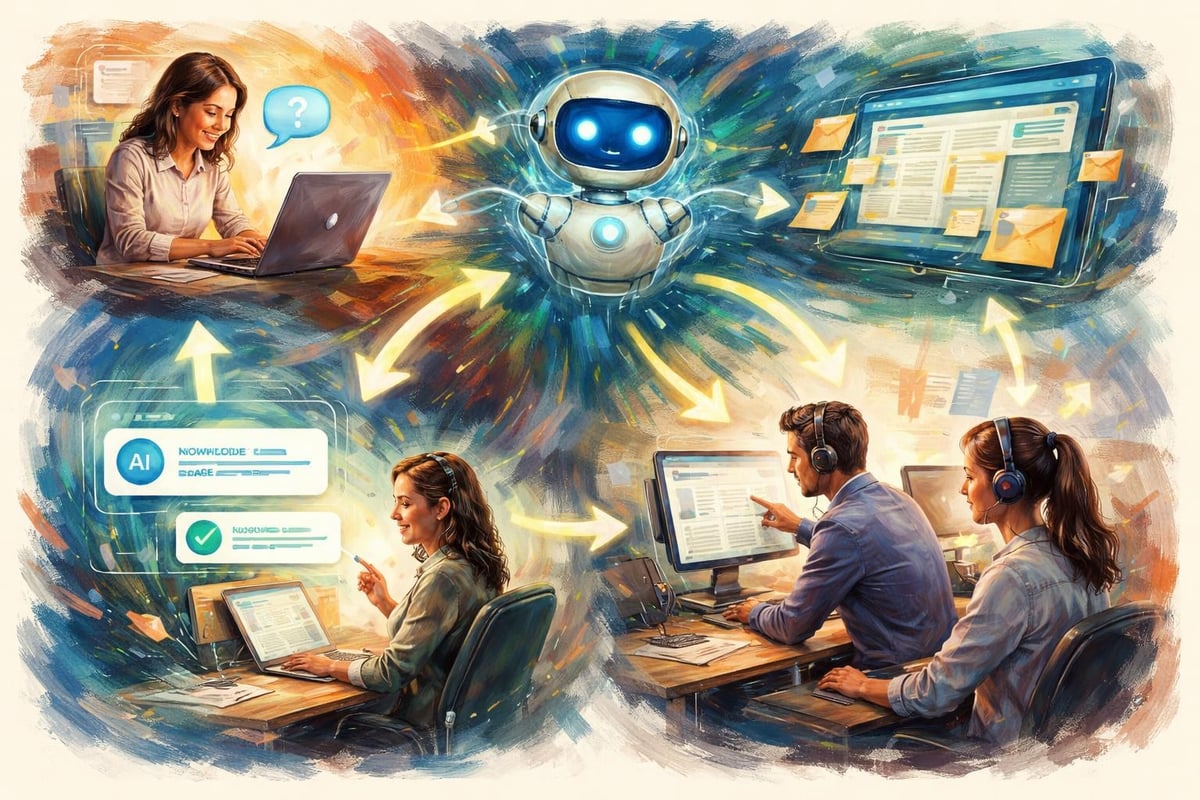
Within six months, performance transformed completely:
- Average handling time dropped from 12 minutes to 3.5 minutes
- First-contact resolution improved from 54% to 82%
- Customer effort scores decreased by 63%
- Net Promoter Score increased 28 points
- Support staff attrition fell from 34% to 12%
The telecommunications example demonstrates comprehensive benefits. Cost savings were significant. Customer experience improved dramatically. Employee satisfaction increased as repetitive tasks decreased.
Retail E-commerce Success
An online retailer specialising in home goods struggled with returns, shipping enquiries, and product questions. The small team couldn't scale with business growth.
They implemented AI in customer support focused on common enquiry patterns. The system learned from historical data spanning three years. Integration with inventory and logistics systems enabled real-time information.
Results appeared quickly. The AI handled 89% of order status enquiries automatically. Product recommendation accuracy reached 84%. Return processing time decreased from 3 days to 4 hours.
Revenue impact proved substantial. Conversion rates increased 23% due to instant product advice. Cart abandonment decreased as shipping questions received immediate answers. The retailer expanded operations without proportional support staff increases.
Advanced Capabilities Transforming Support
Modern AI in customer support extends far beyond basic chatbots. Advanced capabilities deliver sophisticated customer experiences. These technologies represent significant competitive advantages.
Predictive Support and Proactive Engagement
AI systems now predict issues before customers report them. Analysis of usage patterns identifies potential problems. The system initiates contact proactively.
A software company using Synap AI automation detected patterns indicating imminent service failures. The AI contacted affected customers before they experienced disruptions. It offered solutions or alternatives automatically.
This proactive approach achieved remarkable outcomes:
- 67% reduction in reactive support tickets
- 91% customer appreciation for proactive contact
- 42% decrease in subscription cancellations
- Significant brand loyalty improvements
- Reduced crisis management requirements
Sentiment Analysis and Emotional Intelligence
Understanding customer emotion transforms support interactions. AI analyses tone, word choice, and context. It adapts responses accordingly.
The technology identifies frustration, confusion, or satisfaction. High-emotion interactions escalate immediately. Positive interactions receive reinforcement. Neutral exchanges maintain efficient resolution focus.
Creatio's research on AI benefits shows sentiment analysis improves outcomes by 56%. Customers feel understood. Resolution approaches match emotional states. Escalations decrease as issues receive appropriate handling.
Omnichannel Integration
Customers expect seamless experiences across channels. AI in customer support unifies interactions across email, chat, phone, social media, and messaging apps.
Context persists regardless of channel switches. Customers don't repeat information. Previous interactions inform current responses. The experience feels continuous and personalised.
| Channel | AI Capability | Customer Benefit | Business Impact |
|---|---|---|---|
| Intent classification, auto-responses | Faster replies | 70% automation rate | |
| Live Chat | Real-time suggestions, auto-resolution | Instant answers | 85% self-service success |
| Phone | Speech recognition, smart routing | Right specialist immediately | 45% call reduction |
| Social Media | Sentiment analysis, priority flagging | Quick issue resolution | Brand protection |
| SMS/Messaging | Context-aware responses | Convenient communication | Higher engagement |
Addressing Implementation Challenges
Despite clear benefits, implementing AI in customer support presents challenges. Understanding obstacles enables better preparation. Success requires addressing concerns systematically.
Data Privacy and Security Concerns
Australian businesses must comply with strict privacy regulations. Customer data requires careful handling. AI systems process sensitive information.
Robust security measures are essential:
- Encrypt all customer data in transit and at rest
- Implement strict access controls and authentication
- Conduct regular security audits and penetration testing
- Maintain comprehensive audit trails
- Ensure compliance with Privacy Act requirements
- Use on-premise or private cloud options for sensitive data
Synap AI's approach to business solutions prioritises privacy by default. Private AI platforms keep sensitive data within organisational control.
Managing the Human-AI Balance
Complete automation isn't always desirable. Some situations require human empathy and judgement. Finding the right balance proves crucial.
Effective strategies include:
- Reserve complex issues for human agents
- Enable seamless AI-to-human handoffs with full context
- Use AI to assist human agents with suggestions
- Monitor customer preference for human interaction
- Train staff on AI collaboration techniques
The goal isn't replacing humans. AI in customer support augments human capabilities. Staff handle higher-value interactions. AI manages routine enquiries efficiently.
Maintaining Brand Voice and Personality
AI responses must reflect brand identity. Generic, robotic interactions damage relationships. Customisation ensures consistency with brand values.
Configuration includes:
- Define tone guidelines specific to your brand
- Create response templates matching your voice
- Train AI models on your existing communications
- Review and refine outputs regularly
- Adjust formality levels appropriately

A Melbourne-based professional services firm worked with AI consultants in Melbourne to develop distinctive AI personality. The system reflected their approachable yet professional brand. Customer feedback indicated the AI felt "authentically them."
Measuring Success and ROI
Quantifying AI in customer support impact requires appropriate metrics. Traditional measures may not capture full value. Comprehensive assessment considers multiple dimensions.
Key Performance Indicators
Operational Metrics:
- First response time (target: under 30 seconds)
- Average handling time (reduction of 50%+ typical)
- Resolution rate (aim for 70%+ automated resolution)
- Escalation rate (should decrease over time)
- Support volume capacity (can increase 3-5x)
Customer Experience Metrics:
- Customer satisfaction scores (CSAT)
- Net Promoter Score (NPS)
- Customer effort score (CES)
- Resolution quality ratings
- Channel preference shifts
Business Impact Metrics:
- Cost per interaction (typically decreases 40-60%)
- Support staff productivity (increases as routine work decreases)
- Revenue impact from faster resolution
- Customer retention improvements
- Employee satisfaction and retention
Calculating Return on Investment
ROI calculation requires comprehensive cost-benefit analysis. Consider both direct and indirect impacts.
Cost Components:
- Platform licensing fees
- Implementation and integration expenses
- Training and change management
- Ongoing maintenance and optimisation
- AI readiness assessment investments
Benefit Components:
- Reduced staffing requirements for routine enquiries
- Increased customer lifetime value from improved experience
- Expanded service capacity without proportional cost increases
- Decreased customer churn
- Improved employee productivity and satisfaction
Most Australian businesses report positive ROI within 8-14 months. The timeline varies based on implementation scope and existing infrastructure.
Future Developments in AI Customer Support
The evolution of AI in customer support continues rapidly. Understanding emerging trends enables strategic planning. Forward-thinking organisations prepare for upcoming capabilities.
Advanced Language Models
Large language models demonstrate unprecedented understanding. They grasp context, nuance, and complexity. Responses feel increasingly natural and helpful.
The Agent-in-the-Loop framework represents cutting-edge development. It creates continuous improvement through integrated human feedback. Systems learn from every interaction.
Australian businesses gain competitive advantage through early adoption. Superior customer experiences drive market differentiation. The gap between leaders and laggards widens.
Autonomous Problem Resolution
AI systems increasingly handle complex, multi-step problems. They coordinate across systems independently. Human intervention decreases for sophisticated issues.
Examples include:
- Processing refunds across multiple payment methods
- Coordinating service appointments with third parties
- Resolving technical issues through system configuration
- Managing subscription changes with prorated billing
- Handling complex return and exchange scenarios
Recent developments show AI replacing traditional support roles. Organisations must plan workforce transitions thoughtfully. Focus shifts to oversight, quality assurance, and exception handling.
Voice and Multimodal Interactions
Voice-based AI support improves dramatically. Natural conversation flows replace rigid phone trees. Systems understand accents, dialects, and colloquialisms.
Virtual agents now replace traditional receptionists entirely. They handle routing, basic enquiries, and appointment scheduling. The experience surpasses traditional automated systems.
Multimodal capabilities combine text, voice, images, and video. Customers share screenshots showing issues. AI analyses visual information and provides targeted solutions. Support becomes more intuitive and effective.
Building Your AI Customer Support Strategy
Developing comprehensive strategy ensures successful implementation. Ad-hoc approaches deliver inconsistent results. Strategic planning aligns technology with business objectives.
Strategic Planning Framework
1. Define Your Support Vision
Articulate ideal customer support experience. Consider current pain points. Envision future capabilities. Align with overall business strategy.
2. Assess Organisational Readiness
Evaluate technical infrastructure. Review data quality and accessibility. Consider staff skills and change readiness. Identify gaps requiring attention.
Conducting an AI readiness assessment provides objective evaluation. This identifies specific preparation requirements.
3. Develop Phased Roadmap
Break implementation into manageable stages. Prioritise high-impact, low-complexity initiatives first. Build momentum through early wins. Plan resource allocation across phases.
4. Establish Governance Framework
Define decision-making authority. Create quality assurance processes. Set performance review cadences. Establish escalation procedures. Document policies and standards.
5. Plan Change Management
Prepare staff for transformation. Communicate benefits clearly. Provide comprehensive training. Address concerns proactively. Celebrate successes and learn from challenges.
6. Monitor and Iterate
Track performance against objectives. Gather feedback systematically. Identify improvement opportunities. Make data-driven adjustments. Share learnings across organisation.
Working with AI Specialists
Implementing AI in customer support benefits from expert guidance. Specialists bring experience across industries and technologies. They accelerate implementation and reduce risk.
Considerations when selecting partners:
- Look for Australian-based consultants understanding local market
- Verify experience with your industry and use cases
- Ensure they offer ongoing support beyond implementation
- Check references and case studies
- Confirm they build internal capabilities rather than creating dependency
Working with experienced AI consultants transforms outcomes. They navigate technical complexity. They prevent common pitfalls. They transfer knowledge to internal teams.
Training Your Team
Staff must adapt to new workflows. AI changes job requirements significantly. Effective training ensures smooth transition.
Training should cover:
- How AI systems work and their limitations
- When and how to escalate from AI to humans
- Using AI suggestions to enhance own responses
- Monitoring AI performance and providing feedback
- Handling customer concerns about AI interaction
Successful organisations view AI as collaborative tool. Staff augmented by AI deliver superior outcomes. The combination exceeds either alone.
Industry-Specific Applications
AI in customer support adapts to different industry requirements. Vertical-specific solutions deliver better outcomes than generic platforms.
Healthcare and Medical Services
Medical practices face unique support challenges. Appointment scheduling dominates enquiries. Patients require accurate, compliant information. Privacy requirements are stringent.
AI implementations address:
- Automated appointment booking, rescheduling, and reminders
- Pre-appointment information collection and triage
- Prescription refill requests and authorisation
- Insurance verification and claims status
- General health information within appropriate boundaries
A Sydney medical centre reduced phone volume by 68% through AI implementation. Patient satisfaction increased as wait times disappeared. Staff focused on in-person care rather than repetitive calls.
Professional Services
Consulting, legal, and accounting firms require sophisticated client communication. Enquiries involve complex, confidential matters. Relationships depend on personalised attention.
AI applications include:
- Meeting scheduling across multiple calendars
- Document request and collection
- Project status updates
- Invoice and payment enquiries
- Initial client intake and qualification
Sydney-based AI consultants helped a legal firm implement private AI systems. Client confidentiality remained absolute. Efficiency gains allowed expansion without additional administrative staff.
Hospitality and Tourism
Hotels, restaurants, and tour operators manage high enquiry volumes. Questions range from simple to complex. Seasonal fluctuations create staffing challenges.
AI handles:
- Reservation enquiries and modifications
- Facility and amenity information
- Local recommendations and directions
- Special request coordination
- Feedback collection and response
A Mornington Peninsula hotel group implemented AI in customer support across properties. Enquiry response time dropped from hours to seconds. Booking conversion increased 31% due to instant information availability.
AI in customer support represents essential infrastructure for modern Australian businesses. The technology delivers measurable improvements in efficiency, customer satisfaction, and operational costs. Strategic implementation requires careful planning, appropriate technology selection, and ongoing optimisation. Whether you're exploring initial automation or scaling existing capabilities, partnering with specialists accelerates success and reduces risk. Synap AI provides expert guidance tailored to Australian businesses, from readiness assessment through implementation and beyond. Book a consultation with our AI technologist at this link to discuss your specific customer support transformation opportunities.