
The business landscape is experiencing a fundamental shift as organisations adopt autonomous systems that can perceive, reason, and act independently. Intelligent agents represent a breakthrough in artificial intelligence applications that enable businesses to automate complex decision-making processes without constant human oversight. These software entities are transforming how Australian companies operate by handling repetitive tasks, analysing data in real-time, and responding to changing conditions with minimal intervention. Recent studies indicate that 78% of enterprises implementing intelligent agents report significant productivity improvements within the first six months of deployment.
Understanding the Core Architecture
Intelligent agents operate through a fundamental perception-action cycle. They sense their environment through data inputs, process information using algorithms, and execute actions to achieve specific goals. This architecture differs from traditional software because agents maintain autonomy in decision-making.
The perception layer collects data from multiple sources. Reasoning mechanisms evaluate this information against predefined objectives. Action modules implement decisions based on the reasoning process.
Key Components That Enable Autonomy
- Perception Systems: Sensors and data connectors that gather information from business environments
- Knowledge Base: Stored information and rules that guide decision-making processes
- Inference Engine: Logic systems that process data and determine appropriate responses
- Action Mechanisms: Interfaces that execute decisions across various platforms
- Learning Capabilities: Algorithms that improve performance through experience
Modern intelligent agents incorporate machine learning to enhance their capabilities over time. According to research published in 2024, agents with learning capabilities demonstrate 43% better performance compared to static rule-based systems.

Implementation Strategies for Australian Businesses
Deploying intelligent agents requires careful planning and systematic execution. The following approach has proven effective for organisations across Victoria and broader Australia.
Step-by-Step Deployment Framework
- Identify Automation Opportunities: Analyse current workflows to find repetitive, rule-based tasks consuming significant staff time
- Define Agent Objectives: Establish clear performance metrics and success criteria for agent operations
- Select Appropriate Technology: Choose platforms aligned with existing infrastructure and technical capabilities
- Develop Agent Logic: Create decision trees and response protocols based on business requirements
- Implement Testing Protocols: Run simulations with controlled data before full deployment
- Deploy Incrementally: Roll out agents to limited processes before scaling organisation-wide
- Monitor Performance: Track key metrics and adjust agent parameters for optimal results
- Iterate Based on Feedback: Refine agent behaviour using insights from operational data
The AI consultant Melbourne team at Synap AI has observed that businesses following this structured approach reduce implementation time by approximately 35% compared to ad-hoc deployments.
Real-World Applications Across Industries
A Melbourne-based logistics company implemented intelligent agents to manage warehouse inventory in 2025. The agents monitor stock levels, predict demand patterns, and automatically generate purchase orders. Within three months, the organisation reduced stockouts by 67% whilst cutting excess inventory by 41%.
Their system operates continuously without breaks. Agents analyse historical data, current trends, and external factors like seasonal variations. When stock falls below calculated thresholds, agents initiate procurement without human approval for routine items.
Customer Service Transformation
Financial services organisations are deploying intelligent agents for client interactions. These agents handle enquiries, process transactions, and escalate complex issues to human staff. Research from 2025 shows that properly configured agents resolve 82% of routine customer requests without human intervention.
| Application Area | Automation Rate | Cost Reduction | Response Time Improvement |
|---|---|---|---|
| Customer Support | 82% | 54% | 89% |
| Inventory Management | 91% | 38% | 95% |
| Data Processing | 88% | 61% | 92% |
| Scheduling Systems | 76% | 44% | 87% |
The applications of intelligent agents extend far beyond these examples. Manufacturing, healthcare, finance, and retail sectors all benefit from autonomous system deployment.
Technical Considerations for Deployment
Security represents a critical concern when implementing intelligent agents. These systems often access sensitive business data and execute consequential decisions. A framework for authenticated delegation addresses security challenges by establishing clear authorisation protocols.
Authentication mechanisms verify agent identity before granting system access. Delegation protocols define which actions agents can perform independently versus those requiring human approval. Audit trails record all agent activities for compliance and troubleshooting purposes.
Integration With Existing Infrastructure
- API Connectivity: Establish secure connections between agents and existing business systems
- Data Format Standardisation: Ensure agents can read and write data in compatible formats
- Error Handling Protocols: Define agent behaviour when encountering unexpected conditions
- Fallback Mechanisms: Create backup processes for situations exceeding agent capabilities
- Version Control: Implement systems to manage agent updates without disrupting operations
The consulting process typically includes infrastructure assessment to identify integration requirements. Synap AI's platform development approach ensures agents work seamlessly with existing business tools.

Performance Optimisation Techniques
Intelligent agents require ongoing refinement to maintain effectiveness. Performance monitoring reveals opportunities for improvement and identifies issues before they impact operations.
Monitoring Framework
- Define Key Performance Indicators: Establish metrics aligned with business objectives
- Implement Logging Systems: Record agent decisions and actions for analysis
- Create Alert Mechanisms: Configure notifications for anomalous behaviour or performance degradation
- Schedule Regular Reviews: Analyse agent performance data at predetermined intervals
- Adjust Decision Parameters: Modify agent logic based on performance insights
- Test Changes Thoroughly: Validate adjustments before production deployment
- Document Modifications: Maintain records of changes and their impacts
Data from 2025 indicates that organisations conducting weekly performance reviews achieve 28% better agent efficiency compared to those reviewing monthly.
Addressing Common Implementation Challenges
Many businesses encounter obstacles when deploying intelligent agents. Understanding these challenges enables proactive mitigation strategies.
The hidden pitfalls of search-powered AI agents include issues with data quality, bias in decision-making, and maintaining accuracy over time. These problems require structured approaches to resolve.
Challenge Mitigation Strategies
| Challenge | Impact | Solution Approach | Success Rate |
|---|---|---|---|
| Poor Data Quality | 68% accuracy reduction | Implement data validation protocols | 87% |
| Decision Bias | 42% suboptimal outcomes | Regular bias audits and retraining | 79% |
| Integration Failures | 53% deployment delays | Comprehensive testing frameworks | 91% |
| Scope Creep | 61% budget overruns | Strict requirement definitions | 84% |
The readiness assessment offered by Synap AI identifies potential obstacles before deployment begins. This proactive approach reduces implementation failures by approximately 56%.
Agent Types and Selection Criteria
Different business requirements demand different agent architectures. Understanding agent classifications helps organisations select appropriate solutions.
Simple Reflex Agents
These agents respond to current perceptions without considering historical context. They excel at straightforward tasks with clear if-then rules. A customer service agent that routes enquiries based on keywords represents this category.
Model-Based Agents
These maintain internal representations of their environment. They track state changes over time and use this context for decision-making. Inventory management agents exemplify this type by tracking stock levels and usage patterns.
Goal-Based Agents
These agents work toward specific objectives, evaluating actions based on goal achievement potential. Project management agents that prioritise tasks based on deadline proximity fit this classification.
Utility-Based Agents
These sophisticated systems evaluate multiple outcomes and select actions maximising overall benefit. Marketing automation agents that optimise campaign performance across multiple metrics demonstrate this approach.
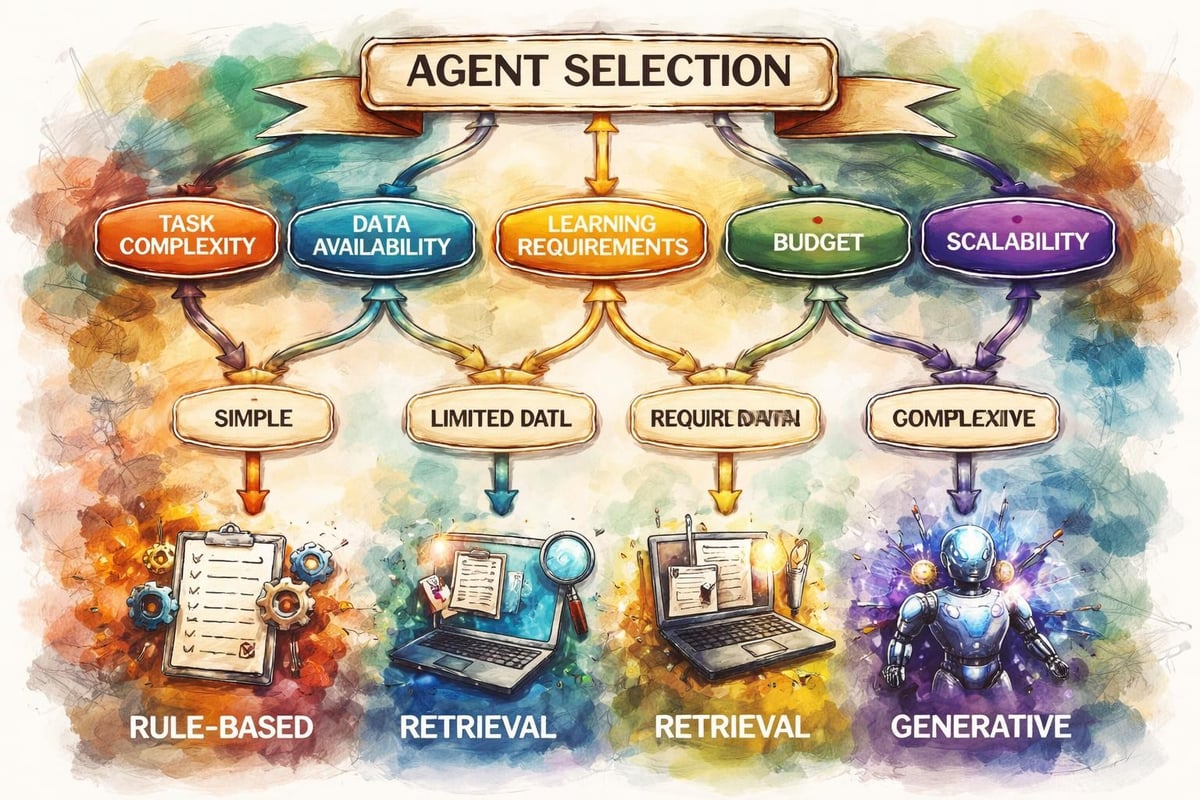
- Assess Task Complexity: Match agent sophistication to problem requirements
- Evaluate Data Availability: Ensure sufficient information exists to support agent decisions
- Consider Learning Requirements: Determine whether static rules suffice or adaptive behaviour is necessary
- Review Budget Constraints: Balance capability requirements against development costs
- Plan for Scalability: Select architectures that accommodate future expansion
Measuring Return on Investment
Quantifying intelligent agent value requires tracking multiple metrics across financial and operational dimensions. Organisations should establish baseline measurements before deployment to accurately assess impact.
Financial Metrics
- Labour Cost Reduction: Calculate salary savings from automated tasks
- Error Prevention Savings: Quantify costs avoided through improved accuracy
- Revenue Impact: Measure sales increases from enhanced customer service
- Efficiency Gains: Value time savings across business processes
- Operational Cost Decreases: Track reductions in resource consumption
A Sydney-based professional services firm implemented intelligent agents for document processing in early 2025. They measured 19 hours of daily staff time saved, translating to AUD 287,000 in annual labour cost reduction. Error rates dropped from 4.2% to 0.7%, preventing an estimated AUD 63,000 in rework costs.
Operational Metrics
Processing speed improvements represent another significant benefit. Agents typically complete tasks 5-10 times faster than human staff for routine operations. This acceleration enables businesses to handle increased volume without proportional staff expansion.
According to statistics from organisations deploying intelligent agents in 2024-2025, the median ROI period is 8.3 months. Companies with well-defined requirements and proper implementation frameworks achieve positive returns within 5-6 months.
Advanced Capabilities Through Learning Systems
Modern intelligent agents incorporate machine learning to improve performance without explicit programming. These adaptive systems analyse outcomes and adjust behaviour to optimise results.
Reinforcement Learning Applications
- Define Reward Functions: Establish metrics that guide agent learning
- Create Safe Exploration Environments: Allow agents to test strategies without business risk
- Implement Feedback Loops: Ensure agents receive clear signals about action quality
- Monitor Learning Progress: Track performance improvements over time
- Set Performance Boundaries: Define acceptable behaviour ranges
- Intervene When Necessary: Override agent decisions that violate business rules
The services provided by Synap AI include machine learning integration for intelligent agents. These capabilities enable continuous improvement aligned with changing business conditions.
Regulatory Compliance and Governance
Australian businesses deploying intelligent agents must address compliance requirements across multiple domains. Privacy legislation, industry-specific regulations, and internal governance frameworks all constrain agent behaviour.
Documentation requirements extend beyond traditional software systems. Organisations must maintain records explaining agent decision logic, particularly for actions affecting customers or involving sensitive data.
Governance Framework Elements
- Decision Transparency: Implement explainability mechanisms for agent actions
- Human Oversight: Define situations requiring human approval
- Audit Capabilities: Enable comprehensive review of agent activities
- Privacy Protection: Ensure agents handle personal information appropriately
- Accountability Structures: Establish responsibility for agent outcomes
- Regular Compliance Reviews: Schedule periodic assessments of agent behaviour against regulations
Research on intelligent information agents emphasises the importance of coordination mechanisms. These ensure multiple agents work harmoniously whilst maintaining compliance standards.
Future Developments in Agent Technology
The intelligent agent landscape continues evolving rapidly. Emerging capabilities promise even greater business value as technology matures.
Natural language processing improvements enable more sophisticated communication between agents and humans. Agents increasingly understand context, nuance, and intent rather than just keywords.
Multi-agent systems represent another frontier. These networks of specialised agents collaborate to solve complex problems beyond individual agent capabilities. A logistics optimisation system might deploy separate agents for route planning, vehicle maintenance scheduling, and customer communication that coordinate activities.
Emerging Trends
- Emotional Intelligence: Agents detecting and responding to human emotional states
- Predictive Capabilities: Advanced forecasting integrated into decision-making
- Cross-Platform Operation: Agents working seamlessly across diverse systems
- Enhanced Autonomy: Reduced human oversight requirements for complex decisions
- Collaborative Networks: Multiple agents working together toward shared objectives
Industry projections suggest that by 2028, 89% of large Australian enterprises will deploy some form of intelligent agent technology. The question shifts from whether to adopt agents to how quickly organisations can implement them effectively.
The product explorer at Synap AI showcases current capabilities and roadmap features for intelligent agent platforms. These tools enable businesses to evaluate options aligned with their specific requirements.
Intelligent agents represent transformative technology that enables Australian businesses to automate complex processes whilst maintaining quality and compliance standards. Implementation success depends on systematic planning, appropriate technology selection, and ongoing performance optimisation. If you're considering intelligent agent deployment for your organisation, Synap AI provides comprehensive consulting and platform development services tailored to Victorian businesses, helping you navigate the technical and strategic challenges of autonomous system implementation.