
The landscape of sales has fundamentally shifted in recent years. What once relied on intuition and relationship-building now combines human expertise with machine intelligence. Sales teams across Australia are discovering that ai in sales isn't replacing their roles but amplifying their effectiveness. According to recent data, 87% of sales organisations report that AI tools have improved their team's productivity by at least 30%. This transformation represents more than just efficiency gains. It's reshaping how businesses identify prospects, nurture relationships, and close deals in an increasingly competitive market.
Understanding Modern AI Sales Applications
The practical applications of AI in sales extend far beyond simple automation. Modern systems analyse vast datasets to identify patterns humans cannot detect. They process customer interactions, purchase histories, and market signals simultaneously. The result is actionable intelligence that guides every stage of the sales cycle.
Lead Scoring and Qualification
Traditional lead scoring relied on manual point systems and gut feelings. AI-based systems analyse hundreds of data points in real time. These systems consider website behaviour, email engagement, social media activity, and demographic information. The technology assigns probability scores indicating conversion likelihood.
- Machine learning models train on historical conversion data
- Algorithms identify characteristics of successful deals
- Systems automatically prioritise leads based on engagement patterns
- Sales teams receive real-time notifications for high-value opportunities
- Continuous learning improves accuracy as more data becomes available
Companies implementing AI lead scoring report a 50% reduction in time spent on unqualified prospects. This efficiency allows sales professionals to focus energy where it matters most.

Predictive Analytics and Forecasting
Revenue forecasting has always challenged sales leadership. AI in sales transforms this process through predictive analytics. Advanced AI systems analyse historical performance, market trends, and external factors simultaneously. They generate forecasts with accuracy levels exceeding 90%.
| Traditional Forecasting | AI-Powered Forecasting |
|---|---|
| Based on past performance | Incorporates real-time market signals |
| Manual pipeline reviews | Automated opportunity analysis |
| 60-70% accuracy typical | 85-95% accuracy achievable |
| Monthly or quarterly updates | Continuous, real-time updates |
| Limited data sources | Integrates multiple data streams |
The shift to predictive analytics enables proactive decision-making. Sales managers adjust strategies before problems emerge. Resource allocation becomes data-driven rather than reactive.
Implementing AI Sales Tools Successfully
Successful implementation requires more than purchasing software. Organisations must approach ai in sales strategically. The businesses achieving the best results follow structured deployment processes. They combine technology with change management and training programmes.
Step-by-Step Implementation Framework
Phase One: Assessment and Planning
- Evaluate current sales processes and identify bottlenecks
- Define specific objectives and success metrics
- Assess data quality and availability across systems
- Identify stakeholders and establish governance structures
- Create realistic timelines with milestone checkpoints
Many Australian businesses start with a readiness assessment to understand their AI maturity level. This baseline evaluation prevents costly mistakes during deployment.
Phase Two: Platform Selection and Integration
- Research vendors aligned with your industry requirements
- Request demonstrations using your actual data samples
- Evaluate integration capabilities with existing CRM systems
- Assess scalability for future growth requirements
- Review security protocols and data privacy compliance
The integration phase determines long-term success rates. Systems that don't communicate create data silos. Choose platforms offering robust API connections and native integrations.
Phase Three: Training and Adoption
- Develop role-specific training programmes for sales teams
- Create documentation covering common scenarios and workflows
- Establish feedback channels for continuous improvement
- Monitor adoption metrics and address resistance points
- Celebrate early wins to build momentum across teams
According to recent industry research, companies with structured training programmes achieve 3x higher adoption rates. The technology only delivers value when teams actively use it.
Real-World AI Sales Automation Examples
Theory matters less than practical application. Several Australian organisations have transformed their sales operations through strategic AI deployment. These examples demonstrate tangible benefits across different industries.
Case Study: B2B Technology Services
A Melbourne-based software company struggled with inconsistent pipeline management. Their sales team of 15 people managed over 400 active opportunities. Manual follow-ups fell through cracks regularly. Lost deals often resulted from timing failures rather than product fit.
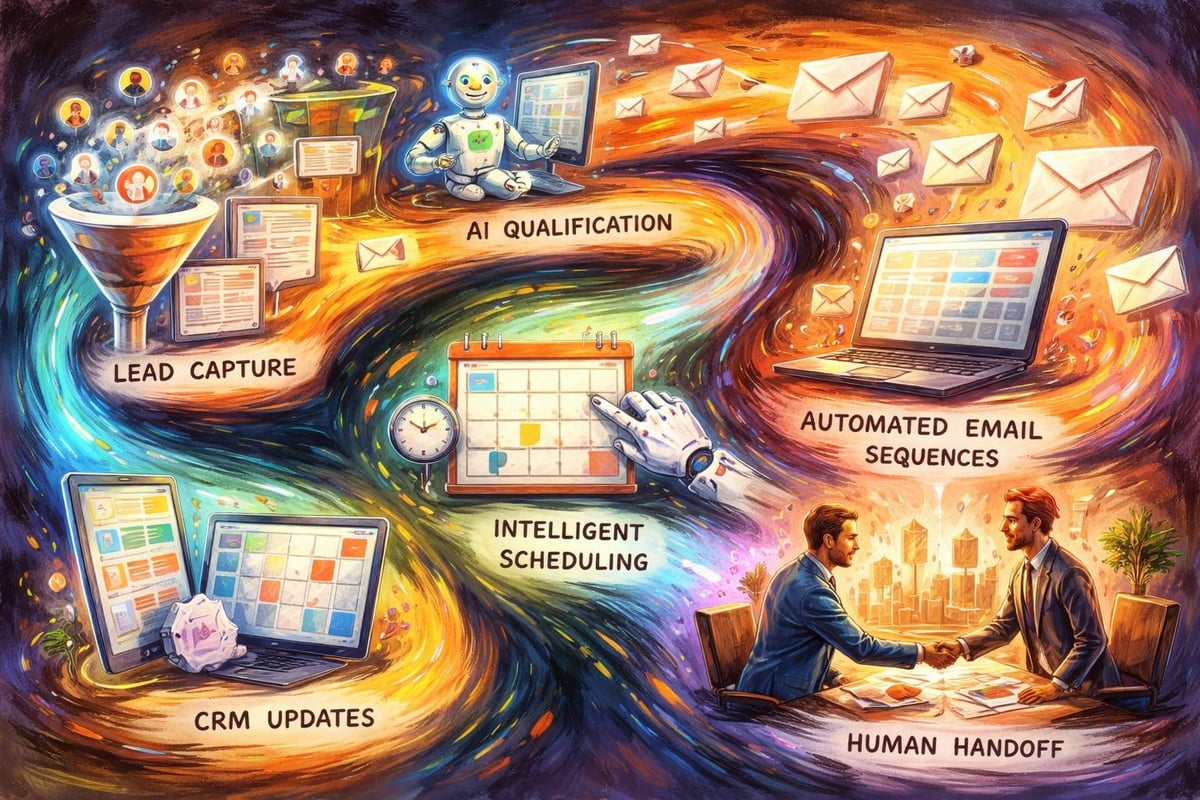
The company implemented AI-powered sales automation through Synap AI's consulting services. The solution included automated email sequencing, intelligent meeting scheduling, and predictive lead scoring.
Results after six months:
- Response time to new leads decreased from 4 hours to 12 minutes
- Sales cycle length reduced by 23% on average
- Win rate improved from 18% to 29%
- Revenue per sales representative increased by 41%
- Customer satisfaction scores rose due to faster engagement
The automation handled routine tasks while humans focused on relationship building. This division of labour optimised both efficiency and effectiveness.
Financial Services Lead Generation
A Sydney financial advisory firm faced challenges identifying qualified prospects. Their market included high-net-worth individuals and business owners. Traditional advertising generated volume but lacked quality. The cost per qualified lead exceeded $800.
They deployed AI systems analysing public data, social signals, and wealth indicators. The technology identified prospects matching their ideal customer profile. It also predicted optimal engagement timing based on life events and market conditions.
The transformation delivered measurable improvements:
- Cost per qualified lead dropped to $220
- Appointment booking rates increased from 3% to 17%
- Average deal size grew by 35% through better targeting
- Sales team size remained constant while revenue doubled
- Customer lifetime value increased due to better fit
This example shows how ai in sales improves both efficiency metrics and revenue quality. Better targeting creates sustainable growth rather than just volume increases.
Conversational AI and Customer Engagement
Modern sales conversations extend beyond phone calls and meetings. Customers expect instant responses across multiple channels. Human teams cannot maintain 24/7 availability. AI-powered conversational tools bridge this gap without sacrificing personalisation.
Intelligent Chatbots and Virtual Assistants
Today's AI chatbots differ dramatically from early automated response systems. They understand context, maintain conversation history, and learn from interactions. Natural language processing enables human-like conversations.
- Chatbots qualify leads through conversational discovery questions
- Systems route complex queries to appropriate team members
- Virtual assistants schedule meetings by accessing calendar availability
- AI analyses sentiment and escalates frustrated customers immediately
- Automated follow-ups maintain engagement between human interactions
Businesses implementing conversational AI report 60% reduction in initial response times. Customer satisfaction improves when queries receive immediate acknowledgment.
Email Intelligence and Automation
Email remains central to B2B sales despite newer communication channels. AI enhances email effectiveness through multiple mechanisms. Systems analyse which subject lines generate highest open rates. They identify optimal sending times based on recipient behaviour patterns.
| Email Function | AI Enhancement | Impact |
|---|---|---|
| Subject lines | A/B testing at scale | 25-40% open rate improvement |
| Send timing | Behavioural analysis | 15-30% engagement increase |
| Content personalisation | Dynamic insertion | 20-35% response rate lift |
| Follow-up sequences | Engagement-based triggers | 40-60% meeting booking improvement |
Smart email systems also detect buying signals in responses. When prospects mention budget availability or timeline urgency, AI flags these opportunities. Sales representatives can prioritise these high-intent conversations.
Data-Driven Personalisation at Scale
Generic sales pitches no longer resonate with informed buyers. Customers expect personalised experiences reflecting their specific needs. AI in sales enables this personalisation without exponentially increasing workload.
Dynamic Content Generation
AI systems create customised proposals, presentations, and follow-up materials. They pull relevant case studies based on prospect industry. They adjust messaging based on decision-maker role. The technology maintains brand consistency while varying content details.
- Systems analyse prospect company data and industry trends
- AI selects relevant product features matching identified needs
- Algorithms generate customised ROI calculations using prospect data
- Tools create presentation decks incorporating company-specific examples
- Automated systems update materials as prospect information changes
This automation allows sales teams to deliver enterprise-level personalisation to every prospect. The quality of small-account interactions matches major deal attention.

Account-Based Marketing Integration
Account-based strategies require coordinated efforts across marketing and sales teams. AI platforms unify these activities through shared intelligence. Marketing automation and sales engagement tools share prospect behaviour data. This integration eliminates information gaps between departments.
Sales representatives see exactly which content prospects consumed. They understand which topics generated most engagement. Marketing teams receive feedback on which accounts enter active sales conversations. This closed loop improves targeting continuously.
Performance Analytics and Continuous Improvement
Implementing ai in sales creates massive data volumes. The challenge shifts from data scarcity to insight extraction. Modern analytics platforms transform this data into actionable intelligence. Sales leaders gain visibility into team performance, process bottlenecks, and improvement opportunities.
Conversation Intelligence
AI-powered conversation analysis tools record and transcribe sales calls. They identify successful talk patterns and common objection types. The technology highlights moments where deals stall or accelerate. This intelligence informs coaching programmes and process refinement.
- Systems transcribe calls and meetings automatically
- Natural language processing identifies key topics and sentiment shifts
- Algorithms compare successful versus unsuccessful conversation patterns
- Platforms generate coaching recommendations for individual representatives
- Aggregate data reveals process improvements benefiting entire teams
Companies using conversation intelligence report 23% improvement in win rates. The technology scales coaching beyond what sales managers can deliver manually.
Pipeline Health Monitoring
Traditional pipeline reviews rely on sales representative assessments. These subjective evaluations often prove optimistic. AI systems analyse objective signals indicating deal health. They consider engagement frequency, stakeholder involvement, and progress velocity.
Real-time dashboards alert managers when opportunities stall. Automated systems suggest intervention strategies based on similar historical deals. This proactive approach prevents deal losses from inattention.
Overcoming Implementation Challenges
Despite clear benefits, ai in sales implementation faces common obstacles. Understanding these challenges enables proactive mitigation. The most successful deployments address human factors alongside technical requirements.
Data Quality and Integration Issues
AI systems require clean, structured data for optimal performance. Many organisations discover data quality problems during implementation. CRM records contain duplicates, incomplete fields, and outdated information. Legacy systems lack integration capabilities.
Addressing these challenges requires dedicated effort:
- Conduct comprehensive data audits before system deployment
- Establish data governance policies and ownership structures
- Implement validation rules preventing poor quality entries
- Allocate resources for data cleansing and enrichment
- Create integration roadmaps addressing system compatibility
Organisations investing in data quality achieve 2-3x better AI performance. The foundation determines everything built upon it.
Change Management and Adoption Resistance
Sales professionals often view AI tools with scepticism. Concerns about job security and process changes create resistance. Successful implementations address these human factors directly.
Effective change management strategies include:
- Communicate how AI augments rather than replaces human skills
- Involve sales team members in tool selection and testing
- Start with pilot programmes demonstrating clear value
- Share success stories from early adopters within the organisation
- Provide ongoing support addressing concerns as they emerge
Industry research shows that companies with structured change programmes achieve 4x higher ROI from AI investments. Technology deployment succeeds or fails based on human acceptance.
Building Custom AI Sales Solutions
Off-the-shelf platforms serve many organisations well. However, unique business requirements sometimes demand custom development. Australian companies with specialised sales processes benefit from tailored solutions. Custom AI applications address specific workflow needs and competitive advantages.
When to Consider Custom Development
Standard platforms excel at common sales scenarios. Custom solutions make sense when:
- Your sales process includes unique stages not supported by commercial tools
- Proprietary data sources require specialised integration approaches
- Competitive differentiation depends on unique AI capabilities
- Regulatory requirements demand specific security or privacy controls
- Existing technology investments require deep integration capabilities
Working with AI consultants in Melbourne or Sydney provides access to specialised expertise. These professionals understand Australian business contexts and regulatory environments.
Development Process for Custom Solutions
Building custom AI sales tools follows structured methodologies. Rushing development creates technical debt and maintenance challenges. Proper planning ensures solutions scale as businesses grow.
- Define precise requirements through stakeholder workshops and process mapping
- Develop proof-of-concept addressing highest-value use cases first
- Test with small user groups collecting detailed feedback
- Iterate based on real-world usage patterns and pain points
- Scale deployment gradually while monitoring performance metrics
- Establish maintenance protocols for ongoing optimisation and updates
Custom development timelines typically span 3-6 months for initial deployments. The investment delivers competitive advantages difficult for competitors to replicate quickly.
Measuring ROI from AI Sales Investments
Executive teams demand clear ROI justification for AI initiatives. Measuring impact requires both quantitative metrics and qualitative assessments. Comprehensive measurement frameworks track multiple dimensions simultaneously.
Key Performance Indicators
Different stakeholders care about different metrics. Sales representatives focus on productivity gains. Leadership evaluates revenue impact. Finance teams assess cost efficiency. Comprehensive dashboards address all perspectives.
| Metric Category | Example KPIs | Typical Improvement Range |
|---|---|---|
| Efficiency | Time per deal, administrative hours | 25-40% reduction |
| Effectiveness | Win rate, deal size | 15-30% increase |
| Revenue | Sales per representative, pipeline value | 20-50% growth |
| Customer Experience | Response time, satisfaction scores | 30-60% improvement |
Research from leading platforms indicates that mature AI implementations deliver 35-45% productivity improvements. These gains compound over time as systems learn and improve.
Calculating Total Cost of Ownership
ROI calculations must include all implementation costs. Licensing fees represent only one component. Training, integration, and change management require significant investment. Ongoing maintenance and optimisation demand dedicated resources.
Complete cost analysis includes:
- Software licensing or development costs
- Integration expenses connecting existing systems
- Training programme development and delivery
- Change management support and communications
- Ongoing maintenance, updates, and optimisation
- Internal resource allocation during implementation
Most organisations achieve positive ROI within 8-14 months. The timeline varies based on implementation complexity and adoption rates.
Future Trends Shaping AI Sales Technology
The ai in sales landscape continues evolving rapidly. Understanding emerging trends helps organisations prepare for coming changes. Strategic technology investments consider both current needs and future capabilities.
Autonomous AI Agents
Current AI tools require human oversight and decision-making. Emerging autonomous agents handle complete workflows independently. They manage entire prospect relationships from initial contact through closing. Human sales professionals focus exclusively on complex negotiations and strategic accounts.
These systems will transform sales organisational structures. Teams will shrink while revenue per employee increases dramatically. The technology enables small businesses to compete with enterprise sales forces.
Emotion AI and Advanced Personalisation
Next-generation systems analyse vocal tone, facial expressions, and language patterns. They detect emotional states and adjust approaches accordingly. This emotional intelligence creates deeper connections than traditional personalisation.
Applications include:
- Real-time coaching during live sales conversations
- Automated adjustment of communication style matching prospect preferences
- Identification of subtle buying signals in verbal and non-verbal cues
- Prediction of objections before prospects voice them explicitly
- Dynamic presentation pacing based on engagement indicators
Early implementations show 40% improvement in rapport-building effectiveness. The technology bridges gaps between virtual and in-person interactions.
Predictive Relationship Management
Future AI systems will predict relationship deterioration before customers express dissatisfaction. They'll identify upsell opportunities based on usage patterns and business growth signals. Proactive relationship management prevents churn and maximises lifetime value.
These capabilities require integration across sales, customer success, and product usage data. Organisations investing in unified data platforms will gain competitive advantages.
Getting Started with AI Sales Transformation
Understanding ai in sales provides little value without action. Organisations must develop concrete implementation plans. Starting small and scaling based on results minimises risk while building momentum.
Immediate Action Steps
- Audit current sales processes identifying repetitive manual tasks suitable for automation
- Assess data quality and integration capabilities across existing technology stack
- Research AI platforms aligned with your industry and sales complexity
- Engage with specialists to understand implementation requirements and timelines
- Develop business case including costs, benefits, and risk mitigation strategies
- Secure executive sponsorship ensuring adequate resource allocation
- Launch pilot programme with clearly defined success metrics
Many Australian businesses begin their AI journey through professional guidance. Synap AI's services help organisations navigate technology selection and implementation complexity. Expert support accelerates time-to-value while reducing costly mistakes.
For teams ready to explore AI sales opportunities, booking a consultation with experienced AI technologists provides personalised guidance. These sessions clarify options specific to your business context and growth objectives.
AI in sales represents a fundamental shift in how Australian businesses generate revenue and build customer relationships. The technology delivers measurable improvements in efficiency, effectiveness, and customer experience when implemented strategically. Success requires combining the right tools with proper training, change management, and ongoing optimisation. Synap AI specialises in helping Australian businesses navigate this transformation through private consulting and custom platform development tailored to your unique requirements.