
Australian businesses face unprecedented pressure to do more with less. The convergence of automation and ai has created opportunities that seemed impossible just five years ago. Companies across Melbourne, Sydney, and regional Victoria now leverage intelligent systems to streamline operations, reduce costs, and unlock new revenue streams. This transformation goes beyond simple task automation. It represents a fundamental shift in how organisations operate and compete in 2026.
Understanding the Core Components of Automation and AI
Automation handles repetitive tasks without human intervention. Artificial intelligence adds learning and decision-making capabilities to these processes. Together, they create systems that execute tasks and improve performance over time.
Robotic process automation forms the foundation for many business automation initiatives. RPA bots handle data entry, invoice processing, and customer onboarding workflows. These systems operate 24/7 without breaks or errors.
Modern automation and ai platforms integrate multiple technologies:
- Machine learning algorithms that identify patterns in business data
- Natural language processing for customer communication
- Computer vision for document analysis and quality control
- Predictive analytics that forecast demand and resource needs
- Workflow orchestration connecting multiple systems
The Artificial Intelligence Index Report 2025 reveals that 72% of enterprises now deploy AI in at least one business function. This represents a 35% increase since 2023.
Distinguishing Between Basic Automation and AI-Powered Systems
Basic automation follows predetermined rules. If X happens, do Y. These systems never deviate from programmed instructions.
AI-powered automation adapts based on outcomes. The system learns which approaches work best. It adjusts strategies without manual reprogramming.
Consider email classification. Rule-based automation moves messages containing specific keywords to folders. AI classification learns from user behaviour, understanding context and intent even when keywords vary.

Real-World Applications Across Australian Industries
Manufacturing companies use automation and ai to optimize production schedules. Sensors monitor equipment health, predicting failures before they occur. This preventive approach reduces downtime by up to 40%.
A Melbourne-based food manufacturer implemented predictive maintenance through Synap AI consultation. The system analyses vibration data from packaging machinery. It identifies subtle patterns indicating bearing wear or motor issues. Maintenance teams receive alerts three weeks before failures occur. Annual maintenance costs dropped 28% in the first year.
Financial services leverage intelligent document processing. Traditional loan applications required manual review of bank statements, tax returns, and identity documents. AI-powered systems extract relevant data, verify authenticity, and assess risk in seconds.
Healthcare Administration Transformation
Healthcare providers struggle with appointment scheduling, billing, and patient communication. Automation and ai addresses these challenges through integrated workflows.
The implementation process follows these steps:
- Map existing patient journey touchpoints and pain points
- Identify repetitive administrative tasks consuming staff time
- Deploy AI phone receptionist for appointment scheduling and inquiries
- Integrate billing automation with patient management systems
- Implement follow-up communication workflows for appointment reminders
- Monitor system performance and patient satisfaction metrics
- Refine AI models based on interaction outcomes
A Sydney medical practice reduced administrative overhead by 45% through this approach. The AI receptionist handles 200+ daily calls. Human staff focus on complex patient needs and clinical support.
Building Your Automation and AI Strategy
Successful implementation requires strategic planning, not random tool adoption. Many organisations fail because they automate broken processes rather than optimising first.
Start with a comprehensive readiness assessment examining current workflows, data quality, and team capabilities. This evaluation identifies high-impact opportunities aligned with business objectives.
| Assessment Area | Key Questions | Success Indicators |
|---|---|---|
| Process Maturity | Are workflows documented and standardised? | 80%+ process consistency |
| Data Quality | Is data accurate, complete, and accessible? | <5% error rate in core systems |
| Technical Infrastructure | Can current systems integrate with AI platforms? | API availability, cloud readiness |
| Team Skills | Does staff understand automation principles? | 60%+ digital literacy score |
| Change Management | Is leadership committed to transformation? | Executive sponsorship secured |
Your strategy should prioritise quick wins that build momentum. Accounts payable automation often delivers immediate ROI. Invoice processing that took days completes in hours.
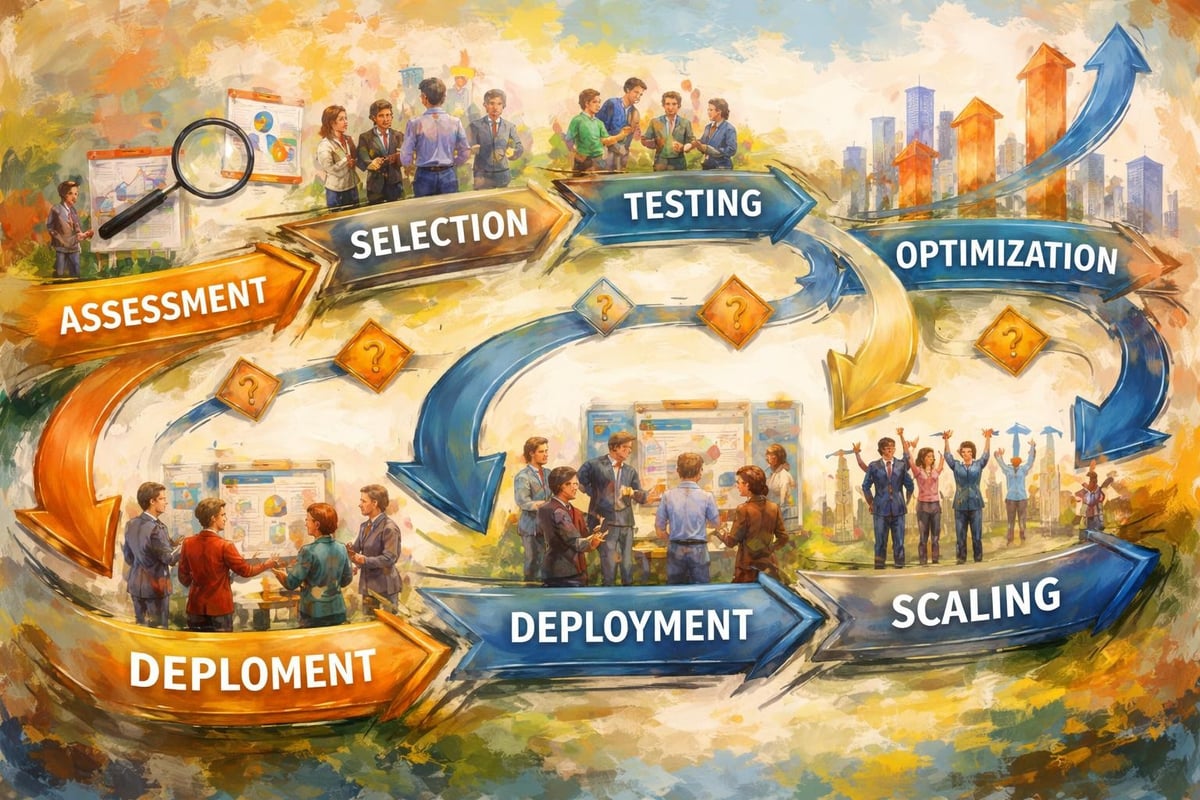
Step-by-Step Implementation Framework
- Select pilot processes with clear metrics and contained scope
- Document current state including time spent, error rates, and costs
- Choose appropriate technology balancing capabilities with complexity
- Build proof of concept testing core functionality with real data
- Train AI models using historical examples and edge cases
- Deploy to limited user group gathering feedback and refinement needs
- Measure performance against baseline metrics established in step two
- Scale gradually expanding to additional processes and departments
- Establish governance defining oversight, ethics, and quality standards
- Create continuous improvement cycle updating models as business evolves
This methodical approach minimises risk while maximising learning. Synap AI consulting services guide Australian businesses through each phase with localised expertise.
Overcoming Common Implementation Challenges
Resistance to change represents the most significant barrier. Employees fear job displacement when automation discussions begin. Martin Ford's research on automation's economic impact suggests this concern requires thoughtful management.
Transparent communication addresses these fears. Automation and ai eliminate tedious tasks, not positions. Staff transition to higher-value work requiring human judgment and creativity.
A Brisbane logistics company faced significant pushback when introducing route optimization AI. Drivers worried about autonomy loss. Management positioned the system as a copilot, not a replacement. Drivers retained final routing decisions while receiving AI recommendations. Fuel costs decreased 18% as drivers learned from AI suggestions.
Data Privacy and Security Considerations
Australian businesses must navigate privacy regulations when implementing automation and ai. Personal information processing requires careful governance frameworks.
Key compliance steps include:
- Conduct privacy impact assessment for AI applications
- Implement data minimisation collecting only necessary information
- Establish clear retention policies and automated deletion workflows
- Deploy encryption for data in transit and at rest
- Create audit trails documenting AI decision-making processes
- Train staff on privacy obligations and breach response
- Review vendor agreements ensuring third-party compliance
The Association for Advancing Automation provides industry standards supporting responsible implementation. These guidelines balance innovation with ethical considerations.
Measuring ROI and Business Impact
Quantifying automation and ai benefits requires comprehensive metrics beyond simple cost savings. Consider productivity gains, quality improvements, customer satisfaction, and employee engagement.
Traditional ROI calculations focus on labour cost reduction. A process taking 10 hours weekly becomes automated. Annual savings equal hourly rate multiplied by 520 hours. This narrow view misses significant value.
Comprehensive measurement frameworks track:
- Processing speed improvements (cycle time reduction)
- Error rate decreases and rework elimination
- Capacity expansion without proportional headcount increases
- Customer experience enhancements reflected in NPS scores
- Employee satisfaction as tedious work decreases
- Revenue opportunities enabled by faster insights
- Compliance improvements reducing regulatory risk
A Melbourne accounting firm implemented AI content generation for client communication. Direct time savings totalled 15 hours weekly. However, consistent communication improved client retention by 12%. This retention impact generated 8x more value than labour savings.
Avoiding Automation Bias in Decision Systems
Automation bias describes the tendency to favour automated suggestions over contradictory information. This cognitive shortcut creates risk when AI systems operate without appropriate oversight.
Financial approval systems demonstrate this challenge. AI might approve a transaction that seems normal based on historical patterns. However, a human reviewer might notice contextual red flags the AI missed.
Effective governance balances efficiency with human judgment:
- Define decision categories requiring human review regardless of AI confidence
- Implement random sampling audits of automated decisions
- Create escalation pathways when AI and human assessments conflict
- Train staff to question AI recommendations constructively
- Document cases where human override proved correct or incorrect
- Update AI models incorporating these learnings
- Maintain transparency about AI limitations and failure modes
This approach leverages automation and ai efficiency while preserving critical thinking. According to research on AI authority, balanced human-AI collaboration outperforms either approach alone.

Industry-Specific Automation Strategies
Professional services firms leverage automation and ai for client management and service delivery. Document review, research synthesis, and preliminary analysis shift to AI systems. Consultants focus on strategic recommendations and client relationships.
Legal practices use AI for contract analysis and precedent research. A Melbourne law firm reduced document review time by 60% through intelligent classification. The system flags clauses requiring attorney attention while auto-processing standard terms.
Retail operations benefit from inventory optimization and demand forecasting. AI analyses sales patterns, weather data, local events, and economic indicators. Stock levels adjust automatically preventing oversupply and stockouts.
Manufacturing Excellence Through Predictive Systems
Manufacturing represents one of automation and ai's most mature applications. The technology extends beyond factory floor robotics into supply chain coordination and quality management.
Implementation roadmap for manufacturers:
- Install IoT sensors on critical production equipment
- Establish data infrastructure collecting and storing sensor readings
- Develop baseline performance models for normal operation
- Train machine learning algorithms recognising anomaly patterns
- Create maintenance scheduling system integrating predictions
- Deploy quality vision systems inspecting products during production
- Implement supply chain forecasting coordinating materials with demand
- Connect production planning with sales forecasting systems
- Establish digital twin models simulating production scenarios
- Create continuous feedback loops improving models over time
A Victorian furniture manufacturer achieved 35% productivity gains following this approach. Machine downtime decreased from 12% to 4% of production time. Quality defects dropped by 42% through real-time vision inspection.
The Future Landscape of Business Automation
Generative AI introduces new automation possibilities beyond traditional process automation. Content creation, software development, and strategic analysis benefit from these advanced capabilities.
Google's AI-driven search updates demonstrate how automation and ai reshape information discovery. Businesses must adapt content strategies as AI synthesises information rather than simply ranking pages.
The convergence of automation technologies creates compound benefits. When robotic process automation connects with AI decision-making and natural language interfaces, entirely new business models emerge.
Small businesses gain enterprise capabilities through accessible AI platforms. A two-person consulting firm accesses the same analytical tools as multinational corporations. This democratisation levels competitive playing fields across industries.
Preparing Your Organisation for Continuous Evolution
Technology advancement accelerates annually. Systems deployed today require updates within months. Building adaptable foundations proves more valuable than perfect initial implementations.
Strategic preparation involves:
- Adopt modular architectures allowing component replacement without full rebuilds
- Invest in staff AI literacy through ongoing training programs
- Establish innovation budgets for experimentation with emerging technologies
- Create cross-functional teams bridging technical and business expertise
- Partner with AI consultants in Melbourne who understand local market dynamics
- Monitor industry developments through research and peer networks
- Conduct quarterly reviews reassessing priorities and opportunities
This proactive stance positions organisations to capitalise on advances rather than scramble to catch up. Companies treating automation and ai as ongoing journeys outperform those viewing it as one-time projects.
Ethical Considerations and Responsible Implementation
The power of automation and ai carries corresponding responsibilities. Systems making decisions affecting people require ethical frameworks ensuring fairness and transparency.
Bias in training data creates biased AI outputs. A hiring automation system trained on historical data might perpetuate past discrimination. Diverse training sets and regular auditing mitigate these risks.
Current AI development critiques highlight the importance of realistic expectations. AI solves specific problems exceptionally well. It doesn't replace human judgment in complex situations requiring empathy and contextual understanding.
Responsible automation practices include:
- Conduct fairness audits examining outcomes across demographic groups
- Provide explanation mechanisms showing why AI made specific decisions
- Establish appeal processes when individuals disagree with automated decisions
- Limit automated systems to appropriate use cases matching their capabilities
- Maintain human accountability for AI system outcomes
- Document training data sources and potential bias considerations
- Create ethics review boards evaluating high-stakes applications
- Publish transparency reports detailing AI use and performance
These safeguards build trust while capturing automation benefits. Organisations demonstrating responsible AI practices gain competitive advantages through enhanced reputation and reduced regulatory risk.
Integration with Existing Business Systems
Legacy infrastructure poses significant challenges for automation and ai adoption. Many Australian businesses run critical processes on systems decades old. Complete replacement proves cost-prohibitive and risky.
Modern integration approaches connect new AI capabilities with existing systems through APIs and middleware. This incremental modernisation delivers value without disrupting operations.
A Perth mining company maintained its core ERP system while adding AI forecasting for equipment maintenance. The integration extracted sensor data, processed predictions, and created maintenance orders in the legacy system. This approach cost 70% less than ERP replacement while delivering comparable benefits.
Building Scalable Integration Architectures
- Map data flows documenting how information moves between systems currently
- Identify integration points where AI can enhance without replacing infrastructure
- Establish data governance ensuring consistent definitions and quality standards
- Deploy integration platform providing connectors for various system types
- Create API layers abstracting legacy system complexity from AI applications
- Implement monitoring tracking integration health and performance
- Document dependencies understanding which systems rely on integration points
- Plan redundancy ensuring business continuity if integrations fail
- Version control managing changes without breaking existing connections
- Test thoroughly validating data accuracy across integrated systems
Synap AI's enterprise solutions specialise in these complex integration scenarios. Our team understands the realities of Australian business technology landscapes.
Taking Action on Your Automation Journey
Theory transforms into value through implementation. Every business regardless of size or industry can benefit from automation and ai. The key lies in starting strategically and scaling systematically.
Begin with OpenClaw for document processing if your team spends hours extracting data from PDFs and images. This immediate pain point solution demonstrates ROI quickly while building organisational confidence.
Progress to comprehensive workflow automation addressing end-to-end processes. Customer onboarding, employee offboarding, procurement, and reporting all contain automation opportunities. Each improvement compounds creating exponential efficiency gains.
Advanced implementations leverage predictive analytics and autonomous decision systems. These sophisticated applications require strong data foundations and clear governance frameworks. Partner with specialists who understand both technology and business context.
The automation and ai landscape evolves rapidly. What seemed cutting-edge last year becomes standard practice today. Organisations maintaining learning mindsets and experimental cultures thrive in this environment. Those waiting for perfect stability miss opportunities competitors capture.
Australian businesses possess unique advantages in this transformation. Strong regulatory frameworks provide clear guardrails. Educated workforces adapt quickly to new tools. Geographic position enables learning from Asian and Western markets simultaneously.
Automation and ai represents a fundamental business capability in 2026, not optional technology experimentation. The strategies, frameworks, and examples throughout this article provide actionable pathways for organisations at any maturity level. Whether you're just beginning your automation journey or scaling sophisticated AI systems, strategic implementation delivers measurable results. Synap AI partners with Australian businesses to navigate this transformation with private consulting and platform development tailored to your specific context. Book an online consultation with our AI technologists to discuss how automation and ai can address your unique business challenges and unlock new growth opportunities.