
The convergence of ai and automation has fundamentally altered how Australian businesses operate in 2026. These technologies now drive efficiency, reduce operational costs, and unlock new capabilities previously reserved for large enterprises. Understanding the practical applications and implementation strategies has become essential for organisations seeking competitive advantage.
Understanding the AI and Automation Landscape
The distinction between artificial intelligence and traditional automation matters more than many realise. Robotic process automation handles repetitive, rule-based tasks through predetermined workflows. AI and automation together create intelligent systems that learn, adapt, and improve performance over time.
Traditional automation follows scripts. AI introduces decision-making capabilities that respond to changing conditions.
According to the Artificial Intelligence Index Report 2024, global AI adoption increased by 47% across industries between 2023 and 2024. This acceleration reflects growing confidence in measurable returns on investment.

Current Market Penetration
Australian businesses demonstrate varied adoption rates across sectors:
| Industry | AI Adoption Rate | Primary Application | ROI Timeline |
|---|---|---|---|
| Financial Services | 78% | Risk assessment, fraud detection | 6-12 months |
| Manufacturing | 64% | Quality control, predictive maintenance | 8-14 months |
| Healthcare | 59% | Diagnostic support, patient scheduling | 12-18 months |
| Retail | 71% | Inventory management, personalisation | 4-8 months |
| Professional Services | 52% | Document processing, client insights | 6-10 months |
The data reveals financial services leading implementation. Manufacturing and retail follow closely with strong business cases for ai and automation integration.
Strategic Implementation Framework
Successful deployment requires systematic planning rather than reactive technology purchases. Many Australian organisations fail by starting with tools instead of objectives.
Step-by-Step Implementation Process
Conduct readiness assessment to identify process bottlenecks and automation opportunities across your operation. Document current workflows, time allocations, and error rates before evaluating technology solutions.
Map existing processes with detailed workflow diagrams showing decision points, handoffs, and data dependencies. This visual representation highlights redundancy and inefficiency.
Prioritise use cases based on three criteria: implementation complexity, expected return on investment, and strategic importance to core business functions.
Select appropriate technology stack matching your specific requirements rather than adopting popular solutions. Consider integration capabilities with existing systems.
Run pilot programmes in controlled environments with clearly defined success metrics and feedback mechanisms from end users.
Scale gradually after validating results, refining processes, and training staff on new workflows and system interactions.
Monitor and optimise through continuous performance tracking, identifying improvement opportunities and adapting to changing business needs.
The AI consultant services at Synap AI emphasise this methodical approach. Rushed implementations create technical debt and user resistance.
Real-World Application Example
A Melbourne-based legal practice implemented ai and automation to transform document review processes. Previously, solicitors spent 15 hours weekly on contract analysis and clause extraction.
The firm deployed intelligent document processing through Synap AI's platform. The system now automatically extracts key clauses, identifies non-standard terms, and flags potential issues for human review.
Results after six months showed remarkable improvement:
- Document processing time decreased by 73%
- Error rates in clause identification dropped from 12% to 2%
- Solicitors redirected 11 hours weekly to client consultation
- Client satisfaction scores increased by 28%
- The firm handled 40% more cases without additional staff
This exemplifies practical ai and automation deployment focused on augmentation rather than replacement. The technology enhanced human expertise instead of eliminating it.
Overcoming Implementation Challenges
Understanding automation bias remains critical when deploying intelligent systems. Humans tend to over-rely on automated outputs without appropriate verification. This creates risk when AI confidence scores don't match actual accuracy.
Common Deployment Obstacles
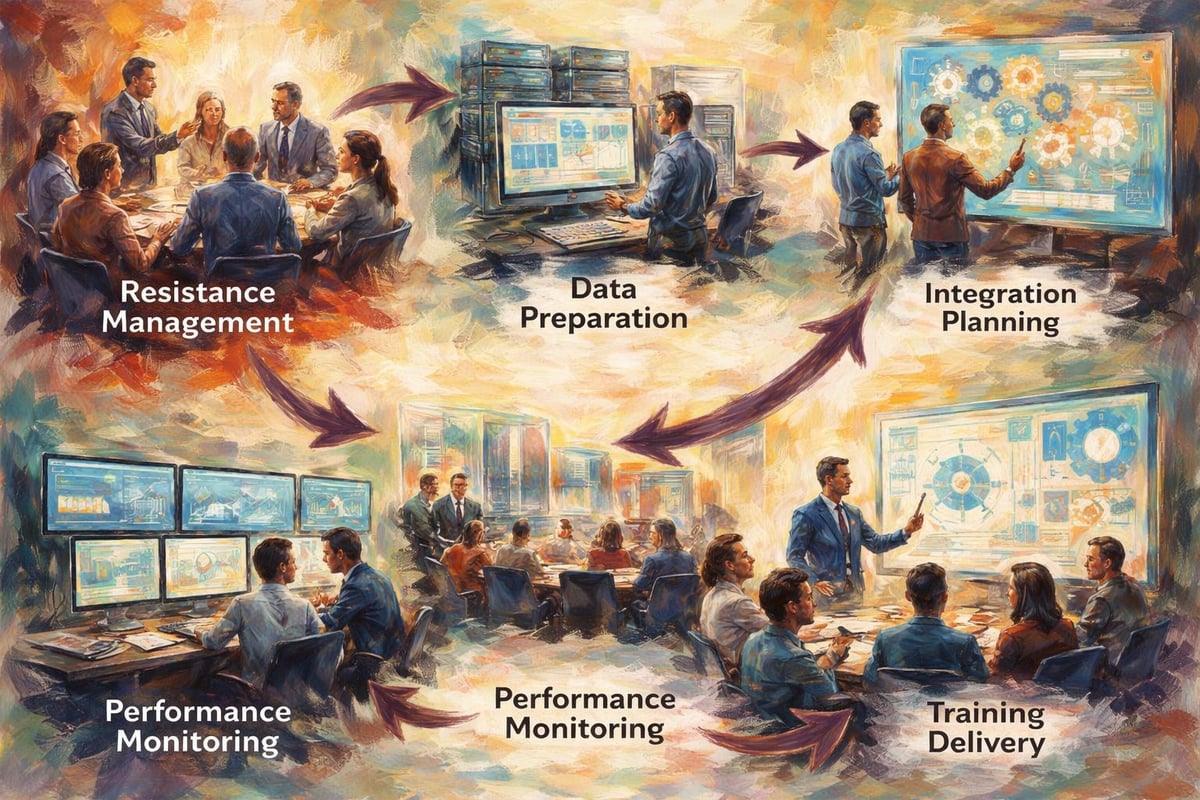
Staff resistance emerges as the primary barrier in 68% of implementations according to 2026 industry research. Employees fear job displacement and struggle with new workflows.
Address this through transparent communication about technology augmentation goals. Demonstrate how ai and automation removes tedious tasks rather than eliminating positions.
Data quality issues undermine 54% of initial deployments. AI systems require clean, structured information to function effectively. Legacy data often contains inconsistencies, duplicates, and formatting errors.
Budget overruns affect 43% of projects when organisations underestimate integration complexity. Connect new systems to existing infrastructure requires careful planning and technical expertise.
Technical Integration Considerations
Modern ai and automation platforms must communicate with existing software ecosystems. API compatibility, data format standardisation, and authentication protocols require thorough evaluation.
Synap AI's platform development approach prioritises seamless integration with popular business systems. This reduces implementation friction and accelerates time to value.
Security considerations grow more complex with automated decision-making systems. Ensure your chosen solution maintains data sovereignty within Australian infrastructure. The integration of AI into life sciences demonstrates how cognitive sovereignty protects sensitive information while leveraging automation benefits.
Sector-Specific Applications
Different industries extract unique value from ai and automation depending on their operational characteristics and regulatory requirements.
Customer Service Transformation
The AI phone receptionist technology demonstrates practical automation in client communication. These systems handle initial enquiries, schedule appointments, and route complex issues to appropriate staff members.
Benefits extend beyond simple call answering:
- 24/7 availability without staffing costs
- Consistent message delivery across all interactions
- Multi-language support for diverse customer bases
- Automatic CRM updates from conversation data
- Reduction in hold times and abandoned calls
Implementation takes approximately 2-3 weeks for most organisations. The system learns from each interaction, improving response accuracy and conversation naturalness over time.
Content Creation and Marketing
Automated journalism pioneered AI-generated content in news organisations. This technology has evolved for business applications including product descriptions, email campaigns, and social media posts.
The AI content machine from Synap AI demonstrates enterprise-grade content automation. Marketing teams maintain brand voice while producing volume previously requiring larger headcount.
Quality control remains essential. Human review ensures factual accuracy, brand alignment, and appropriate tone for target audiences.
Design and Engineering Automation
AI-driven design automation accelerates product development cycles in engineering-focused organisations. These systems optimise designs based on performance criteria, material constraints, and manufacturing capabilities.
Australian manufacturing firms using ai and automation for design report 35% faster time-to-market for new products. The technology explores design variations far exceeding human capacity within project timelines.
Measuring Return on Investment
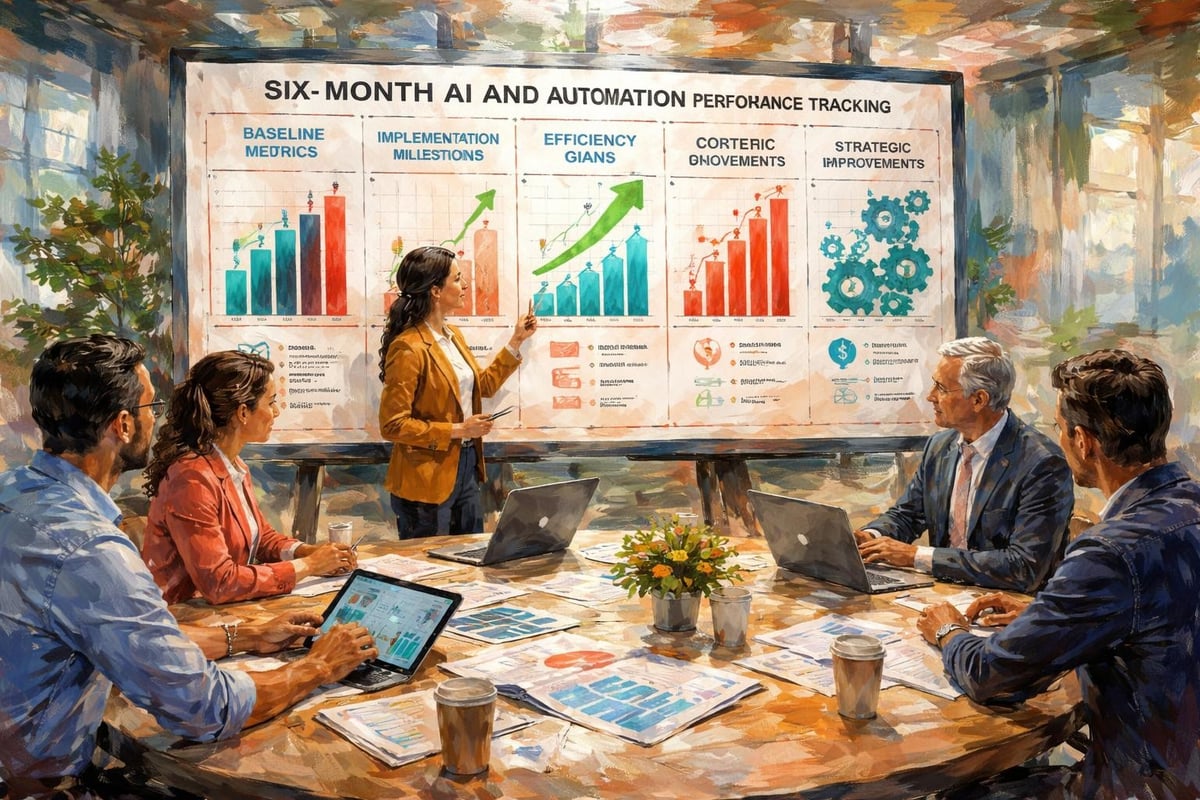
Quantifying ai and automation value requires appropriate metrics aligned with business objectives. Revenue growth and cost reduction provide obvious measures, but indirect benefits matter equally.
Key Performance Indicators
| Metric Category | Specific Measures | Typical Improvement Range |
|---|---|---|
| Operational Efficiency | Processing time, throughput volume | 40-75% |
| Quality Improvement | Error rates, rework requirements | 50-85% reduction |
| Customer Experience | Response time, satisfaction scores | 25-60% |
| Employee Productivity | Output per person, task completion | 30-55% |
| Strategic Capacity | Time for value-added activities | 35-70% increase |
Track these metrics before implementation to establish accurate baselines. Monthly reporting reveals trends and identifies optimisation opportunities.
Financial Considerations
Australian businesses investing in ai and automation typically see positive ROI within 8-16 months depending on implementation scope. Initial costs include software licensing, integration services, and staff training.
Ongoing expenses cover system maintenance, model updates, and expansion to additional use cases. Cloud-based solutions reduce upfront capital requirements through subscription pricing models.
The readiness assessment service helps organisations forecast realistic investment requirements and expected returns based on their specific circumstances.
Ethical and Regulatory Considerations
Responsible ai and automation deployment addresses transparency, fairness, and accountability in automated decision-making. Australian Privacy Principles govern how businesses collect, use, and protect customer data within AI systems.
Explainability requirements vary by application. Customer-facing decisions require clear reasoning that non-technical users understand. Internal process automation accepts less transparency if properly governed.
Critical perspectives like those in The AI Con remind practitioners to maintain realistic expectations about AI capabilities. Hype-driven implementations often disappoint when technology limitations clash with inflated promises.
Building Trustworthy Systems
Establish clear governance frameworks before deployment. Define who authorises automated decisions, what oversight mechanisms exist, and how errors get addressed.
Regular audits identify bias in AI models that might disadvantage specific customer groups. Testing across demographic segments reveals unintended discrimination requiring corrective action.
Transparency with customers about ai and automation usage builds trust. Clear communication about what systems automate and what remains under human control manages expectations appropriately.
Future Trends and Preparation
The ai and automation landscape continues rapid evolution. Multi-modal AI systems processing text, images, and audio simultaneously enable richer business applications.
Edge computing brings AI processing closer to data sources. This reduces latency, improves privacy, and enables real-time decision-making in environments with limited connectivity.
Industry analysts predict 83% of Australian businesses will operate hybrid human-AI workflows by 2028. Organisations starting implementation now gain experience while competitive pressure remains moderate.
Authors like Martin Ford examine long-term economic implications of widespread automation. Forward-thinking businesses consider workforce development alongside technology deployment.
Preparing Your Organisation
Building internal AI literacy across all organisational levels creates capacity for ongoing innovation. Staff understanding fundamental capabilities and limitations contribute more effectively to implementation projects.
Develop partnerships with experienced AI consultants in Melbourne and Sydney who understand local business contexts and regulatory requirements. External expertise accelerates learning and reduces costly mistakes.
Allocate budget for experimentation beyond core implementations. Testing emerging capabilities in low-risk environments builds knowledge and identifies unexpected opportunities.
Advanced Automation Strategies
Sophisticated ai and automation deployments combine multiple technologies for compounding benefits. Process mining identifies optimisation opportunities through actual system usage data rather than documented procedures.
Predictive analytics forecast demand patterns, equipment failures, and resource requirements before issues emerge. This shifts operations from reactive to proactive management.
Natural language processing transforms unstructured data from emails, documents, and customer feedback into actionable insights. Previously inaccessible information now drives decision-making.
Integration Architecture
Successful ai and automation platforms follow modular design principles. Components connect through standardised interfaces allowing independent updates and replacements.
Cloud-native architectures provide scalability as usage grows. Start with minimal infrastructure and expand based on actual demand rather than projected estimates.
The product explorer from Synap AI demonstrates how businesses evaluate technology options matching their specific requirements and growth trajectories.
Making Your First Move
Starting your ai and automation journey requires clear objectives and realistic timelines. Begin with high-impact, low-complexity use cases that demonstrate value quickly.
Document current processes thoroughly before selecting technology. Understanding existing workflows reveals genuine improvement opportunities rather than forcing solutions onto problems.
Partner selection matters significantly. Choose providers with proven Australian business experience, technical depth, and commitment to client success beyond initial implementation.
The practical applications of ai and automation deliver measurable business improvements across industries and company sizes. Strategic deployment focused on specific outcomes generates returns that justify investment and build momentum for expansion.
The transformation potential of ai and automation extends across every business function when implemented thoughtfully and strategically. Australian organisations gain competitive advantage by starting now with focused, measurable deployments that demonstrate value and build internal capability. Ready to explore how intelligent automation can transform your specific business challenges? Synap AI brings deep technical expertise and practical implementation experience to organisations throughout Australia, helping you navigate the complexity and capture the opportunities these technologies offer.