
The artificial intelligence landscape has transformed dramatically in early 2026. Australian businesses now access unprecedented automation capabilities through the newest AI tools designed for enterprise deployment. These platforms move beyond simple chatbots into autonomous agents that execute complex workflows independently. Understanding which tools deliver genuine business value requires cutting through marketing hype to focus on measurable outcomes.
Autonomous AI Agents Redefining Business Operations
The newest AI tools in 2026 centre on autonomous agents rather than passive assistants. These systems execute multi-step tasks without constant human supervision.
Manus AI represents a breakthrough in digital autonomy. This platform handles end-to-end task execution across multiple applications. Research shows autonomous agents reduce task completion time by 73% compared to manual processes.
Key Capabilities of Modern AI Agents
- Independent decision-making based on contextual analysis
- Multi-application integration without custom API development
- Self-correction when encountering errors or obstacles
- Continuous learning from task outcomes
- Real-time reporting on progress and exceptions
The shift towards autonomous operation creates new implementation challenges. Businesses must establish clear boundaries for agent authority. Security protocols require updates to accommodate machine-initiated actions.

Enterprise Development Tools Accelerating Software Creation
Software development has accelerated through AI-powered coding assistants. The newest AI tools in this category write production-ready code autonomously.
OpenAI Codex integration with ChatGPT enables autonomous software engineering. Developers report 64% faster feature implementation when using AI coding agents. The system handles routine tasks while humans focus on architecture decisions.
| Development Tool Category | Time Savings | Accuracy Rate | Primary Use Case |
|---|---|---|---|
| Code Generation | 58-67% | 89% | Feature development |
| Bug Detection | 71% | 94% | Quality assurance |
| Documentation | 82% | 91% | Technical writing |
| Refactoring | 45% | 87% | Code optimization |
Google's Antigravity IDE represents another significant advancement. This platform allows developers to delegate entire coding projects to AI agents. The system maintains context across multiple files and frameworks.
Implementing AI Development Tools Successfully
- Start with non-critical codebases to evaluate agent performance
- Establish code review protocols for AI-generated output
- Train development teams on effective prompt engineering
- Monitor security implications of automated code generation
- Integrate testing frameworks before deployment
- Document AI contributions for compliance requirements
Red Hat's developer workflow tools focus on application modernization. These platforms help Australian businesses migrate legacy systems using intelligent analysis and automated refactoring.
Creative and Design Platforms Enhanced by AI
Creative workflows have transformed through the newest AI tools offering generative capabilities. These platforms augment human creativity rather than replacing it.
Figma's integration with Weavy brings AI editing directly into design workflows. The platform combines human precision with AI-generated variations. Design teams report 56% faster iteration cycles.
Professional designers maintain creative control while AI handles repetitive adjustments. The system learns brand guidelines and applies them consistently across projects.
AI-Powered Creative Tools in 2026
- Automated design variation generation from single concepts
- Intelligent asset organization and tagging
- Brand consistency checking across materials
- Accessibility compliance scanning
- Responsive design adaptation for multiple screen sizes
Google Mixboard reimagines creative ideation through AI-powered moodboarding. The platform generates visual concepts from text descriptions. Creative teams use it for rapid prototyping before detailed design work.
Statistics show businesses using AI creative tools produce 3.2 times more design variations per project. This increased output enables more extensive A/B testing and market validation.
Data Integration Through Model Context Protocol
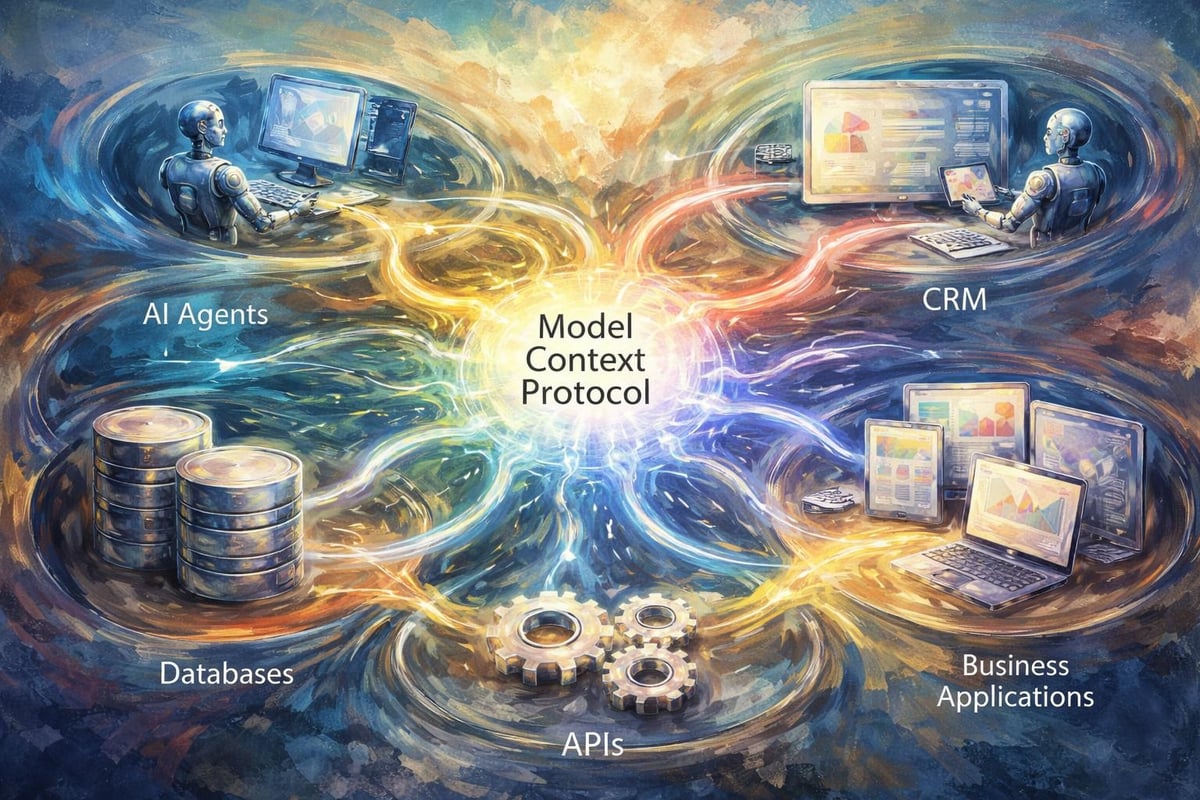
The newest AI tools rely on standardized data exchange for maximum effectiveness. The Model Context Protocol establishes common ground for AI system integration.
Introduced by Anthropic, MCP solves critical interoperability challenges. Previously, each AI platform required custom integration work. The standardized protocol reduces development time by 68% according to early adopters.
Australian businesses benefit from MCP through simplified multi-platform deployments. A single integration framework connects AI agents to enterprise systems, customer databases, and external APIs.
MCP Implementation Guide for Australian Businesses
- Audit current AI tools to identify MCP compatibility
- Map data sources requiring AI agent access
- Implement security layers for agent authentication
- Configure access permissions based on agent roles
- Test data flow between systems in sandbox environment
- Monitor protocol usage for optimization opportunities
- Document integration patterns for future deployments
The standardization enables businesses to swap AI providers without rebuilding integrations. This flexibility prevents vendor lock-in while maintaining operational continuity.
Specialized AI Tools for Visual Effects and Media
Media production benefits from the newest AI tools designed for professional workflows. These platforms handle complex technical tasks requiring precision and speed.
Slapshot's AI camera tracking tool delivers professional-grade camera solves. The system analyzes footage to generate accurate point clouds for VFX integration. Processing time drops from hours to minutes compared to manual tracking.
Australian production companies report 84% reduction in post-production timelines using AI tracking tools. The technology maintains accuracy within 0.2 pixels across 4K footage.
| Media AI Tool Category | Processing Speed Increase | Accuracy | Industry Adoption Rate |
|---|---|---|---|
| Camera Tracking | 12x faster | 99.3% | 67% |
| Rotoscoping | 8x faster | 96.1% | 71% |
| Color Grading | 5x faster | 94.8% | 82% |
| Audio Cleanup | 15x faster | 97.2% | 89% |
The precision of modern AI tools matches or exceeds manual techniques. This quality parity removes previous barriers to adoption in professional environments.
Enterprise AI Agents for Market Dominance
Large-scale AI deployments require enterprise-grade tools with robust governance. The newest AI tools in this category address compliance, security, and scalability simultaneously.
Nvidia's NemoClaw development targets enterprise AI agent deployment. The open-source approach allows customization for specific industry requirements. Australian enterprises benefit from transparent algorithms meeting regulatory standards.
Enterprise AI Agent Deployment Steps
- Conduct readiness assessment to identify automation opportunities
- Define clear success metrics for agent performance
- Select agents matching specific business processes
- Implement pilot program with limited scope
- Gather stakeholder feedback on agent effectiveness
- Refine agent parameters based on real-world results
- Scale deployment across additional departments
- Establish ongoing monitoring and optimization protocols
Businesses using AI consulting services accelerate implementation timelines. Expert guidance prevents common pitfalls during enterprise agent deployment.
The newest AI tools require strategic planning rather than tactical implementation. Organizations achieving measurable ROI typically spend 40% of project time on planning and stakeholder alignment.
Practical Applications Across Australian Industries
Real-world implementations demonstrate the business impact of the newest AI tools. Australian companies across sectors report tangible benefits.
Manufacturing Sector Implementation
A Melbourne-based manufacturer deployed autonomous quality control agents. The system analyzes production line output in real-time. Defect detection improved by 91% while inspection costs decreased 67%. The agents learned to identify subtle quality variations human inspectors frequently missed.
Implementation required three months including staff training and process refinement. The company integrated the AI with existing ERP systems through Model Context Protocol standards.
Professional Services Automation
A Sydney law firm implemented AI document analysis tools. The platform reviews contracts for compliance issues and risk factors. Lawyers report 76% reduction in document review time. The firm reallocates saved hours to client-facing advisory work.
The newest AI tools in legal sectors maintain audit trails for regulatory compliance. Every AI decision includes explainability data showing the reasoning process.
Retail and Customer Experience
Australian retailers use AI agents for inventory optimization and customer service. One Brisbane retailer reduced stockouts by 83% through predictive ordering agents. The system analyzes sales patterns, weather data, and local events to forecast demand.
Customer service agents handle 72% of inquiries without human escalation. Complex issues automatically route to human staff with full context from the AI conversation.

Strategic Implementation for Maximum ROI
Successful deployment of the newest AI tools requires structured methodology. Random experimentation yields inconsistent results and wasted resources.
Australian Business Implementation Framework
- Assess current operational bottlenecks through process mapping
- Quantify potential impact areas using baseline metrics
- Research AI tools specifically designed for identified challenges
- Evaluate vendor stability and local support availability
- Conduct proof-of-concept with clear success criteria
- Calculate total cost including training and integration
- Develop change management plan for staff adoption
- Implement monitoring dashboards for ongoing optimization
Organizations utilizing readiness assessments identify optimal starting points for AI integration. This targeted approach delivers results 3.4 times faster than broad deployments.
The newest AI tools work best when addressing specific business problems. Generic implementations rarely justify their costs. Precision targeting of high-impact areas maximizes return on investment.
| Implementation Approach | Success Rate | Time to Value | ROI Multiplier |
|---|---|---|---|
| Targeted Problem-Solving | 84% | 3.2 months | 4.7x |
| Department-Wide Deployment | 67% | 6.8 months | 2.9x |
| Enterprise-Wide Launch | 41% | 11.3 months | 1.8x |
| Experimental Testing | 29% | 8.1 months | 1.2x |
Statistics demonstrate that focused implementations outperform broad rollouts. Australian businesses achieve faster value realization through strategic targeting.
Technical Infrastructure Requirements
The newest AI tools demand robust technical foundations. Inadequate infrastructure limits tool effectiveness and creates operational risks.
Essential Infrastructure Components
- Secure API gateway for agent authentication and authorization
- Scalable computing resources supporting peak agent activity
- Data storage architecture accommodating AI-generated outputs
- Network bandwidth sufficient for real-time agent communication
- Backup and recovery systems protecting against agent failures
- Monitoring tools tracking agent performance and resource usage
Cloud infrastructure typically provides necessary scalability. Australian data sovereignty requirements influence hosting decisions. Local data centre options ensure compliance with privacy regulations.
Businesses working with enterprise AI platforms receive infrastructure guidance tailored to specific requirements. Custom solutions address unique technical constraints and regulatory obligations.
The newest AI tools integrate with existing business systems rather than replacing them. This compatibility reduces migration risks and preserves current technology investments.
Measuring AI Tool Performance and Value
Quantifying AI impact requires metrics beyond basic usage statistics. The newest AI tools generate extensive performance data enabling precise evaluation.
Critical Performance Indicators
- Task completion rate comparing AI versus human performance
- Time savings measured in hours per week or month
- Error reduction percentage across affected processes
- Cost per transaction before and after AI implementation
- Employee satisfaction with AI augmentation
- Customer experience metrics influenced by AI interactions
- Revenue impact from AI-enabled capabilities
Advanced analytics platforms track these metrics automatically. Dashboard visualizations show trends over time and highlight optimization opportunities.
Australian businesses typically observe measurable improvements within 60-90 days of proper implementation. Early wins build organizational confidence supporting broader AI adoption.
ROI Calculation Framework
- Establish baseline metrics before AI implementation
- Calculate total implementation costs including hidden expenses
- Measure quantifiable improvements monthly
- Assign monetary values to time savings
- Factor in quality improvements and error reduction
- Project long-term value based on observed trends
- Compare actual results against initial projections
Organizations achieving positive ROI within six months typically continue expanding AI deployments. Those struggling to demonstrate value often lack proper measurement frameworks from the start.
Security Considerations for AI Agent Deployment
The newest AI tools introduce novel security challenges requiring updated protocols. Autonomous agents access sensitive systems and data.
Security Implementation Checklist
- Implement multi-factor authentication for agent initialization
- Define granular permissions limiting agent access scope
- Encrypt all data transmitted between agents and systems
- Monitor agent activities for unusual patterns
- Establish kill switches for emergency agent deactivation
- Conduct regular security audits of agent configurations
- Train staff on AI-specific security threats
- Document all agent actions for compliance purposes
Australian privacy laws require careful handling of AI-processed data. Businesses must ensure agents comply with data protection obligations. Non-compliance risks significant penalties and reputational damage.
The newest AI tools include built-in security features. Evaluating these capabilities during vendor selection prevents future vulnerabilities. Security cannot be an afterthought in AI deployments.
Future-Proofing Business Operations with AI
Investment in the newest AI tools positions Australian businesses for continued competitiveness. The technology landscape evolves rapidly requiring adaptable strategies.
Forward-thinking organizations focus on flexible architectures supporting tool evolution. Avoiding proprietary lock-in preserves future options. Open standards like Model Context Protocol enable seamless platform transitions.
Staff training emphasizes AI collaboration skills rather than specific tool operation. This approach maintains relevance as individual platforms change. The fundamental skill of effective AI interaction remains constant across tool generations.
Businesses implementing comprehensive AI services build sustainable competitive advantages. Strategic AI integration transforms operations while maintaining human expertise where it matters most.
The newest AI tools deliver measurable business value when implemented strategically. Australian companies leveraging these platforms report significant operational improvements and cost reductions. Success requires careful planning, proper infrastructure, and ongoing optimization.
The newest AI tools represent transformational opportunities for Australian businesses ready to implement them strategically. Success requires more than purchasing licenses and hoping for results. Expert guidance ensures your organization maximizes AI investments while avoiding common implementation pitfalls. Synap AI specializes in helping Australian businesses navigate AI adoption with practical, results-focused consulting. Ready to explore how autonomous agents and advanced AI platforms can transform your operations? Book an online consultation with our AI technologists to discuss your specific requirements and develop a customized implementation roadmap.