
The ability to discover AI solutions that genuinely transform business operations has become essential for Australian organisations in 2026. Many companies struggle to identify which artificial intelligence technologies deliver measurable value. This comprehensive guide explores practical pathways for businesses to discover AI applications, evaluate their potential, and implement solutions that drive competitive advantage. Understanding how to navigate the AI landscape separates thriving enterprises from those falling behind.
Understanding the Australian AI Landscape
The Australian AI market reached $2.8 billion in 2025, with projections indicating growth to $4.3 billion by 2028. This expansion reflects genuine business adoption rather than speculative investment.
When you discover AI opportunities within your organisation, context matters tremendously. Australian businesses face unique challenges including data sovereignty requirements, privacy regulations, and a competitive talent market. The ACCC reported that 67% of Australian businesses now use some form of AI, yet only 23% have fully integrated solutions.
Regional Considerations for AI Discovery
Sydney and Melbourne lead Australia's AI adoption, with firms in these cities accessing deeper talent pools and vendor networks. However, regional businesses increasingly access powerful AI capabilities through cloud platforms. AI consultant services in Melbourne demonstrate how location matters less than strategic implementation.
The Victorian government invested $145 million in AI infrastructure during 2025. Queensland allocated $89 million toward similar initiatives. These investments create opportunities for businesses across all regions to discover AI solutions previously accessible only to major metropolitan enterprises.
| State | AI Investment 2025 | Primary Focus Areas | Business Adoption Rate |
|---|---|---|---|
| Victoria | $145M | Healthcare, Manufacturing | 71% |
| New South Wales | $132M | Finance, Retail | 69% |
| Queensland | $89M | Agriculture, Tourism | 58% |
| Western Australia | $76M | Mining, Logistics | 62% |
Practical Steps to Discover AI Opportunities
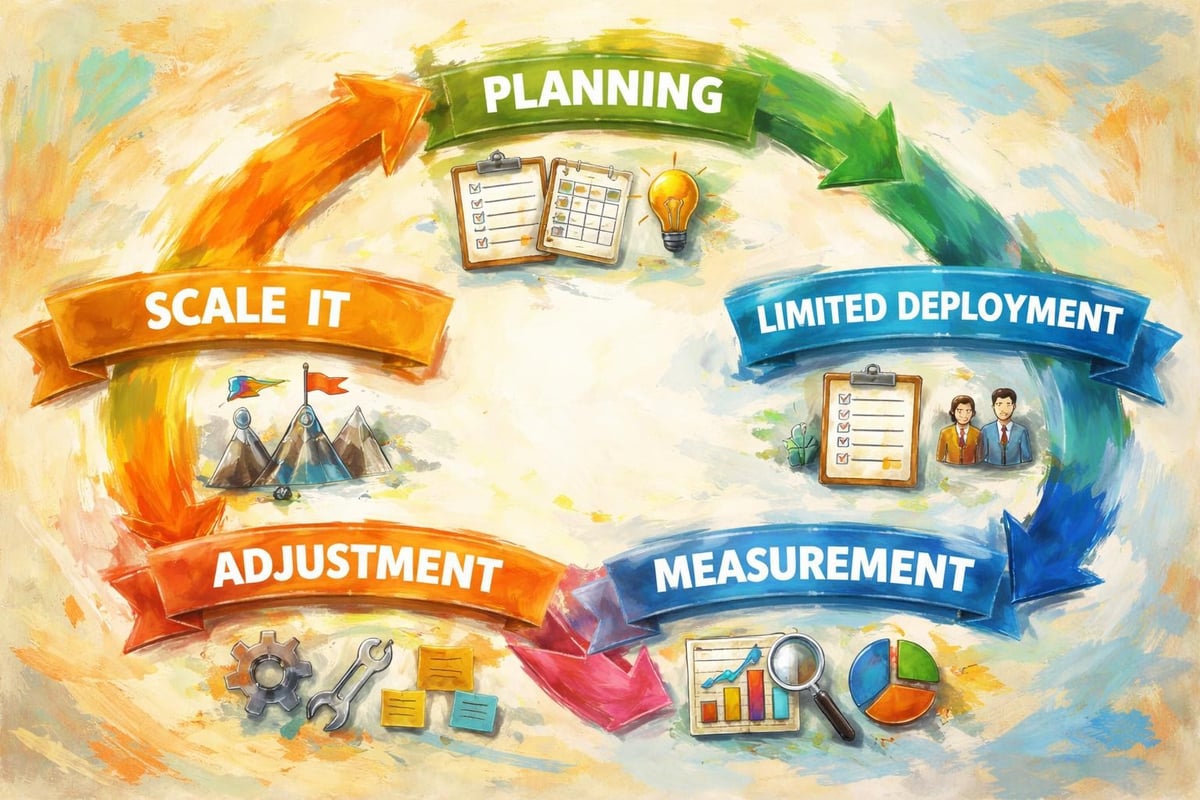
Discovering AI begins with systematic assessment rather than technology-first thinking. Follow these steps to identify genuine opportunities within your organisation.
Step 1: Conduct Internal Process Audits
Document every business process consuming significant time or resources. Interview team members handling repetitive tasks. Identify bottlenecks causing customer frustration or operational delays.
Manufacturing firms typically discover AI opportunities in quality control processes. Service businesses often find applications in customer communication workflows. Retail operations frequently identify inventory management as prime AI territory.
One Melbourne-based logistics company documented 47 separate manual data entry points across their shipping workflow. This audit revealed opportunities to discover AI solutions eliminating 83% of manual input through intelligent automation.
Step 2: Quantify Impact Potential
Assign metrics to every identified opportunity. Calculate current costs in labour hours, error rates, and customer satisfaction impacts. Estimate potential improvements with reasonable assumptions about AI performance.
Use conservative estimates initially. A customer service AI might handle 60% of routine enquiries rather than 90%. Manufacturing quality inspection systems typically catch 85-95% of defects, not 100%. These realistic projections prevent disappointing implementations.
Step 3: Research Available Solutions
Modern businesses can discover AI tools through multiple channels. Industry-specific platforms often provide ready-made solutions requiring minimal customization. Discovery AI offers specialized tools for legal and compliance sectors, demonstrating how vertical-specific solutions accelerate deployment.
General-purpose AI platforms enable custom development. Cloud providers including AWS, Google Cloud, and Microsoft Azure offer AI services through subscription models. Australian businesses benefit from data residency options ensuring compliance with privacy regulations.
The development tools landscape continues expanding, with platforms like Discover AI's development suite providing resources for organisations building custom solutions. However, most Australian SMEs achieve better outcomes through configured platforms rather than ground-up development.
Step 4: Evaluate Vendor Capabilities
Request demonstrations using your actual data where possible. Generic demos rarely reveal implementation challenges. Assess vendor understanding of Australian regulatory requirements, particularly regarding privacy and data handling.
Verify local support availability and response times. A 24-hour support delay becomes costly when business-critical systems fail. Consulting services provide independent assessments when internal expertise proves insufficient.
Step 5: Pilot Before Scaling
Launch limited trials with defined success metrics and timeframes. Three-month pilots provide sufficient data for informed decisions without excessive commitment. Include frontline staff in pilot programs since their adoption determines ultimate success.
Document everything during pilots. Technical performance matters, but user acceptance, training requirements, and workflow integration prove equally important. One Sydney accounting firm discovered their AI bookkeeping tool performed perfectly but created unacceptable workflow disruptions requiring complete process redesign.
Real-World AI Discovery Examples
Australian businesses across industries successfully discover AI applications transforming operations and customer experiences.
Manufacturing Quality Control
A Brisbane automotive parts manufacturer faced quality control challenges with 3.2% defect rates despite thorough manual inspection. Their quality team inspected 840 components hourly, creating production bottlenecks.
They discovered AI-powered computer vision systems could inspect components at 12,000 units per hour with 0.4% defect rates. Implementation required:
- Installing industrial cameras at three production line points
- Training models with 50,000 labelled component images
- Integrating detection systems with production management software
- Establishing human verification protocols for borderline cases
- Creating continuous improvement feedback loops
The system achieved full deployment in seven months. Defect rates dropped to 0.3%, while throughput increased 28%. The company recouped their $180,000 investment within 14 months through reduced waste and increased capacity.
Customer Service Automation
A Perth-based insurance provider handled 12,000 monthly customer enquiries with a 15-person service team. Average response times reached 4.2 hours, contributing to customer satisfaction scores of just 67%.
They implemented AI phone receptionist technology handling initial enquiry triage and routine policy questions. The deployment process included:
- Analyzing 6,000 previous customer interactions to identify common patterns
- Developing response protocols for 23 frequently asked question categories
- Creating seamless handoff procedures to human agents
- Training customer service staff on supervision and exception handling
- Establishing quality monitoring and continuous improvement processes
Within four months, the AI system handled 68% of initial enquiries completely. Human agents focused on complex cases requiring judgment. Response times dropped to 47 minutes average. Customer satisfaction climbed to 84%, while the service team expanded capacity without additional headcount.
Content Production Scaling
A Melbourne marketing agency struggled to maintain content production velocity for growing client portfolios. Their eight-person content team produced approximately 180 pieces monthly, limiting client acceptance and revenue growth.
They discovered AI content assistance tools could augment rather than replace their creative team. Implementation through AI content platforms enabled:
- Rapid research and outline generation reducing preparation time by 70%
- First draft production for standard content types
- SEO optimization recommendations based on competitor analysis
- Multi-format adaptation of core content pieces
- Quality assurance checks identifying inconsistencies and errors
The team's effective output increased to 420 monthly pieces while maintaining quality standards. Client retention improved from 78% to 91%. The agency attributed their 34% revenue growth directly to expanded content capacity enabling broader service offerings.
Measuring AI Implementation Success
Successful AI discovery requires clear measurement frameworks distinguishing genuine value from impressive demonstrations.
Establishing Baseline Metrics
Document current performance across relevant dimensions before implementation. Include efficiency measures, quality indicators, cost factors, and customer impact metrics. Photographic evidence, process maps, and time studies create objective baselines.
Many organisations discover implementation benefits differ significantly from anticipated outcomes. A retail business might implement AI for inventory optimization but discover the greatest value comes from improved demand forecasting enabling better purchasing decisions.
Tracking Adoption and Usage
Monitor how staff actually use AI tools versus intended usage patterns. Low adoption rates indicate training gaps, workflow mismatches, or tool limitations. One Adelaide professional services firm discovered their document analysis AI achieved only 23% adoption because it required file format conversions creating workflow friction.
Usage analytics reveal unexpected applications. Staff often discover AI capabilities solving problems beyond original implementation scope. Encourage experimentation while maintaining governance around data handling and quality standards.

Financial Impact Assessment
Calculate total cost of ownership including licensing, implementation, training, ongoing support, and opportunity costs. Compare against measurable benefits including labour savings, error reduction, capacity expansion, and revenue enablement.
Australian businesses typically achieve positive ROI within 8-18 months for well-selected AI applications. Implementation costs range from $15,000 for configured platforms to $500,000+ for custom enterprise solutions. CB Insights research suggests companies focusing on specific high-impact applications achieve better returns than broad AI strategies.
| Application Type | Typical Implementation Cost | Expected ROI Timeline | Success Rate |
|---|---|---|---|
| Customer Service AI | $25,000 - $80,000 | 6-12 months | 73% |
| Process Automation | $15,000 - $120,000 | 8-14 months | 68% |
| Predictive Analytics | $40,000 - $200,000 | 12-20 months | 61% |
| Quality Control Vision | $60,000 - $300,000 | 10-18 months | 79% |
| Content Generation | $8,000 - $45,000 | 4-8 months | 71% |
Overcoming Common AI Discovery Challenges
Australian businesses encounter predictable obstacles when they discover AI opportunities and attempt implementation.
Data Quality and Availability Issues
AI systems require substantial quality data for training and operation. Many organisations discover their data exists in incompatible formats, contains significant errors, or lacks necessary labelling.
Address data challenges through systematic cleanup and preparation. Allocate 30-40% of project timelines to data work for first AI implementations. This proportion decreases as organisations establish better data governance practices.
A Canberra government services provider invested nine months preparing procurement data before implementing AI-powered spend analysis. This preparation enabled successful deployment, while similar organisations skipping data work experienced failed implementations.
Skills and Knowledge Gaps
The Australian AI talent shortage continues despite growing university programs and training initiatives. The Australian Computer Society reported 14,000 unfilled AI-related positions across Australia in late 2025.
Bridge skills gaps through partnerships rather than solely hiring. AI consulting firms provide expertise for assessment, implementation, and knowledge transfer. Hybrid approaches combining external specialists with internal team development prove most sustainable.
Change Management Resistance
Staff resistance represents the primary failure factor for AI implementations according to Deloitte's 2025 Australian AI survey. People fear job displacement, struggle with new workflows, or distrust AI recommendations.
Address resistance through transparent communication and inclusive implementation. Involve affected staff in solution selection and pilot phases. Demonstrate how AI augments rather than replaces human work. The most successful implementations position AI as eliminating tedious tasks and enabling higher-value work.
Regulatory and Ethical Considerations
Australian businesses must navigate evolving AI regulations while maintaining ethical practices.
Privacy and Data Protection
The Privacy Act amendments introduced in 2025 created specific requirements for AI systems processing personal information. Organisations must demonstrate AI decisions affecting individuals remain explainable and contestable.
Ensure AI vendors provide adequate transparency into decision-making processes. Maintain human oversight for consequential decisions. Document AI training data sources and processing methodologies for regulatory compliance.
Sector-Specific Requirements
Financial services, healthcare, and government sectors face additional AI regulations. APRA released updated prudential standards for AI use in regulated entities during 2025. The TGA established AI medical device frameworks creating clear approval pathways.
Insight Platforms' approach to cultural insights demonstrates how specialised AI applications address sector-specific requirements while maintaining regulatory compliance. Verify vendors understand your industry's regulatory landscape before significant commitments.
Algorithmic Bias and Fairness
AI systems inherit biases present in training data or design assumptions. Australian anti-discrimination laws apply to AI-driven decisions affecting employment, lending, insurance, and service provision.
Conduct bias assessments during development and deployment. Test AI performance across demographic groups and edge cases. Maintain processes for investigating and correcting biased outcomes. One Melbourne recruitment firm discovered their AI screening tool systematically disadvantaged candidates from regional areas, requiring model retraining with geographically diverse datasets.
Building Long-Term AI Capabilities
Discovering AI opportunities represents the beginning of an ongoing transformation journey rather than a discrete project.
Establishing AI Governance
Create clear policies governing AI development, deployment, and monitoring. Define approval processes for new AI applications. Establish data handling standards and quality requirements. Designate responsible parties for AI system oversight.
Governance frameworks scale more easily than retrofitting controls onto proliferating AI implementations. Companies with established governance deploy new AI capabilities 40% faster according to Gartner research.
Developing Internal Expertise
Invest in building AI literacy across your organisation. Technical staff need hands-on development experience. Business leaders require strategic AI understanding. Frontline employees benefit from user-focused training.
Australian universities offer microcredentials and executive education programs focused on practical AI application. Industry associations provide sector-specific training increasingly relevant to real-world implementation challenges. Readiness assessments identify specific knowledge gaps requiring attention.
Creating Innovation Processes
Systematize how you discover AI opportunities and evaluate potential applications. Establish regular review cycles examining emerging AI capabilities against business challenges. Create safe experimentation environments enabling controlled testing without production system risks.
Companies treating AI discovery as continuous process rather than one-time project achieve 3x higher value realization according to McKinsey research. Regular capability assessments ensure you leverage advancing AI technologies as they mature.
Strategic AI Partnership Selection
Choosing the right AI implementation partners significantly impacts success probability and long-term value realization.
Evaluating Technical Capabilities
Assess vendors based on relevant experience rather than general AI credentials. A vendor with extensive retail AI experience may struggle with manufacturing applications despite impressive client lists. Request case studies from your specific industry and use case category.
Evaluate technical architecture for scalability, security, and integration capabilities. Cloud-native solutions typically offer better scaling economics than on-premise deployments. API availability determines integration ease with existing business systems.
Understanding Support and Development Models
Clarify ongoing support arrangements, update frequencies, and customization options. Subscription models typically include regular updates and support. Perpetual licensing often requires separate maintenance agreements with unpredictable long-term costs.
Understand vendor product roadmaps and development priorities. AI capabilities evolve rapidly. Vendors actively developing in your problem domain provide better long-term value than those maintaining legacy systems.
Assessing Cultural Alignment
Successful AI implementations require genuine partnerships between vendors and clients. Assess communication styles, responsiveness, and problem-solving approaches during evaluation processes.
Companies report cultural misalignment causes 31% of AI project failures despite technical success. Vendors treating implementations as transactions rather than partnerships create downstream challenges. For complex AI initiatives requiring significant customization, consider booking an online consultation with experienced AI technologists to discuss specific requirements and partnership approaches.
Future AI Trends Affecting Australian Businesses
Understanding emerging AI trends helps businesses discover opportunities before competitive advantage diminishes.
Generative AI Maturation
Generative AI moved beyond content creation into design, analysis, and decision support applications during 2025-2026. Australian businesses increasingly deploy generative AI for customer service, product development, and strategic planning.
The technology continues improving in accuracy, controllability, and specialization. Industry-specific models trained on domain data outperform general-purpose alternatives for specialized applications. Expect continued rapid advancement through 2027-2028.
Edge AI Deployment
Processing AI workloads locally rather than in cloud environments addresses latency, privacy, and connectivity challenges. Manufacturing, agriculture, and remote operations particularly benefit from edge AI capabilities.
Australian telecommunications infrastructure improvements enable hybrid approaches combining edge processing with cloud-based training and management. This architecture balances performance requirements with practical deployment constraints.
Multimodal AI Integration
Systems combining text, image, audio, and video understanding create more comprehensive solutions than single-modality approaches. Customer service applications benefit from analyzing tone, facial expressions, and spoken content simultaneously. Quality control systems evaluate visual, thermal, and acoustic data together.
Multimodal capabilities reduce integration complexity by consolidating multiple specialized systems into unified platforms. Australian businesses discover these integrated approaches simplify deployment while improving overall performance.
Successfully discovering AI opportunities requires systematic assessment, realistic expectations, and strategic implementation. Australian businesses that approach AI discovery methodically identify high-impact applications, avoid costly missteps, and build sustainable competitive advantages. The journey from initial discovery through full deployment demands expertise, patience, and ongoing commitment to improvement. Synap AI provides Australian businesses with private AI consulting and platform development services, helping organisations navigate the complete AI discovery and implementation journey from their Mornington, Victoria base.