
The enterprise landscape has fundamentally changed with artificial intelligence. Organisations investing in ai for enterprise now operate with unprecedented efficiency, data-driven decision-making, and competitive advantage. According to recent industry data, 25% of applications now include AI capabilities, yet many businesses struggle to extract full value from these investments. Understanding how to properly implement and leverage ai for enterprise determines which organisations thrive and which fall behind.
Understanding Enterprise AI Implementation
AI for enterprise differs significantly from consumer-facing AI applications. Enterprise systems require robust security, scalability, integration with existing infrastructure, and compliance with regulatory frameworks. IBM defines enterprise AI as the integration of advanced machine learning technologies within large organisations to enhance business functions across departments.
The complexity of ai for enterprise stems from multiple factors. Legacy systems often resist integration. Data silos prevent comprehensive analysis. Organisational resistance creates adoption barriers. Budget constraints limit experimental projects.
Core Components of Enterprise AI Systems
- Data infrastructure: Centralised repositories that aggregate information from multiple sources
- Machine learning models: Custom-trained algorithms specific to business requirements
- Integration layers: APIs and middleware connecting AI systems to existing platforms
- Governance frameworks: Policies ensuring ethical AI use and regulatory compliance
- User interfaces: Accessible tools allowing non-technical staff to leverage AI capabilities
Australian businesses face unique challenges when deploying ai for enterprise. Data sovereignty requirements necessitate local hosting solutions. Privacy regulations demand strict compliance measures. Geographic distribution complicates implementation across multiple sites.

Strategic Planning for AI Integration
Successful ai for enterprise deployment begins with comprehensive planning. Organisations that rush implementation without strategy waste resources and create confusion. The Synap AI consulting approach emphasises structured assessment before any technology deployment.
Step-by-Step Strategic Planning Process
- Conduct readiness assessment: Evaluate current infrastructure, skills, and organisational maturity
- Identify high-impact use cases: Focus on processes offering measurable ROI and operational improvement
- Define success metrics: Establish clear KPIs measuring AI performance and business outcomes
- Allocate budget and resources: Assign dedicated teams and financial commitment to AI initiatives
- Create governance structure: Establish oversight committees and ethical guidelines
- Develop timeline: Set realistic milestones accounting for complexity and learning curves
- Plan change management: Prepare communication strategies addressing employee concerns
| Planning Phase | Duration | Key Deliverables | Success Criteria |
|---|---|---|---|
| Assessment | 2-4 weeks | Infrastructure audit, skills gap analysis | Comprehensive understanding of readiness |
| Use case selection | 3-6 weeks | Prioritised project list, ROI projections | Executive alignment on priorities |
| Pilot implementation | 3-6 months | Working prototype, initial metrics | Demonstrated value in controlled environment |
| Scaled deployment | 6-12 months | Enterprise-wide rollout, training programs | Adoption rates above 60% |
Salesforce research on enterprise AI indicates that organisations with clear implementation strategies achieve 3.5 times higher success rates than those without structured approaches.
The Synap AI readiness assessment provides businesses with detailed analysis of their AI preparedness. This evaluation identifies gaps, recommends priorities, and creates actionable roadmaps.
Real-World Applications Across Industries
AI for enterprise delivers tangible value across diverse sectors. Financial institutions use machine learning for fraud detection and risk assessment. Manufacturing companies deploy predictive maintenance systems reducing downtime by 40%. Healthcare organisations leverage diagnostic AI improving accuracy rates.
Financial Services Case Study
A Melbourne-based wealth management firm implemented ai for enterprise through Synap's platform development services. Their challenge involved processing thousands of client documents monthly while maintaining compliance standards.
The solution involved several components:
- Document processing automation: OCR and natural language processing extracted data from unstructured forms
- Compliance checking: AI systems flagged potential regulatory issues before submission
- Client matching: Machine learning algorithms connected advisors with ideal prospects
- Performance forecasting: Predictive models anticipated portfolio performance under various scenarios
Results showed 67% reduction in processing time. Compliance errors dropped by 82%. Client satisfaction scores increased 34 points. The firm recovered implementation costs within 11 months.
Manufacturing Optimisation Example
A Queensland manufacturing plant deployed ai for enterprise focusing on supply chain optimisation. Traditional forecasting methods created either excess inventory or stockouts. Both scenarios cost the business significantly.

The implementation process included:
- Data integration: Connected ERP systems, supplier databases, and sales platforms
- Demand forecasting: ML models analysed historical data, seasonal patterns, and market indicators
- Inventory optimisation: Algorithms calculated optimal stock levels balancing costs and availability
- Supplier coordination: Automated systems sent orders based on predicted requirements
- Production scheduling: AI aligned manufacturing capacity with forecasted demand
Statistics from the first year revealed remarkable improvements. Inventory carrying costs decreased 28%. Stockout incidents fell from 47 to 9 annually. Production efficiency increased 19%. The plant reduced waste by AUD$1.3 million.
Automation and Workflow Enhancement
Workflow automation represents the most accessible entry point for ai for enterprise adoption. Grid Dynamics research shows that 78% of enterprises begin their AI journey with process automation before advancing to complex applications.
Common Automation Opportunities
- Customer service: AI-powered chatbots handle routine enquiries, freeing staff for complex issues
- Data entry: Automated extraction from emails, PDFs, and forms eliminates manual input
- Reporting: AI systems generate insights and visualisations from raw data
- Scheduling: Intelligent calendaring optimises meeting times across global teams
- Email management: Classification and routing based on content and urgency
- Document generation: Template-based creation of contracts, proposals, and reports
The Synap AI phone receptionist demonstrates practical automation for Australian businesses. This system handles incoming calls, answers common questions, schedules appointments, and transfers complex queries to appropriate staff members.
Implementation requires systematic approach:
- Map existing workflows: Document current processes identifying bottlenecks and repetitive tasks
- Prioritise automation targets: Select high-volume, rule-based activities offering clear benefits
- Select appropriate tools: Match technology capabilities to specific requirements
- Configure and customise: Adapt platforms to organisational needs and terminology
- Test thoroughly: Validate accuracy and performance before full deployment
- Train users: Ensure staff understand how to work alongside AI systems
- Monitor and refine: Continuously improve based on performance data and user feedback
| Automation Type | Implementation Complexity | Typical ROI Timeline | Maintenance Requirements |
|---|---|---|---|
| Chatbots | Low to Medium | 3-6 months | Monthly updates |
| Document processing | Medium | 6-9 months | Quarterly retraining |
| Predictive analytics | High | 12-18 months | Continuous monitoring |
| Workflow orchestration | Medium to High | 9-15 months | Bi-weekly optimisation |
Data Strategy and AI Performance
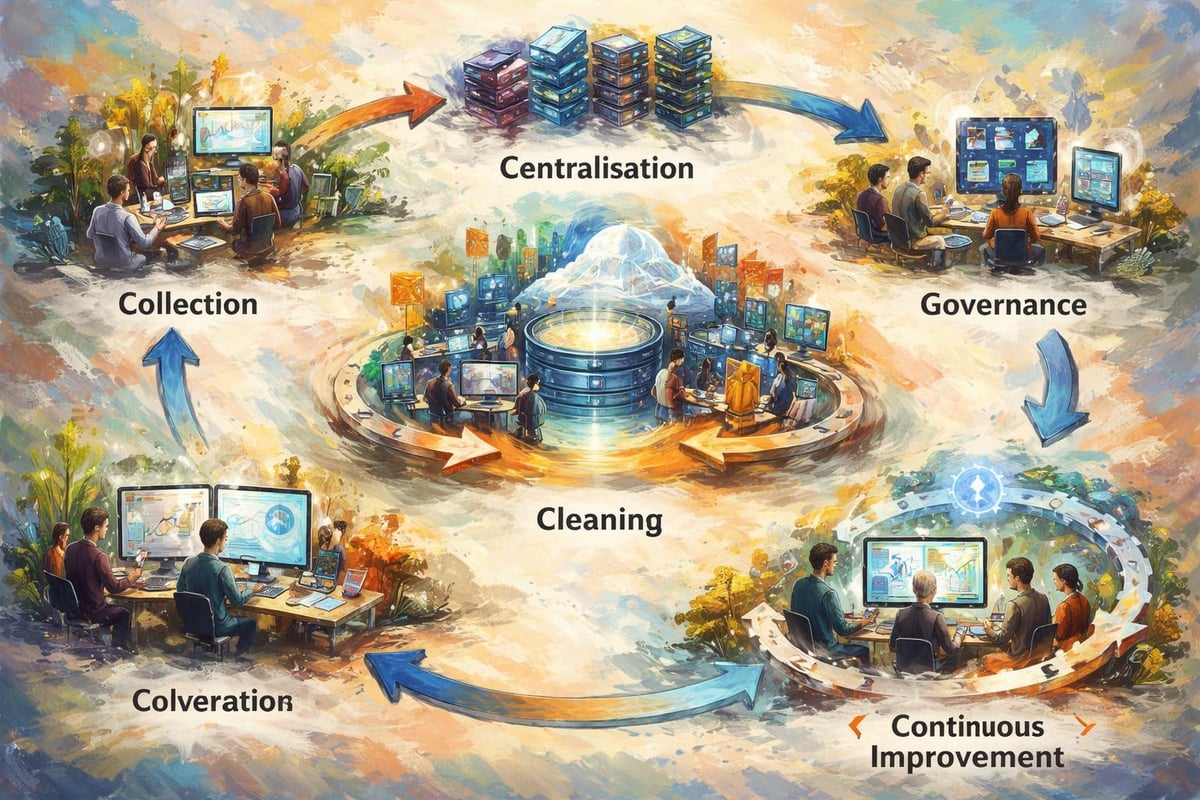
Quality data fuels effective ai for enterprise systems. Organisations often possess vast information repositories but lack structured approaches to data management. Poor data quality undermines even sophisticated AI algorithms.
Essential Data Management Principles
- Centralisation: Aggregate information from disparate sources into unified repositories
- Standardisation: Enforce consistent formats, naming conventions, and validation rules
- Cleaning: Remove duplicates, correct errors, and fill gaps in existing datasets
- Governance: Establish ownership, access controls, and update procedures
- Privacy protection: Implement anonymisation and encryption safeguarding sensitive information
- Documentation: Maintain metadata explaining data sources, definitions, and lineage
Recent research published on arXiv demonstrates how proper data architecture enables sophisticated AI applications. The FinRobot framework shows enterprise resource planning systems achieving 94% accuracy when built on well-structured financial data.
Australian privacy regulations add complexity to data strategies. GDPR compliance, Australian Privacy Principles, and industry-specific requirements demand careful attention. The Synap AI platform incorporates privacy-by-design principles ensuring regulatory compliance.
Skills Development and Change Management
Technology alone cannot deliver ai for enterprise success. Organisations must develop internal capabilities and manage cultural transformation. According to Indeed's enterprise AI research, 64% of implementation failures stem from people issues rather than technical problems.
Building AI Competency
- Executive education: Leadership must understand AI capabilities, limitations, and strategic implications
- Technical training: IT teams require skills in machine learning, data engineering, and AI operations
- User enablement: Business users need practical training on AI tools relevant to their roles
- Ethics awareness: All staff should understand responsible AI principles and organisational policies
- Continuous learning: Establish ongoing education programs tracking rapid AI advancement
Change management strategies should address common concerns:
- Job security fears: Communicate how AI augments rather than replaces human capabilities
- Skills gaps: Provide training and support helping employees adapt to new tools
- Process changes: Involve affected teams in design ensuring practical, user-friendly systems
- Performance expectations: Set realistic goals acknowledging learning curves and adjustment periods
- Communication channels: Maintain transparent dialogue addressing questions and feedback
The Synap AI consulting services include comprehensive change management support. This approach recognises that successful ai for enterprise implementation depends equally on technology and people.
Platform Selection and Vendor Evaluation
Choosing appropriate ai for enterprise platforms significantly impacts long-term success. The market offers numerous options ranging from comprehensive suites to specialised tools. Google's Gemini Enterprise platform represents one approach providing integrated workplace AI across multiple functions.
Platform Evaluation Criteria
| Criterion | Importance | Evaluation Questions |
|---|---|---|
| Functionality | Critical | Does it address core business requirements without excessive customisation? |
| Scalability | High | Can it grow with organisational needs and data volumes? |
| Integration | Critical | Does it connect seamlessly with existing systems and workflows? |
| Security | Critical | Does it meet industry standards and regulatory requirements? |
| Cost structure | High | Are pricing models transparent and aligned with usage patterns? |
| Support | Medium | What training, documentation, and technical assistance are provided? |
| Vendor stability | High | Will the provider continue operating and investing in the product? |
Build versus buy decisions require careful analysis. Custom development offers perfect fit but demands significant resources and expertise. Commercial platforms provide faster deployment but may include unnecessary features and ongoing licensing costs.
Hybrid approaches often work best for ai for enterprise scenarios. Organisations leverage commercial platforms for common functions while developing proprietary solutions for competitive differentiators. The Synap platform development expertise helps Australian businesses navigate these decisions.
Security and Compliance Frameworks
AI for enterprise deployment introduces new security considerations. Traditional cybersecurity measures must expand to address AI-specific risks including model poisoning, adversarial attacks, and data leakage through model outputs.
Essential Security Measures
- Access controls: Implement role-based permissions limiting who can use, modify, or view AI systems
- Encryption: Protect data at rest and in transit using current cryptographic standards
- Audit logging: Track all AI system interactions enabling investigation and compliance verification
- Model validation: Test AI systems for bias, fairness, and unexpected behaviours before deployment
- Incident response: Establish procedures addressing AI-specific security events
- Third-party assessment: Engage external auditors verifying security posture
Compliance requirements vary by industry and jurisdiction. Healthcare organisations must satisfy HIPAA equivalents. Financial institutions face APRA regulations. Government contractors require specific certifications.
Privacy-preserving AI techniques help organisations balance utility and protection:
- Federated learning: Train models on distributed data without centralising sensitive information
- Differential privacy: Add controlled noise ensuring individual records remain unidentifiable
- Synthetic data: Generate artificial datasets maintaining statistical properties without exposing real information
- Homomorphic encryption: Enable computation on encrypted data without decryption
Measuring ROI and Business Impact
Quantifying ai for enterprise value ensures continued investment and identifies improvement opportunities. Organisations must establish metrics aligned with strategic objectives rather than vanity statistics.
ROI Measurement Framework
- Define baseline: Document current performance before AI implementation
- Identify relevant metrics: Select KPIs directly influenced by AI systems
- Establish attribution: Determine which improvements result from AI versus other factors
- Calculate total costs: Include implementation, training, maintenance, and opportunity costs
- Measure benefits: Quantify efficiency gains, revenue increases, and cost reductions
- Account for intangibles: Consider difficult-to-measure benefits like employee satisfaction
| Metric Category | Example Measurements | Calculation Method |
|---|---|---|
| Efficiency | Processing time, error rates, throughput | Compare before/after periods with statistical controls |
| Financial | Cost savings, revenue growth, profit margins | Direct calculation from financial systems |
| Customer impact | Satisfaction scores, retention rates, lifetime value | Survey data and behavioural analysis |
| Employee effects | Productivity, engagement, turnover | HR metrics and workforce analytics |
Real-world data from Clustox's enterprise AI tools analysis shows average ROI timelines of 14 months for well-implemented projects. Poorly planned initiatives often fail to break even.
Future-Proofing Your AI Strategy
AI for enterprise evolves rapidly. Organisations must build adaptable strategies accommodating technological advancement and changing business requirements. Systems deployed today should remain relevant for 3-5 years minimum.
Future-Proofing Principles
- Modular architecture: Design systems with interchangeable components allowing selective upgrades
- Open standards: Prefer technologies supporting industry standards over proprietary formats
- Continuous learning: Implement systems that improve automatically through ongoing data exposure
- Flexible infrastructure: Build on cloud platforms enabling rapid scaling and technology adoption
- Vendor diversification: Avoid excessive dependence on single providers
- Skills investment: Develop internal expertise reducing reliance on external consultants
Emerging trends shaping ai for enterprise include:
- Multimodal AI: Systems processing text, images, audio, and video simultaneously
- Edge computing: AI processing occurring on local devices rather than centralised servers
- Explainable AI: Transparent systems showing how conclusions were reached
- AI orchestration: Coordinating multiple specialised AI agents solving complex problems
- Sustainable AI: Energy-efficient models reducing environmental impact
The Synap AI content machine demonstrates how modular, adaptable AI systems serve Australian businesses. This platform evolves with advancing technology while maintaining consistent user experience.
Partnering for Implementation Success
Many organisations lack internal resources for comprehensive ai for enterprise deployment. Strategic partnerships with experienced consultants accelerate implementation while avoiding common pitfalls.
Selecting AI Consulting Partners
- Verify technical expertise: Review portfolios, case studies, and technical certifications
- Assess industry knowledge: Ensure consultants understand sector-specific requirements and regulations
- Evaluate methodology: Examine structured approaches to assessment, planning, and implementation
- Check references: Speak with previous clients about results, communication, and support quality
- Confirm local presence: Australian businesses benefit from consultants understanding local market conditions
- Review engagement models: Understand pricing structures, deliverables, and ongoing support options
Effective partnerships extend beyond initial implementation. Ongoing support, training updates, and strategic guidance maintain AI system value over time. The Synap AI services approach provides continuous engagement ensuring long-term success.
Working with specialists based in Mornington, Victoria offers Australian enterprises distinct advantages. Local consultants understand regional business challenges, regulatory environments, and market dynamics. Time zone alignment facilitates communication and collaboration.
For organisations ready to explore ai for enterprise opportunities, booking a consultation with AI technologists provides personalised assessment and recommendations. These sessions evaluate specific business contexts and identify high-value implementation paths.
AI for enterprise represents fundamental transformation rather than incremental improvement. Organisations implementing these technologies strategically gain competitive advantages through enhanced efficiency, better decision-making, and improved customer experiences. Success requires careful planning, quality data, appropriate technology selection, and strong change management. Synap AI helps Australian businesses navigate this complexity through expert consulting, platform development, and ongoing support tailored to local market requirements.