
Australian organisations are facing unprecedented pressure to modernise operations while maintaining competitive advantage. Enterprise AI represents the systematic integration of artificial intelligence technologies across business functions to deliver measurable outcomes. Unlike consumer-focused AI applications, enterprise AI demands robust governance, security protocols, and seamless integration with existing infrastructure. This transformation requires strategic planning and expert guidance to navigate successfully.
Understanding Enterprise AI in 2026
Enterprise AI encompasses more than deploying chatbots or automation tools. It represents a fundamental shift in how organisations process information, make decisions, and serve customers.
Modern enterprise AI platforms integrate multiple capabilities simultaneously. These include natural language processing, predictive analytics, computer vision, and autonomous decision-making systems. The enterprise AI stack of 2026 emphasises the integration of knowledge management, data infrastructure, intelligent agents, and comprehensive governance frameworks.
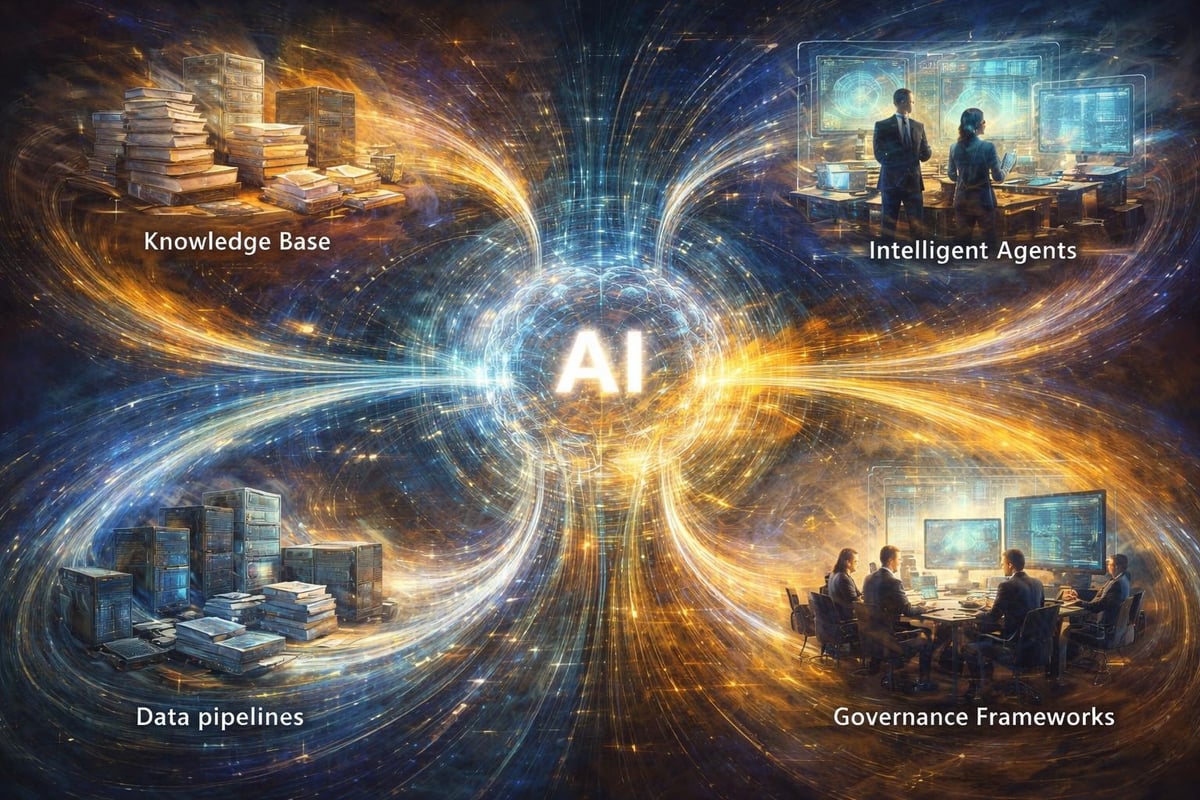
Australian businesses implementing enterprise AI see average productivity increases of 37% according to recent industry surveys. However, success requires addressing specific challenges unique to enterprise environments. Data security, regulatory compliance, and system integration complexity remain primary concerns.
The Current Enterprise AI Landscape
Statistics reveal compelling adoption trends. Research from the Artificial Intelligence Index Report 2023 shows that 72% of enterprises now deploy AI in at least one business function. Investment in enterprise AI exceeded $154 billion globally in 2025.
Australian organisations face unique considerations. Data sovereignty requirements under the Privacy Act 1988 demand careful attention. Private AI deployments, where data never leaves organisational boundaries, address these concerns effectively.
The shift towards agent-driven architectures marks a significant evolution. Rather than static models, modern enterprise AI employs autonomous agents that reason about missing information and validate conclusions against authoritative sources.
Implementing Enterprise AI: A Strategic Approach
Successful enterprise AI implementation follows a structured methodology. Rushing deployment without proper foundation creates technical debt and security vulnerabilities.
Step One: Conduct Comprehensive Readiness Assessment
Begin by evaluating your current technological maturity and organisational capability. This assessment identifies gaps between current state and AI-ready infrastructure.
- Audit existing data infrastructure and quality standards
- Evaluate team technical capabilities and training requirements
- Review current security protocols and compliance frameworks
- Identify business processes with highest automation potential
- Calculate baseline performance metrics for future ROI measurement
Synap AI's readiness assessment provides structured evaluation frameworks specifically designed for Australian businesses. This process typically requires two weeks for comprehensive analysis.
Step Two: Establish Governance Framework
Enterprise AI without governance creates risk. The PBSAI Governance Ecosystem provides a multi-agent reference architecture aligned with NIST AI Risk Management Framework functions.
Your governance framework must address:
- Data access controls and privacy protection mechanisms
- Model validation and performance monitoring protocols
- Ethical AI guidelines and bias detection systems
- Audit trails and compliance documentation requirements
- Incident response procedures for AI system failures
Melbourne-based financial services firm implemented comprehensive governance protocols before deploying AI across operations. This foundation prevented compliance issues that competitors faced during regulatory audits.
Step Three: Design Data Architecture
Enterprise AI effectiveness depends entirely on data quality and accessibility. Poor data architecture undermines even sophisticated models.
| Data Architecture Component | Implementation Requirement | Timeline |
|---|---|---|
| Data Lake Infrastructure | Centralised storage with schema validation | 4-6 weeks |
| ETL Pipeline Development | Automated data cleaning and transformation | 6-8 weeks |
| Metadata Management | Comprehensive cataloguing and lineage tracking | 3-4 weeks |
| Access Control Systems | Role-based permissions and audit logging | 2-3 weeks |
Private AI implementations require additional security layers. Data encryption, both at rest and in transit, becomes non-negotiable. Regular security audits verify protection mechanisms remain effective.

Step Four: Select Appropriate AI Technologies
Technology selection determines long-term success and scalability. Avoid vendor lock-in by prioritising open standards and interoperable systems.
Systematic approaches for deploying large language models in enterprise applications address distributed deployment challenges and data security requirements. This research demonstrates how organisations can maintain control whilst leveraging advanced AI capabilities.
Consider these technology categories:
- Retrieval Augmented Generation (RAG) systems for knowledge-based applications
- Predictive analytics engines for forecasting and planning
- Computer vision platforms for visual data processing
- Natural language processing tools for document analysis
- Automation frameworks for process optimisation
A Sydney logistics company deployed OpenClaw, Synap AI's web scraping and data extraction platform, to automate supplier data collection. This reduced manual data entry by 89% whilst improving accuracy rates.
Step Five: Implement Retrieval Strategies
Retrieval remains the real engine of enterprise AI. Systems must access the right information at the right time with complete accuracy.
Effective retrieval strategies require:
- Semantic search capabilities that understand context and intent
- Multi-source integration accessing structured and unstructured data
- Validation mechanisms ensuring answer accuracy against authoritative sources
- Citation systems providing transparency and traceability
- Continuous learning from user interactions and feedback
Manufacturing enterprises using Synap AI's automation platforms report 94% reduction in information retrieval time. Employees access critical data through natural language queries rather than navigating complex systems.
Building Enterprise AI for Maximum ROI
Return on investment determines whether enterprise AI initiatives receive continued support and expansion funding.
Measuring Enterprise AI Performance
Establish clear metrics before deployment begins. Baseline measurements enable accurate ROI calculation.
| Performance Indicator | Measurement Method | Target Improvement |
|---|---|---|
| Process Completion Time | Average task duration tracking | 40-60% reduction |
| Error Rate Reduction | Quality control audits | 70-85% decrease |
| Customer Satisfaction | NPS and CSAT surveys | 25-35% increase |
| Employee Productivity | Output per hour metrics | 30-50% improvement |
| Cost Per Transaction | Full activity-based costing | 35-55% reduction |
Melbourne professional services firm achieved 312% ROI within 18 months of deploying enterprise AI across client service operations. Cost savings from automation funded expansion into additional business units.
Ensuring Source Credibility in AI Systems
Enterprise AI systems must distinguish between reliable and unreliable information sources. Signals that tell AI a source is credible include clear organisational identity, demonstrated author expertise, and alignment with trusted ecosystem sources.
Implement verification mechanisms:
- Authoritative source databases identifying trusted information providers
- Citation validation confirming referenced materials exist and support claims
- Recency checks ensuring information currency and relevance
- Cross-reference verification comparing multiple independent sources
- Expert review processes for critical business decisions
The AI information retrieval framework emphasises trust, citations, and explainability. These elements reduce compliance risks whilst building confidence in AI-generated information.
Real-World Implementation Example
A Perth-based healthcare provider partnered with Synap AI's consulting team to transform patient data management. Their implementation followed a phased approach.
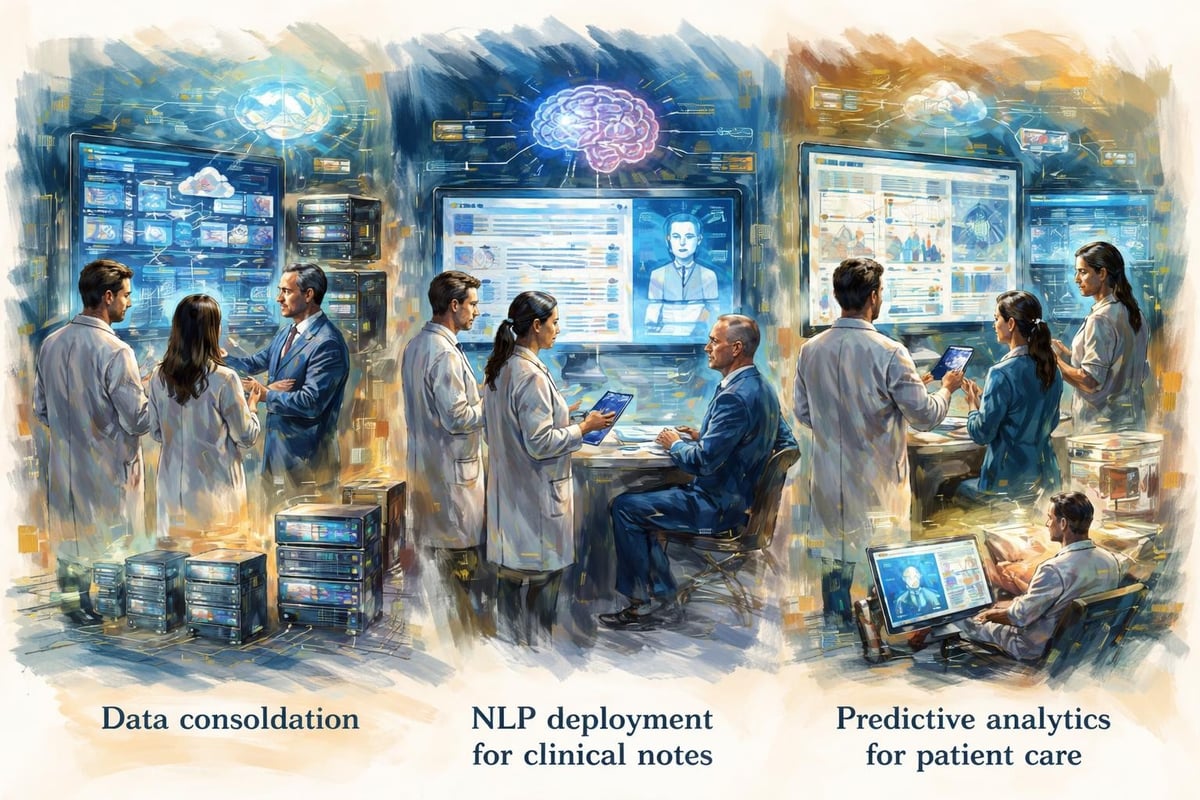
Phase One involved data consolidation from seven legacy systems into unified architecture. This required three months and established foundation for AI deployment.
Phase Two deployed natural language processing for clinical note analysis. The system extracted structured data from unstructured physician notes, improving coding accuracy by 76%.
Phase Three implemented predictive analytics identifying patients at risk of readmission. This enabled proactive intervention, reducing readmission rates by 43%.
Phase Four introduced automated scheduling and resource allocation. AI optimised appointment booking whilst balancing staff workload and facility capacity.
Total implementation timeline spanned 11 months. ROI became positive at month 14. Annual savings now exceed $2.8 million whilst patient satisfaction scores increased 31%.
Advanced Enterprise AI Capabilities
Beyond basic automation, advanced enterprise AI delivers transformative capabilities that redefine competitive positioning.
Autonomous Agent Systems
Modern enterprise AI employs intelligent agents operating with minimal human intervention. These systems reason about complex situations, identify information gaps, and execute multi-step processes autonomously.
Agent capabilities include:
- Dynamic decision-making adapting to changing business conditions
- Cross-system coordination managing workflows spanning multiple platforms
- Exception handling identifying and resolving anomalies automatically
- Continuous optimisation improving processes through machine learning
- Natural language interaction enabling conversational business intelligence
Synap AI's AI phone receptionist demonstrates autonomous agent capabilities. The system handles customer enquiries, schedules appointments, and escalates complex issues appropriately, all whilst maintaining natural conversation flow.
Knowledge Management Integration
Enterprise AI transforms how organisations capture, organise, and leverage institutional knowledge. Traditional knowledge bases require manual updates and become outdated quickly.
AI-powered knowledge management systems:
- Automatically extract insights from documents, emails, and communications
- Identify knowledge gaps and recommend content creation priorities
- Generate documentation from recorded processes and interactions
- Maintain knowledge currency through continuous validation and updating
- Personalise knowledge delivery based on user role and context
Synap AI's platforms integrate knowledge management with operational systems. This ensures teams access relevant information precisely when needed, embedded within workflow.
Securing Enterprise AI Deployments
Security concerns represent the primary barrier to enterprise AI adoption. Securing Retrieval Augmented Generation applications requires comprehensive approach addressing data protection, model security, and access control.
Essential security measures:
- Zero-trust architecture requiring continuous authentication and authorisation
- Data classification ensuring sensitive information receives appropriate protection
- Model isolation preventing cross-contamination between applications
- Audit logging capturing complete activity history for compliance
- Adversarial testing identifying vulnerabilities before deployment
Private AI deployments hosted within Australian data centres provide maximum security control. This approach ensures compliance with data sovereignty requirements whilst maintaining performance.
Enterprise AI Vendor Selection
Choosing the right implementation partner significantly impacts project success. Evaluate potential vendors carefully.
| Evaluation Criteria | Assessment Questions | Weight |
|---|---|---|
| Technical Expertise | What enterprise AI projects have you delivered? | 30% |
| Australian Presence | Can you support on-site collaboration when required? | 15% |
| Security Credentials | What certifications and compliance frameworks do you maintain? | 25% |
| Industry Experience | Do you understand our sector-specific requirements? | 20% |
| Ongoing Support | What post-deployment support and maintenance do you provide? | 10% |
Synap AI operates from Mornington, Victoria, providing accessible support for organisations across Australia. This local presence enables collaborative workshops and on-site consultation when projects demand direct engagement.
Building Internal AI Capability
Vendor partnerships should include knowledge transfer enabling internal teams to manage and optimise AI systems independently.
Capability building includes:
- Technical training covering system architecture and maintenance procedures
- Governance education ensuring compliance and risk management understanding
- Prompt engineering instruction maximising AI system effectiveness
- Performance monitoring guidance identifying optimisation opportunities
- Troubleshooting skills enabling rapid issue resolution
The most successful enterprise AI deployments create centres of excellence within organisations. These teams champion AI adoption whilst providing internal consulting and support.
Future-Proofing Enterprise AI Investments
Technology evolution requires architectural decisions supporting adaptability and scalability.
Modular Architecture Design
Build systems using composable components that can be upgraded or replaced independently. Monolithic architectures create inflexibility and vendor lock-in.
Design principles:
- API-first development enabling seamless integration
- Microservices architecture isolating functionality for independent scaling
- Standard data formats ensuring interoperability
- Cloud-agnostic deployment supporting infrastructure flexibility
- Open-source foundation reducing dependency on proprietary systems
This approach allows organisations to adopt emerging technologies without wholesale system replacement. New AI capabilities integrate alongside existing infrastructure.
Continuous Improvement Frameworks
Enterprise AI requires ongoing optimisation. Establish feedback loops capturing user experience and system performance.
Implement improvement processes:
- Weekly performance review analysing key metrics and identifying trends
- Monthly stakeholder feedback sessions gathering user perspectives
- Quarterly capability assessments evaluating new technology opportunities
- Biannual architecture reviews ensuring technical debt management
- Annual strategic planning aligning AI initiatives with business objectives
Melbourne manufacturing company established continuous improvement framework resulting in 127% productivity gain over three years. Regular optimisation compounded benefits beyond initial deployment.
Taking Action on Enterprise AI
The competitive landscape demands rapid yet strategic enterprise AI adoption. Organisations delaying implementation risk falling irreversibly behind early adopters.
Begin with clearly defined business objectives. Technology exists to solve problems, not create them. Identify specific pain points where AI delivers measurable value.
Partner with experienced consultants who understand both AI technology and business requirements. AI consultant services in Melbourne and Sydney provide local expertise with deep understanding of Australian regulatory environment.
Start small but think big. Pilot projects demonstrate value whilst minimising risk. Successful pilots create momentum for broader deployment and secure executive support.
For organisations ready to explore enterprise AI opportunities, booking a consultation provides clarity on implementation pathways and expected outcomes. Connect with AI technology specialists at https://cal.com/hamish-mackellar-9sxhbs/30min to discuss your specific requirements and receive tailored recommendations.
Enterprise AI represents essential infrastructure for competitive organisations in 2026, not experimental technology. Strategic implementation delivers measurable returns whilst building capability for continuous innovation. Synap AI specialises in guiding Australian businesses through enterprise AI transformation, from initial assessment through deployment and ongoing optimisation, ensuring your organisation captures full value from AI investment whilst maintaining security and compliance.