
Artificial intelligence is fundamentally reshaping how Australian businesses operate. The integration of ai for automation represents more than just technological advancement. It signals a complete transformation in operational efficiency, cost management, and competitive positioning. Modern organisations across Melbourne, Sydney, and beyond are discovering that automated systems powered by intelligent algorithms deliver unprecedented productivity gains while reducing human error and operational costs.
Understanding AI for Automation in Modern Business
The concept of ai for automation extends far beyond simple task replacement. It encompasses intelligent systems that learn, adapt, and improve over time.
These systems analyse patterns in data, make informed decisions, and execute complex workflows without constant human intervention. According to the Artificial Intelligence Index Report 2024, businesses implementing AI automation report average productivity increases of 37% within the first year.
Core Components of AI Automation Systems
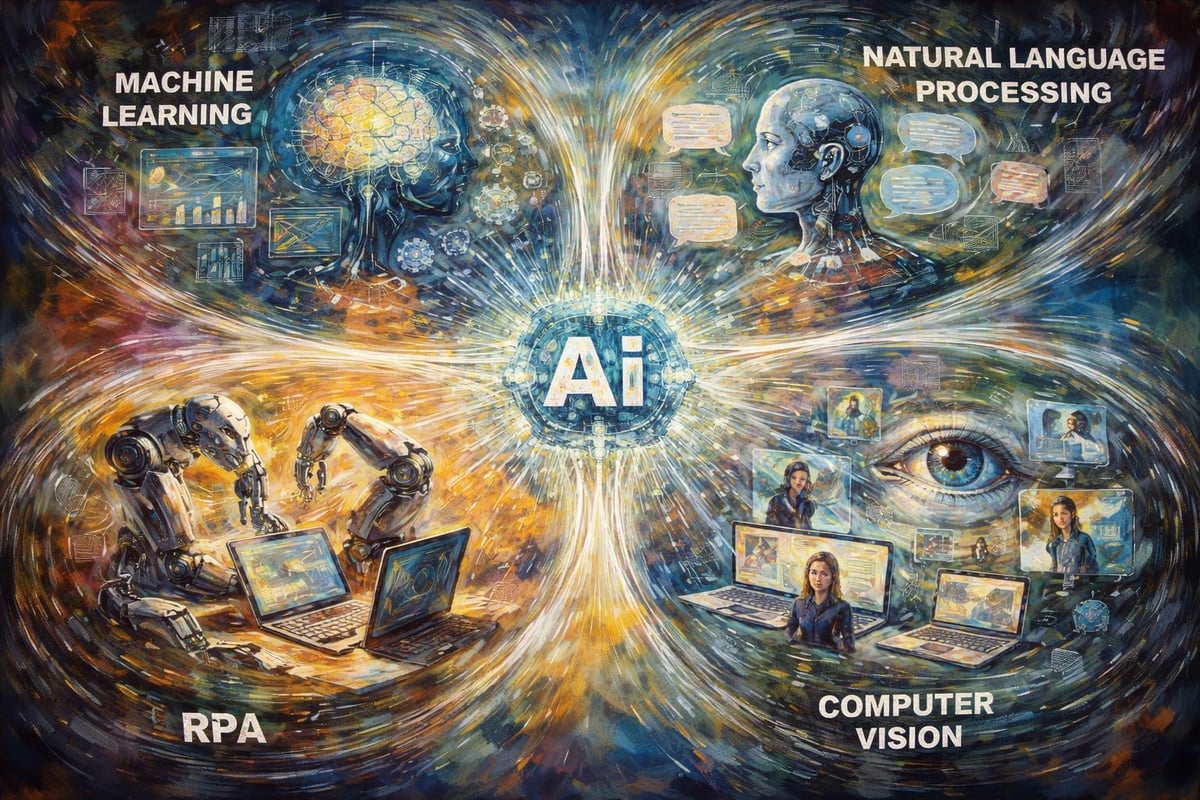
Modern ai for automation relies on several interconnected technologies working in harmony:
- Machine learning algorithms that identify patterns and predict outcomes
- Natural language processing for understanding and generating human communication
- Computer vision systems that interpret visual information
- Robotic process automation for executing repetitive digital tasks
- Decision-making engines that evaluate options and select optimal actions
The integration of AI into automation systems requires careful architectural planning. Each component must communicate seamlessly with existing infrastructure while maintaining data security and operational continuity.
Why Australian Businesses Adopt AI Automation
Three primary drivers push organisations toward ai for automation adoption:
- Labour cost reduction: Australian wage costs average 28% higher than global benchmarks
- Skills shortage mitigation: Automation fills gaps in specialised technical roles
- Competitive pressure: Early adopters gain significant market advantages
Research shows that 73% of Australian enterprises plan to increase automation budgets in 2026. The shift accelerates particularly in sectors facing talent shortages and rising operational costs.
Implementing AI for Automation: Step-by-Step Framework
Successful implementation requires methodical planning and execution. Rushing deployment creates technical debt and employee resistance.
Phase One: Assessment and Planning
Begin with comprehensive evaluation of current processes:
- Document all existing workflows and identify repetitive tasks
- Measure current performance metrics including time, cost, and error rates
- Prioritise processes based on automation potential and business impact
- Calculate expected return on investment for each candidate process
- Identify technical requirements and integration points
Synap AI's readiness assessment helps Australian businesses understand their automation maturity level. This diagnostic evaluates technical infrastructure, data quality, and organisational readiness before committing resources.
Phase Two: Technology Selection
Choosing appropriate ai for automation technology determines long-term success:
- Evaluate vendor capabilities against specific business requirements
- Assess integration complexity with existing systems
- Review security protocols and compliance certifications
- Calculate total cost of ownership including licensing, training, and maintenance
- Verify vendor support availability and Australian presence
| Selection Criteria | Weight | Evaluation Method |
|---|---|---|
| Technical capability | 35% | Proof of concept testing |
| Integration ease | 25% | API documentation review |
| Security compliance | 20% | Certification verification |
| Cost structure | 15% | Five-year TCO analysis |
| Support quality | 5% | Reference checks |
Phase Three: Pilot Implementation
Start small to validate assumptions and build confidence:
- Select a single, well-defined process for initial deployment
- Establish clear success metrics before implementation begins
- Deploy the automation solution in a controlled environment
- Monitor performance against baseline measurements daily
- Gather feedback from users and stakeholders throughout the pilot
- Document lessons learned and adjustment requirements
The AI consultant services in Melbourne market shows that successful pilots typically run 6-8 weeks. This duration provides sufficient data while maintaining project momentum.
Real-World Applications Across Industries
Australian organisations implement ai for automation across diverse operational areas. These applications demonstrate tangible business value.
Customer Service Automation
Robotic process automation transforms customer interactions through intelligent response systems. Modern AI agents handle enquiries, process requests, and escalate complex issues to human agents.
A Melbourne-based insurance company reduced customer service costs by 41% using AI automation. Their system processes 85% of standard enquiries without human intervention while maintaining 92% customer satisfaction scores.
The AI phone receptionist developed by Synap AI demonstrates practical customer service automation. This system handles incoming calls, schedules appointments, and provides information 24/7 without staffing costs.

Document Processing and Data Entry
Administrative tasks consume enormous resources across Australian businesses. AI for automation dramatically reduces this burden.
Implementation steps for document automation:
- Digitise existing paper documents using OCR technology
- Train AI models to recognise document types and extract key information
- Establish validation rules to ensure data accuracy
- Create automated workflows for routing processed documents
- Build exception handling procedures for non-standard cases
- Monitor accuracy rates and continuously refine extraction algorithms
A Sydney accounting firm processed 15,000 invoices monthly using manual data entry. After implementing ai for automation, processing time decreased from 12 minutes to 47 seconds per invoice while reducing errors by 94%.
Content Generation and Marketing
Automated journalism techniques now extend to marketing content creation. AI systems generate product descriptions, social media posts, and email campaigns at scale.
The AI content machine available through Synap AI produces SEO-optimised content while maintaining brand voice consistency. This automation allows marketing teams to focus on strategy while AI handles execution.
Statistics reveal compelling benefits:
- Content production costs decrease by average 63%
- Publishing frequency increases by 340%
- SEO performance improves through consistent optimisation
- Brand consistency improves across all channels
Financial Operations
Finance departments leverage ai for automation for reconciliation, forecasting, and compliance reporting. These applications require high accuracy and audit trails.
A Brisbane retail chain automated their monthly financial close process. The system reduced closing time from 8 days to 2.5 days while eliminating reconciliation errors. Their finance team now focuses on analysis rather than data compilation.
Addressing Common Challenges and Risks
Implementing ai for automation presents specific challenges requiring proactive management. Understanding these obstacles enables better planning.
Avoiding Automation Bias
Automation bias occurs when humans over-rely on automated decisions without critical evaluation. The impact of AI integration on decision quality requires careful governance.
Mitigation strategies include:
- Implementing human oversight for high-stakes decisions
- Regular auditing of automated decision outcomes
- Training staff to question automated recommendations
- Building transparency into AI decision-making processes
- Establishing clear escalation protocols
Managing Change Resistance
Employee concerns about job security create implementation barriers. Transparent communication and retraining programmes reduce resistance.
Change management approach:
- Communicate automation plans early with clear timelines
- Explain how automation enhances rather than replaces roles
- Provide comprehensive training on new systems
- Involve employees in automation design and testing
- Celebrate efficiency gains and share benefits organisation-wide
Ensuring Data Quality and Security
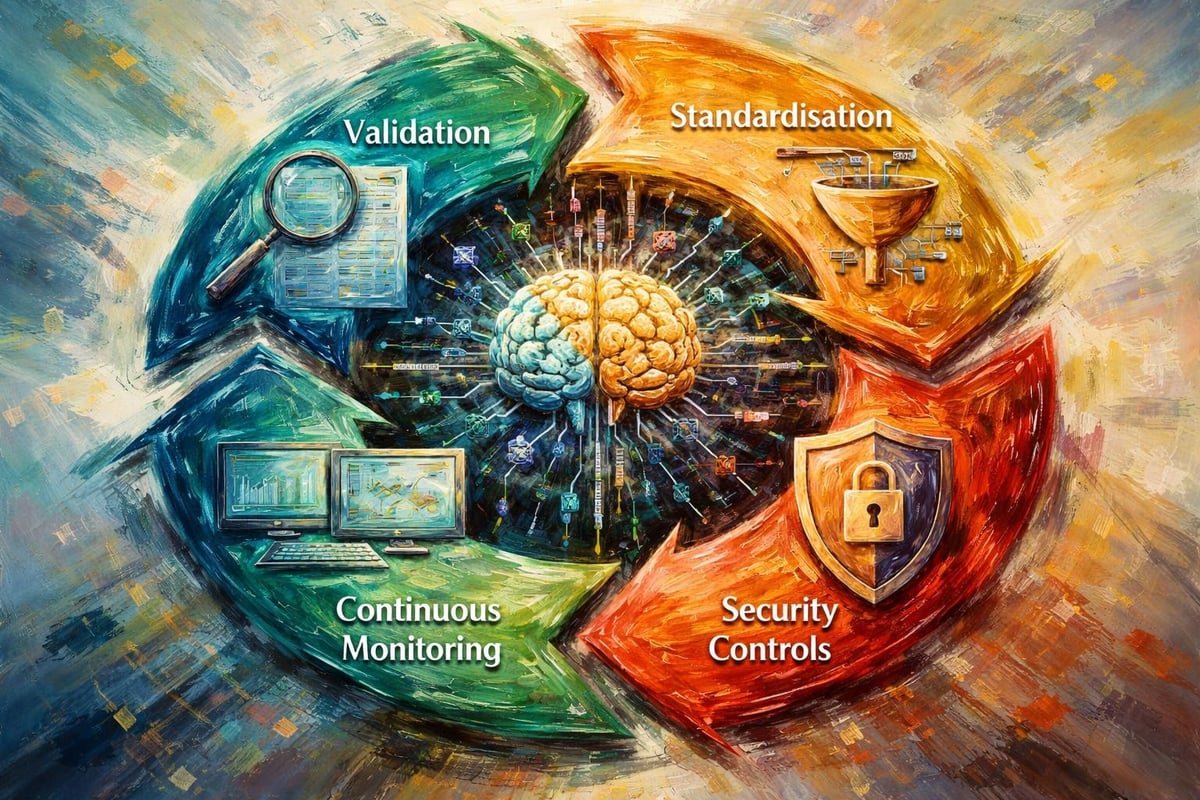
AI for automation depends on accurate, secure data. Poor data quality produces unreliable automation results.
| Data Challenge | Impact | Solution Approach |
|---|---|---|
| Incomplete records | Automation failures | Data validation protocols |
| Inconsistent formats | Processing errors | Standardisation rules |
| Outdated information | Wrong decisions | Regular data refreshes |
| Unauthorised access | Security breaches | Role-based access controls |
| Compliance violations | Legal penalties | Automated audit trails |
The AI consulting services provided by specialists include comprehensive data governance frameworks. These structures ensure automation systems operate on reliable, secure information.
Measuring Automation Success
Quantifying ai for automation impact requires clear metrics and consistent measurement. Without proper tracking, ROI remains unclear.
Key Performance Indicators
Essential metrics for automation projects:
- Processing time reduction: Compare pre and post-automation task duration
- Error rate decrease: Measure accuracy improvements in automated processes
- Cost savings: Calculate labour, overhead, and operational expense reductions
- Throughput increase: Track volume capacity improvements
- Employee satisfaction: Monitor staff engagement with automated tools
- Customer experience scores: Assess automation impact on service quality
Australian businesses implementing ai for automation report average metrics:
- 67% reduction in processing times
- 82% decrease in error rates
- 45% cost savings within 18 months
- 210% throughput capacity increase
- 38% improvement in employee satisfaction
Continuous Improvement Processes
Automation performance degrades without ongoing optimisation:
- Schedule monthly performance reviews comparing actual versus expected outcomes
- Analyse failure patterns to identify improvement opportunities
- Gather user feedback systematically through surveys and interviews
- Update training data to reflect changing business conditions
- Test new AI models against production performance benchmarks
- Document all changes and their impact on system performance
Industry-Specific Automation Opportunities
Different sectors present unique ai for automation applications. Understanding industry-specific opportunities maximises implementation value.
Healthcare and Medical Practices
Medical facilities automate appointment scheduling, patient communication, and billing processes. AI systems analyse symptoms, recommend tests, and flag potential diagnoses.
Benefits specific to healthcare:
- Reduced administrative burden on clinical staff
- Improved appointment attendance through automated reminders
- Faster insurance claim processing and payment
- Enhanced patient communication and engagement
- Better compliance with privacy regulations
Professional Services Firms
Law firms, accounting practices, and consulting companies automate research, document review, and client communication. These implementations free professionals for high-value advisory work.
A Melbourne law firm automated contract review using AI systems. Review time decreased from 4 hours to 23 minutes per document while maintaining 96% accuracy in identifying key clauses and risks.
Manufacturing and Logistics
Production facilities implement ai for automation for quality control, predictive maintenance, and supply chain optimisation. These applications reduce downtime and inventory costs.
Implementation considerations:
- Integration with existing industrial control systems
- Real-time sensor data processing requirements
- Safety protocols for human-machine interaction
- Environmental adaptations for factory floor deployment
- Regulatory compliance for automated quality assurance
Building Internal AI Automation Capabilities
Organisations choose between outsourcing and developing internal ai for automation expertise. Each approach offers distinct advantages.
Developing In-House Expertise
Building internal capabilities requires investment but provides long-term flexibility:
- Recruit AI specialists with automation experience
- Train existing IT staff on AI technologies and tools
- Establish dedicated automation centres of excellence
- Create knowledge sharing programmes across departments
- Partner with universities for research collaboration
The challenge lies in competing for scarce AI talent. Australian businesses face global competition for qualified professionals.
Leveraging External Specialists
Partnering with AI consultant specialists in Sydney and other Australian cities accelerates implementation. External experts bring proven methodologies and avoid common pitfalls.
Benefits of specialist engagement:
- Immediate access to experienced automation professionals
- Reduced implementation timelines and faster ROI
- Knowledge transfer to internal teams
- Objective assessment of automation opportunities
- Ongoing support during scaling phases
Synap AI provides comprehensive automation consultation services across Victoria and throughout Australia. Their platform development expertise helps businesses build custom ai for automation solutions tailored to specific operational requirements.
Future Trends in AI Automation
The ai for automation landscape evolves rapidly. Understanding emerging trends enables proactive planning.
Agentic AI Systems
Agentic artificial intelligence represents the next evolution in automation. These systems make autonomous decisions, learn from outcomes, and adapt strategies without human programming.
Expected capabilities by 2027:
- Self-optimising workflows that improve automatically
- Cross-functional process coordination without human orchestration
- Predictive problem resolution before issues impact operations
- Natural language interaction for non-technical users
- Autonomous vendor negotiation and procurement
Hyperautomation Ecosystems
Hyperautomation combines multiple AI technologies with process mining and analytics. This holistic approach automates end-to-end business processes rather than isolated tasks.
Organizations implementing hyperautomation report:
- 3.2x greater efficiency gains versus single-technology automation
- 54% faster implementation cycles through reusable components
- 71% reduction in integration complexity
- 89% improvement in process visibility and monitoring
Edge AI and Distributed Automation
Processing AI workloads at the edge rather than centralised cloud systems reduces latency and improves privacy. This trend particularly benefits real-time automation applications.
Use cases for edge AI automation:
- Retail point-of-sale systems with instant fraud detection
- Manufacturing quality control with millisecond response times
- Healthcare devices processing patient data locally
- Transportation systems making split-second routing decisions
- Agricultural equipment optimising planting and harvesting
Selecting the Right Automation Partner
Choosing an ai for automation implementation partner significantly impacts project success. Evaluation requires thorough due diligence.
Partner Selection Criteria
Critical factors when evaluating automation specialists:
- Australian market experience: Understanding local regulations and business practices
- Industry expertise: Proven success in your specific sector
- Technical capabilities: Breadth of AI technologies and integration skills
- Implementation methodology: Structured approach with clear milestones
- Support model: Ongoing assistance during and after deployment
- Cultural fit: Alignment with organisational values and communication preferences
| Evaluation Factor | Questions to Ask | Red Flags |
|---|---|---|
| Track record | How many similar projects completed? | Vague case studies |
| Technical depth | What AI frameworks do you specialise in? | Surface-level knowledge |
| Project approach | What's your implementation methodology? | No structured process |
| Team composition | Who will work on our project? | Unclear staffing |
| Support commitment | What post-implementation support is included? | Limited ongoing assistance |
Starting Your Automation Journey
Beginning with ai for automation requires careful first steps:
- Define specific business problems automation should solve
- Establish budget parameters and expected ROI timelines
- Identify internal champions to drive adoption
- Research potential technology and service partners
- Request proposals from qualified automation specialists
- Conduct proof of concept with preferred partner
- Plan phased rollout starting with highest-value processes
For Australian businesses ready to explore ai for automation opportunities, booking an online consultation with AI technologists provides personalised assessment and recommendations. These sessions identify quick wins and long-term automation roadmaps.
AI for automation represents a fundamental shift in how Australian businesses operate and compete. The technology delivers measurable improvements in efficiency, accuracy, and cost management when implemented strategically. Whether you're exploring automation possibilities or scaling existing implementations, expert guidance accelerates success and avoids costly mistakes. Synap AI brings specialised expertise in AI consulting and platform development to businesses throughout Victoria and Australia, helping organisations transform operations through intelligent automation solutions.